
Bespoke Teal Sapphire Rings: Blue Green Elegance
Among the coloured sapphire family, teal sits in a category entirely of its own. Neither fully blue nor fully green, it occupies that precise meeting point between ocean and forest, a colour that shifts depending on the light, the angle, and the stone itself. At GIOIA Fine Jewellery, every teal sapphire in our collection is unheated, hand-selected for velvety saturation and naturally uniform colour, and set in a bespoke design built around the specific dimensions of that particular gem. This is not a colour you find in a catalogue. It is one you choose in person.
Why Teal Sapphire Works for Daily Wear?
Teal sapphires carry a Mohs hardness of 9, the same as any corundum, making them one of the few coloured gemstones genuinely suited to a ring worn daily for decades. Their blue-green character comes from trace amounts of iron and titanium in the crystal structure, the same elements responsible for blue sapphire’s colour, but in a ratio that tips the stone toward that distinctive teal zone. The result is a gem that holds its colour under any lighting condition and does not require the fragility trade-offs you accept with softer stones like emerald or tanzanite.
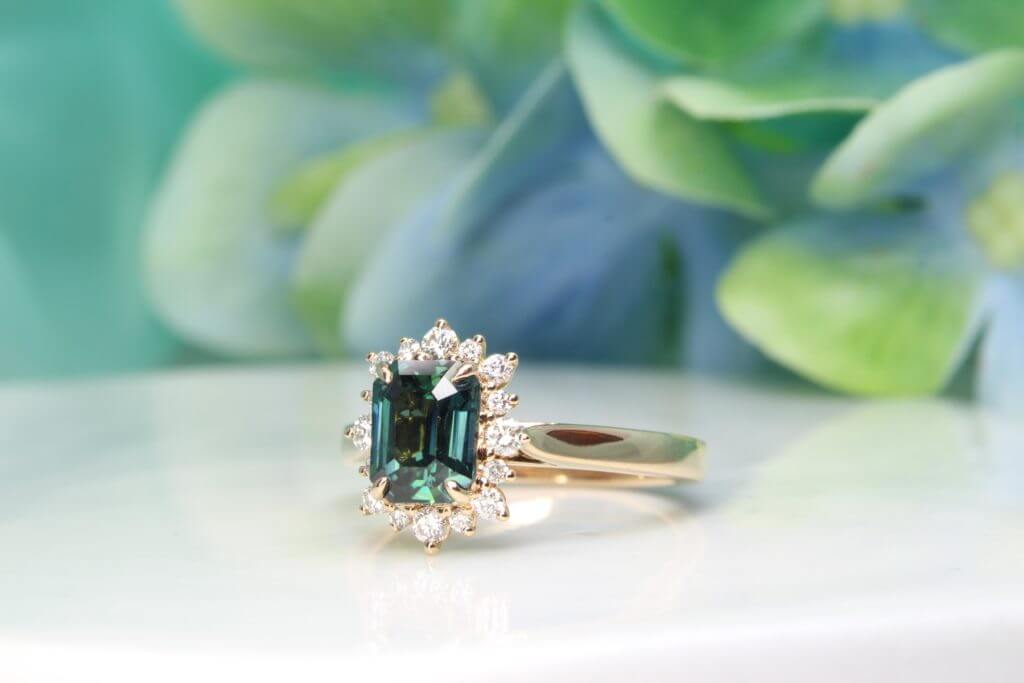
Complementing this teal sapphire in the commission piece shown above are bluish spinels, a natural pairing that reinforces the cool oceanic palette without competing with the centrepiece. The marquise diamonds form a side cluster that draws the eye toward the sapphire rather than away from it. Set in champagne gold, the overall piece reads as sophisticated without effort.
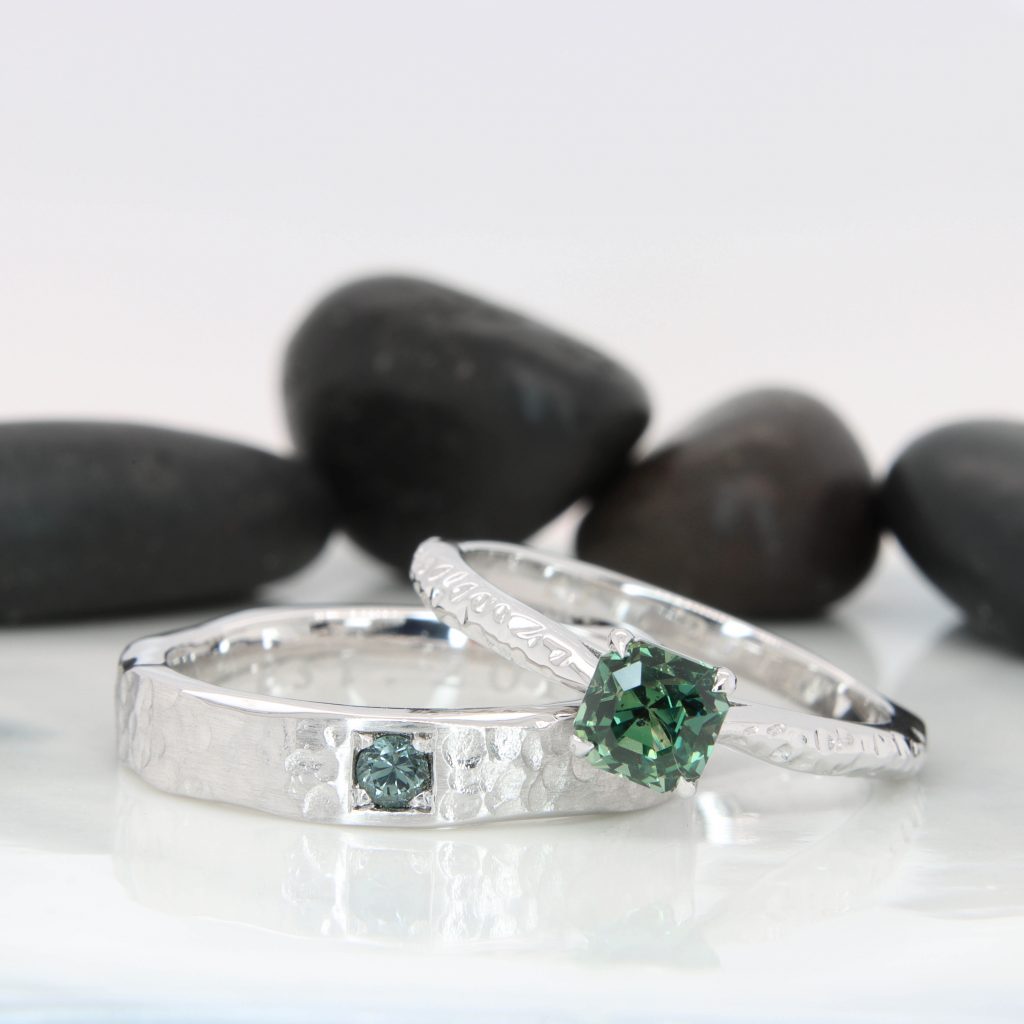
If you are looking for a matching band for your big day, explore our collection of Teal Sapphire Wedding Rings.
Unheated Teal Sapphire
Teal Sapphire Gemstone
Teal sapphires have gained serious ground over the past decade for reasons that go beyond aesthetics. Their blue-green colour, often described as reminiscent of tropical waters or deep forest shade, resonates strongly with buyers who want something visually distinctive without the fragility of other coloured stone alternatives.
The cut matters more with teal sapphires than most buyers initially realise. Because the stone displays both blue and green simultaneously, the cut determines which hue dominates face-up. Oval and asscher cuts tend to balance the two most evenly, showing the full blue-green blend from the face. Round cuts are far less common in teal sapphires because the crystal shape wastes significantly more rough during polishing, which is part of why round teal sapphires in fine quality command a higher premium than oval or emerald cut equivalents of the same carat weight.
Unheated teal sapphires occupy an interesting position in the market. More accessible in price than padparadscha or fine royal blue, they have seen steadily rising demand from a younger buyer demographic that values rarity and natural origin over brand recognition. As with any coloured gemstone, the unheated premium is real, a fine unheated teal with uniform saturation has, in our experience, held its value considerably better than a heated stone of similar appearance.
Teal Sapphire vs Green Sapphire, Understanding the Difference
This is one of the most common points of confusion in the market and worth understanding clearly before you begin shopping. A green sapphire exhibits a pure green to yellowish-green hue. It reads as definitively green from every angle. A teal sapphire is a fundamentally different stone. Its colour sits in the blue-green zone, showing both simultaneously, with neither fully dominant. Under indoor lighting a fine teal sapphire leans greenish shade. In natural daylight the blue component becomes more visible. That dynamic quality is precisely what makes teal sapphires so compelling to wear.
What this means practically is that a stone marketed as “teal” which looks solidly green under all lighting conditions is almost certainly a green sapphire, not a true teal. At GIOIA, we view teal stones under multiple light sources before selecting them for our collection. The blue component must be present and visible in daylight, not just implied in the gemologist’s description.
A key indicator of a high-quality teal sapphire is how seamlessly the colour transitions between green and blue under different light sources. A well-balanced stone shows an even, well-mixed blend where neither hue overwhelms the other, this equilibrium is a direct indicator of superior rough selection and precise cutting. Stones that read as predominantly green or predominantly blue, with only a token trace of the other colour, are technically teal sapphires but fall well below fine quality standard.
The reason this shift happens at all comes down to a phenomenon gemologists call pleochroism, the ability of certain crystals to transmit different colours along different optical axes. In a fine teal sapphire, one axis carries blue and another carries green. A master lapidary must orient the rough crystal with extreme precision during the cutting process so that both axes are visible simultaneously face-up, producing that characteristic blue-green blend. A poor orientation causes one colour to dominate entirely, which is why two teal sapphires from the same origin and with identical treatment status can look completely different once faceted. The difference is entirely in how the cutter worked the rough.
For this reason we always encourage clients to view teal sapphires under natural daylight before committing, what a stone shows under showroom lighting and what it reveals in sunlight can be strikingly different, and the daylight view is the one you will live with most of the time.
Gemstone Engagement Ring Spotlight
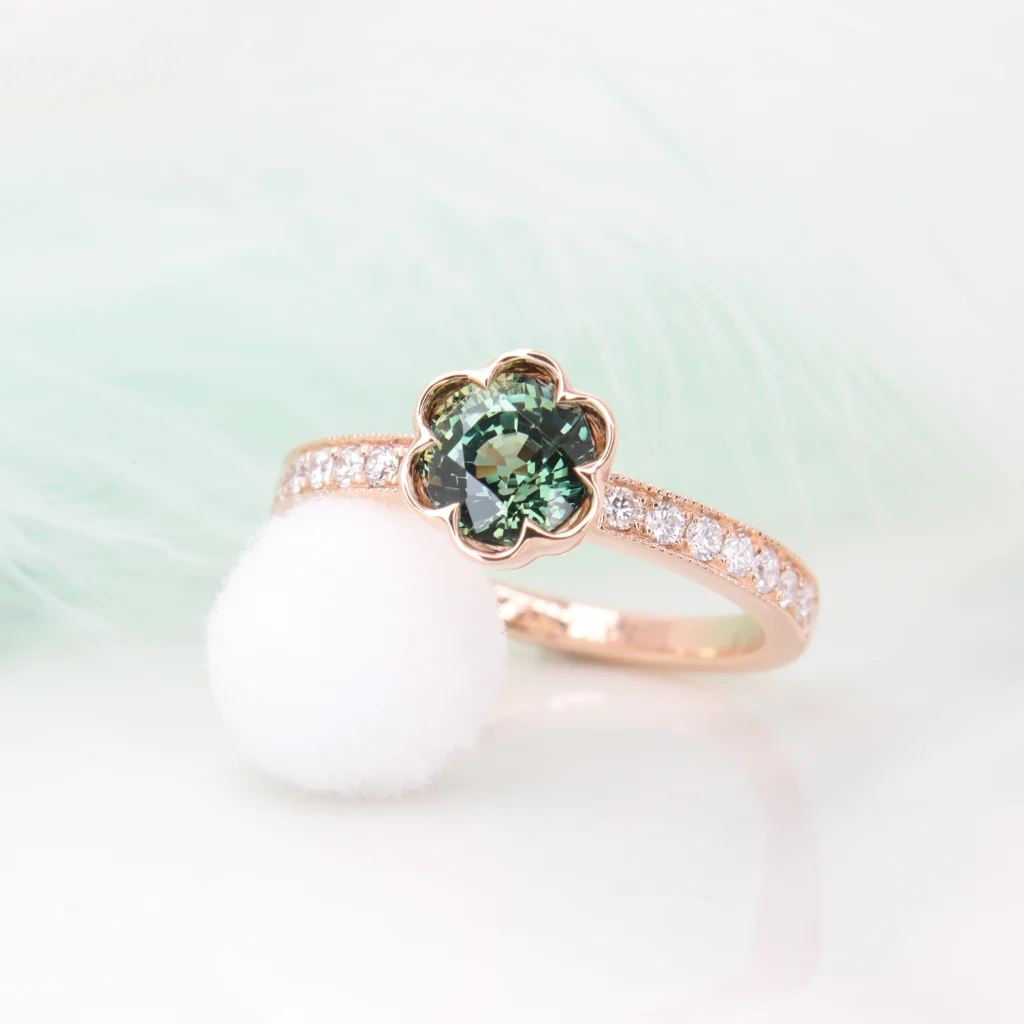
The beauty of a teal sapphire lies in how seamlessly it adapts to different metal settings. When designing a customised engagement ring, your choice of gold can completely transform the aesthetic of the piece. Setting this natural unheated gemstone in elegant rose gold beautifully brings out a delicate, feminine charm. Alternatively, crafting the band in champagne gold offers a subtle, sophisticated look that allows the ring to sit comfortably alongside your existing rose or yellow gold pieces without competing. Because of its unique blue-green blend, a teal sapphire complements these versatile metals perfectly, ensuring your ring is both a brilliant centrepiece and a harmonious addition to your daily wardrobe.
Vintage Yellow Gold Sapphire Ring
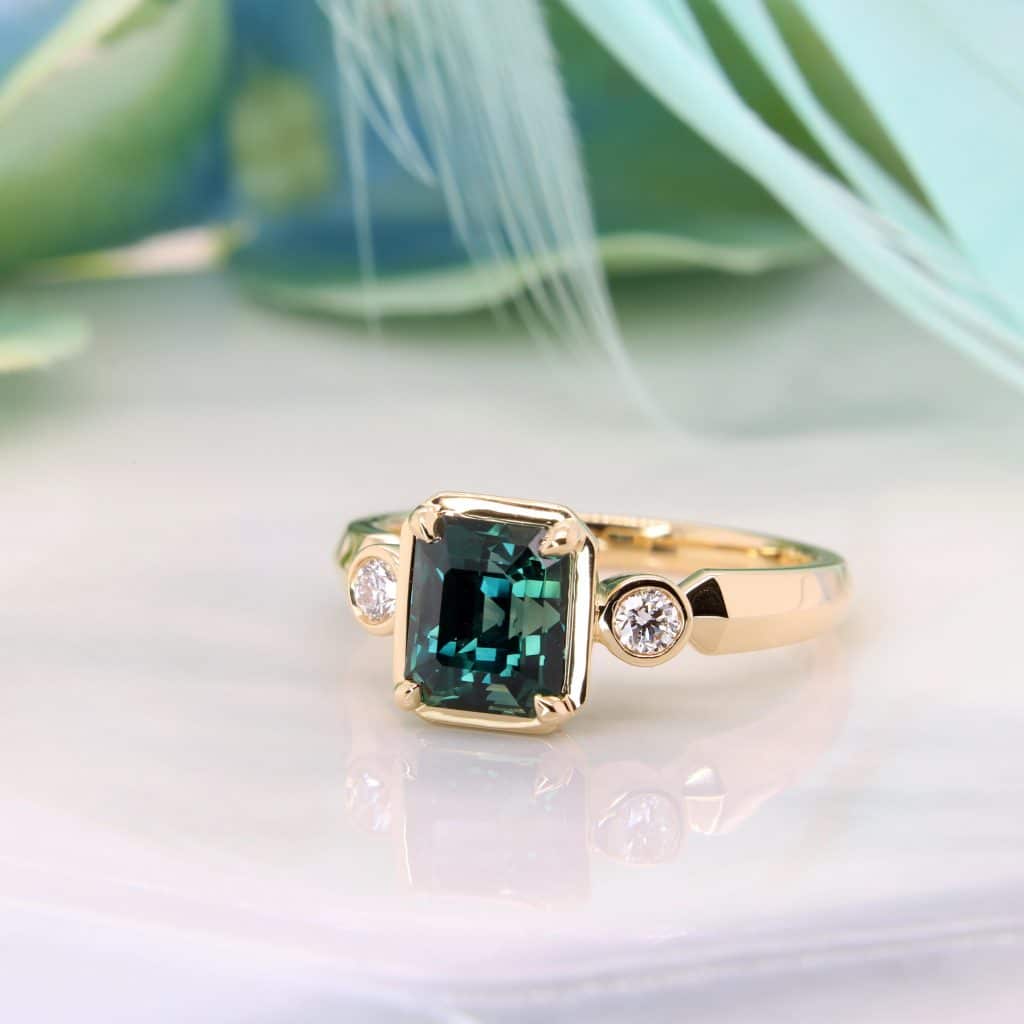
This commission took a different direction entirely. A vintage solitaire emerald-cut teal sapphire, flanked by round brilliant side diamonds with a thin bezel frame, set in bright yellow gold. The knife-edge band keeps the profile sleek without sacrificing structural integrity. Yellow gold against a bluish-green stone creates a warmer, more grounded aesthetic than rose gold or champagne, the contrast pulls the green tones forward and gives the piece a vintage character that feels genuinely antique rather than styled to look that way.
Are Parti Sapphire Valuable?
Do not be misled by the term of “Parti Sapphire” or “Parti Teal Sapphire” commonly exhibit a zoning of blue and green or even additional yellow shade. This uneven colour shade in the gemstone is common for many inferior quality gemstones. The price of such gem is generally lowered compared to a natural blue-green teal sapphire with even colour. While heat treatment is often used to mask uneven colour zoning in lower-grade stones, our focus at GIOIA remains on rare, unheated teal sapphires that possess naturally uniform saturation.
The parti sapphire distinction matters specifically for buyers seeking a truly fine teal stone. A genuine fine teal sapphire shows naturally even, uniform colour across the entire face of the stone. No zoning visible to the naked eye, no patches of lighter or darker saturation, no yellow modifier introducing a murkiness to the overall tone. These standards are not arbitrary, they directly affect how the stone performs under different lighting and how it holds value over decades.
Teal sapphires range from intensely saturated bluish-green through to lighter pastel tones that lean more noticeably toward green. From intense deep saturation to pastel light teal, the colour depth of a fine teal sapphire is best assessed in person at our International Plaza boutique. At GIOIA Fine Jewellery, we don’t just offer off-the-shelf rings. Every teal sapphire in our collection is hand-selected for its velvety saturation and unheated natural beauty. Browse our latest teal sapphire designs or schedule a private consultation to begin your bespoke journey.
Final Thoughts on Choosing a Teal Sapphire
A teal sapphire engagement ring is more than just a departure from tradition, it is a celebration of individuality and a deep connection to the natural world. Whether you are drawn to the mysterious depths of a ‘Lagoon’ blue or the vibrant energy of a ‘Mermaid’ green, these gemstones offer a lifetime of evolving beauty.
At GIOIA Fine Jewellery, we take pride in sourcing only the finest unheated teal sapphires, ensuring that your bespoke ring remains a vibrant and valuable heirloom for generations. We invite you to experience these rare treasures in person and let our master craftsmen bring your unique love story to life.
For clients who want to explore the full teal sapphire journey including matching wedding bands and couple ring sets, our dedicated teal sapphire wedding rings page covers the design considerations specific to bridal sets.

For the full range of colours and settings, see our sapphire engagement rings.
Teal Sapphire Pieces We’ve Built
Every teal sapphire has its own character, and these are some of the bespoke pieces we’ve built around that.