Burma Ruby Rings: The Legend of Fluorescence
The “King of Gems” in its Purest Form
In high jewellery, origin drives value more than any other single factor. While ruby gemstones are found globally, those originating from Burma (Myanmar) are in a league of their own. Historically revered for their intense saturation and “electric” visual character, these stones are prized not just for their colour, but for their unique internal chemistry.
A Burma ruby ring is often a piece people keep for life and pass down, which is why we take so much care over the stone. (Searching for a proposal ring? View our dedicated Ruby Engagement Ring Collection for bridal designs).
Burma Ruby Jewellery
Every Burma ruby ring commission at GIOIA begins not with a design sketch but with the stone. Before we discuss settings, metal colours, or diamond accoutrements, we spend time understanding which loose Burma ruby is right for you, its carat weight, its cut, its GRS certification, and critically, how it performs in natural light when you hold it in your hand. That evaluation process is covered in full on our Burma ruby gemstone page, including how to read a GRS report and what separates a fine stone from one that merely carries a Burma origin report. We strongly suggest reading it before committing to any ring design.
The Science of “The Glow”: What Makes Burma Rubies Different
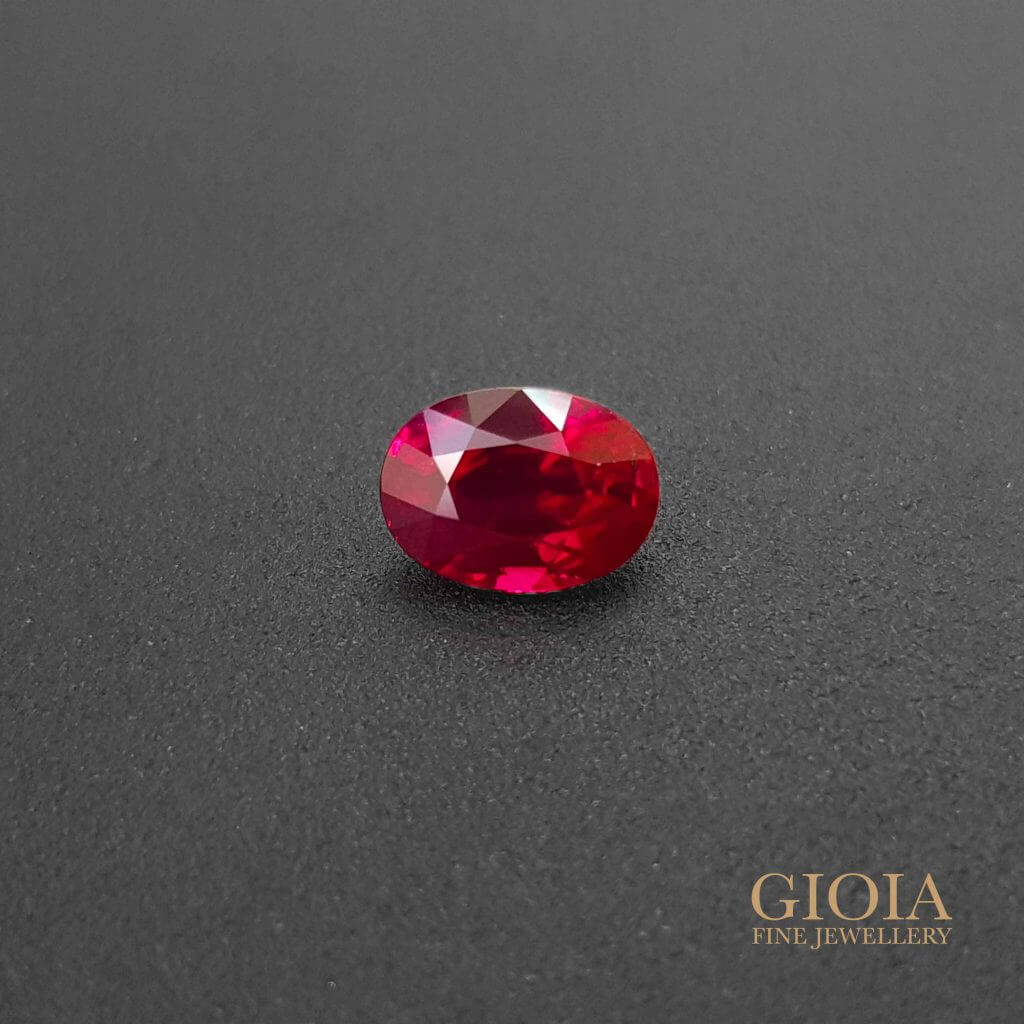
Burmese rubies form in marble deposits that are almost entirely free of iron, and iron is what dulls fluorescence in most rubies from other origins. Without iron suppressing the chromium, a fine Burma ruby does something other rubies cannot replicate consistently: it glows from within. In direct sunlight the stone does not just reflect red, it emits it. That optical character is the reason a Burma ruby ring looks alive in a way that even the finest Mozambican stone cannot always match. It also dictates every design decision we make when setting one. The stone is already doing something extraordinary. The ring’s job is not to compete with it but to present it.
The Market Reality: Pricing, Quality & The “Burma Myth”
If you are comparing stones, it helps to understand how Burma rubies are valued. Prices do not rise in a straight line. They climb steeply with size, driven by the extreme scarcity of “Gem Quality” crystals.
The Exponential Price Curve
When comparing a fine-quality Mozambique Ruby against a Burma Ruby, the price premium is significant but varies by weight:
- At 1.00 Carat: A Burma ruby will typically trade at 1.5x to 2.5x the price of a comparable Mozambique stone. This premium accounts for the “brand value” of the origin and the unique fluorescence.
- At 3.00 Carats & Above: The gap widens drastically. Because the geological conditions in Burma rarely allow for large, clean crystals to form, a 3-carat Unheated Burma Pigeon Blood ruby is an anomaly. At this weight, the premium is no longer around double. It can be 5x to 10x the price of a Mozambique equivalent. Stones like this tend to appear at major auctions rather than in shop windows.
These multiples apply to fine quality stones. Overall quality matters as much as origin, and a fine unheated pigeon blood ruby and a commercial grade ruby can be priced very differently, even when both come from Burma.
Debunking the Myth: “Is Burma Always Best?”
A common misconception in the market is that any ruby with a “Burma” origin report is automatically superior to a Mozambique gem. This is a myth.
A certificate stating “Origin: Myanmar (Burma)” guarantees geography, not beauty. In fact, a large percentage of Burmese rubies circulating in the market are of commercial or inferior quality.
The “Opaque” Trap
Burmese rubies are famous for their “silk” (rutile needle inclusions). In fine quality, this silk scatters light to create a soft glow. However, in lower grades, this silk is so heavy that it blocks light entirely, making the stone look opaque, sleepy, or dead. An opaque Burma ruby lacks the fire and brilliance that defines a precious gemstone. In these cases, a crystalline, transparent Mozambique ruby is visually superior and a better purchase.
The “Pinkish” Issue
Not all Burmese rubies are red. Many stones mined in Mogok have low chromium saturation, resulting in a “Pinkish-Red” or even “Hot Pink” hue. While these are beautiful, they do not qualify for the prestigious “Pigeon Blood” grading.
The pigeon blood designation is a formal laboratory assessment awarded by GRS on the front page of the certificate, not a seller’s claim, and not awarded to every Burmese ruby regardless of colour. For a full explanation of what the GRS report actually says and how to read it, see our Burma ruby gemstone grading page.
Our Curation Standard
At GIOIA Fine Jewellery, we reject the majority of Burmese stones offered to us. We prioritise crystal transparency above all else. A GIOIA Burma Ruby must possess that elusive combination: the soft, fluorescent glow of Myanmar, but with enough crystal clarity to allow light to dance within the stone.
Designing the Ring Around the Ruby
When the stone is this rare, the design cannot be an afterthought. Every Burma ruby ring commission at GIOIA follows the same principle, the setting exists to serve the stone, not to compete with it. That sounds obvious but it produces very specific design decisions in practice.
Yellow gold prongs are our default choice for cradle settings on Burma rubies. The warm colour temperature of 18K yellow gold blends with the red of the ruby rather than contrasting against it, which intensifies the perceived saturation of the stone. White gold or platinum prongs can introduce a cooler reflective tone into the base of the stone that slightly dilutes the red. For a Burma pigeon blood ruby where the colour is the entire point, yellow prongs are not just a matter of taste. In our experience, they show the stone at its best.
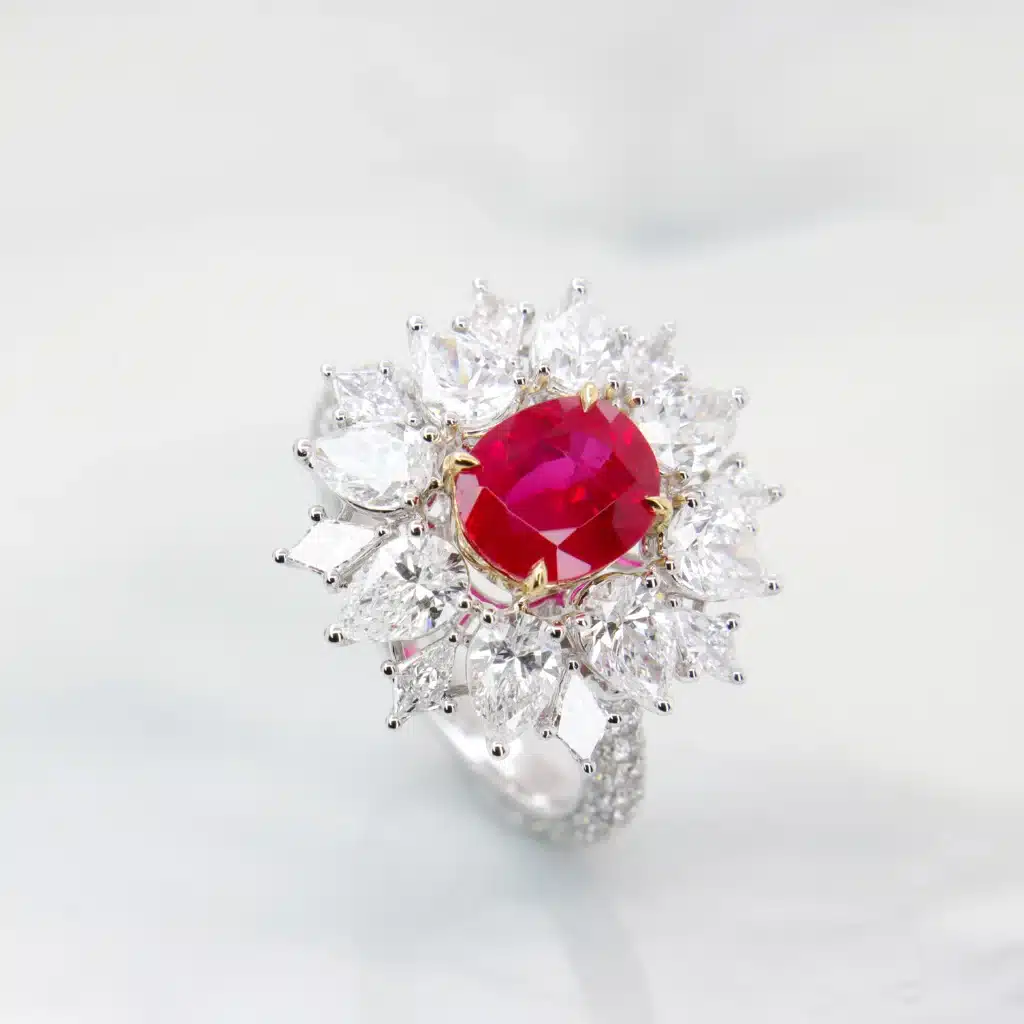
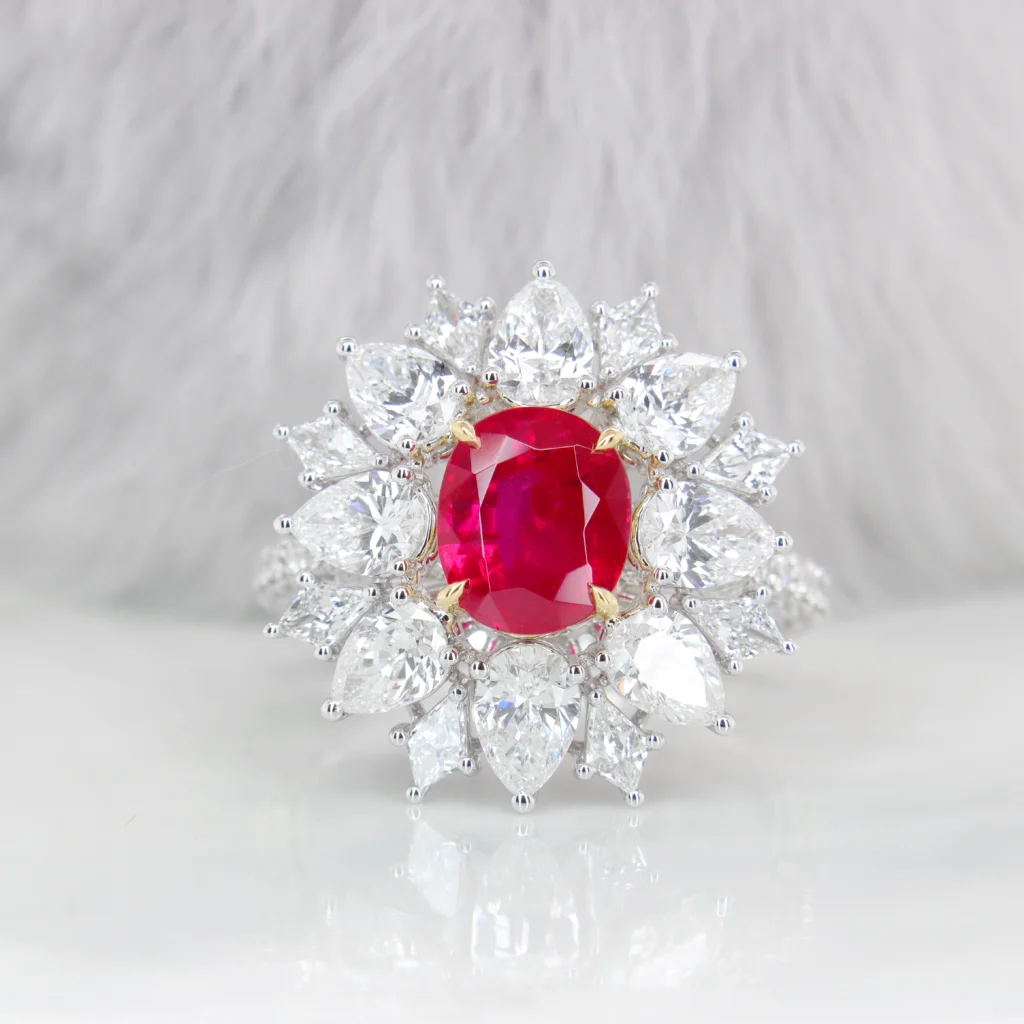
The halo design we are most associated with uses fancy diamond cuts: pear shapes and marquise cuts arranged as petals around the ruby. This is a deliberate choice rather than the more common round brilliant halo. Round brilliant diamonds in a halo all point toward the centre stone and their brilliance can visually compete with it. Pear and marquise cuts arranged as a flower create movement around this Burma ruby ring without drawing the eye away from it.
For clients with a significant Burma ruby above 2 carats, we often recommend considering a solitaire or minimal setting rather than a full halo. A stone of that quality does not need decoration. We know that the fluorescence and colour do the work entirely. Adding complexity around it can actually reduce the visual impact of the gem.
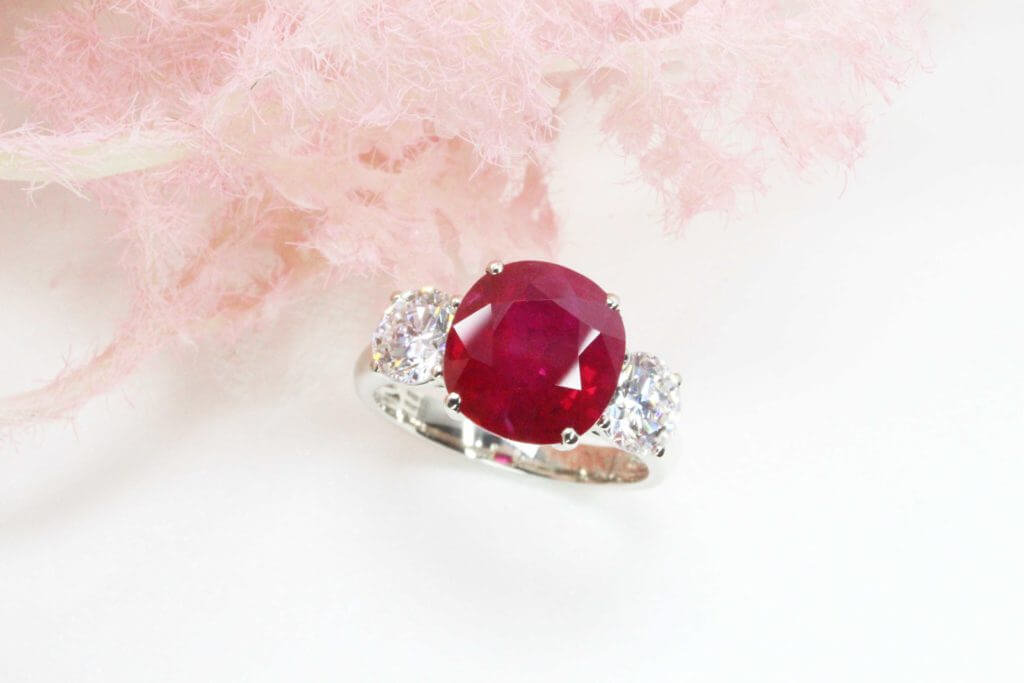
The halo ring pictured above centres on an unheated Burma ruby ring set in exactly this high jewellery halo style. The ring was built over approximately thirteen weeks from stone selection through to final polish, which is typical for a commission at this level of detail.
The 0.83ct Burma Ruby Ring with Diamond Wings
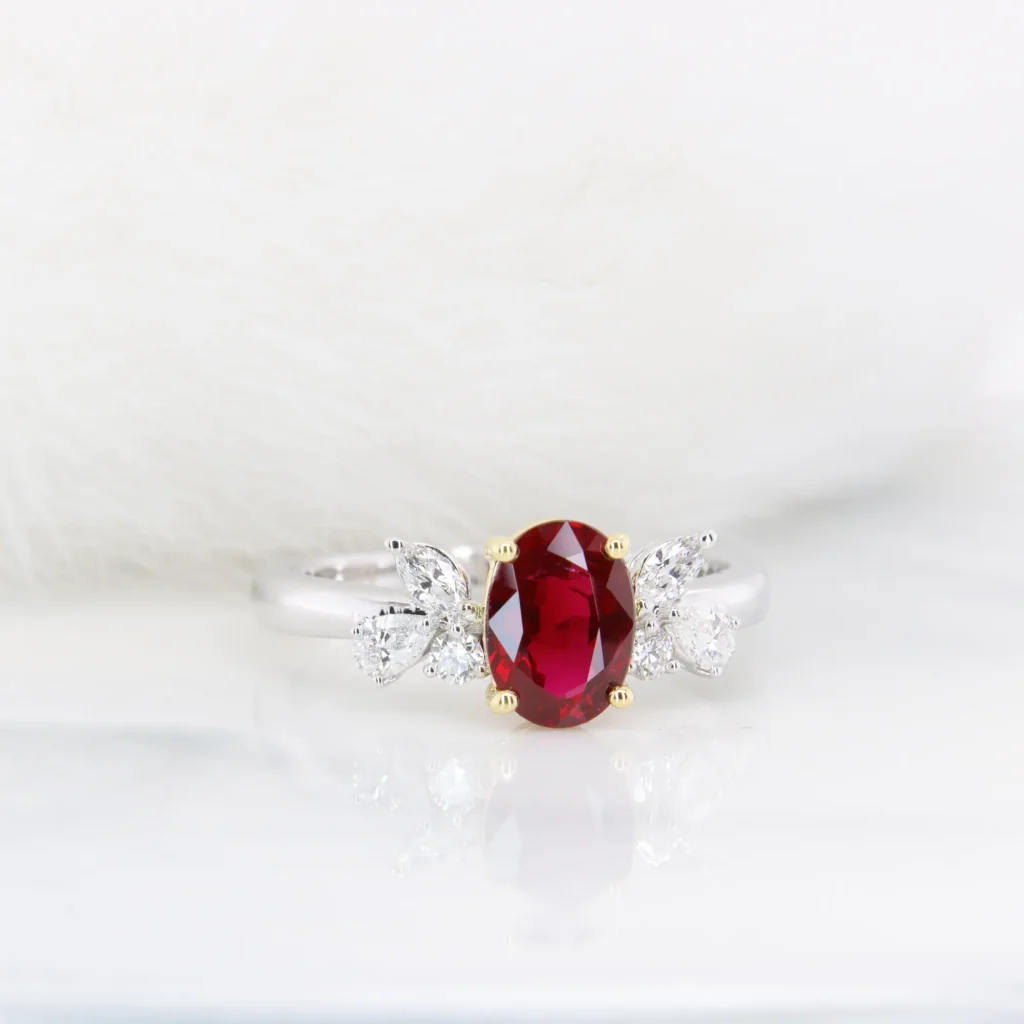
Before we choose any ruby, we look at it in natural daylight, not only under jewellery lights. Burmese rubies are known for a red that seems to glow from inside, and daylight is where a stone either shows that glow or does not. This one does. It is a 0.83ct oval from Burma, and its GRS report confirms Myanmar origin, the “pigeon blood” colour type and no indication of thermal treatment. Finding all three together below one carat is harder than the size suggests, because many smaller Mogok rubies lean pink and many others have been heated to deepen their colour. For Clarence Yee, our co-founder and gemstone specialist, that combination of origin, colour and an untouched stone was the reason to choose it as the centre of a client’s ruby engagement ring.
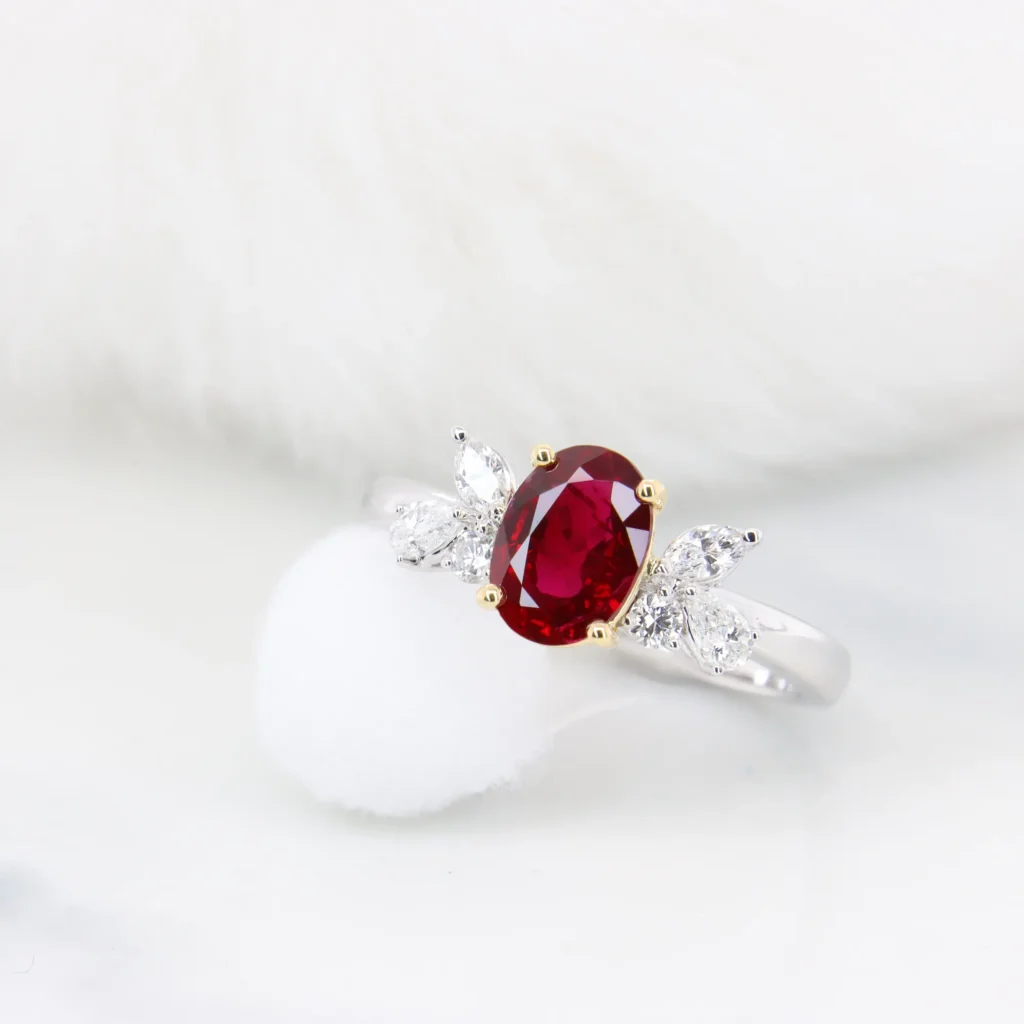
The design came from Cheryl Woon, our co-founder and designer. Rather than surround the ruby with a halo, she opened the ring out. On each shoulder sits a small cluster of three diamonds, a marquise, a pear and a round brilliant, fanned out like a pair of wings. They catch the light at the edges of the ring and lead the eye straight back to the ruby. All six diamonds together weigh 0.19ct, less than a quarter of the ruby’s weight, and that restraint is the point. The diamonds frame the red without competing with it.
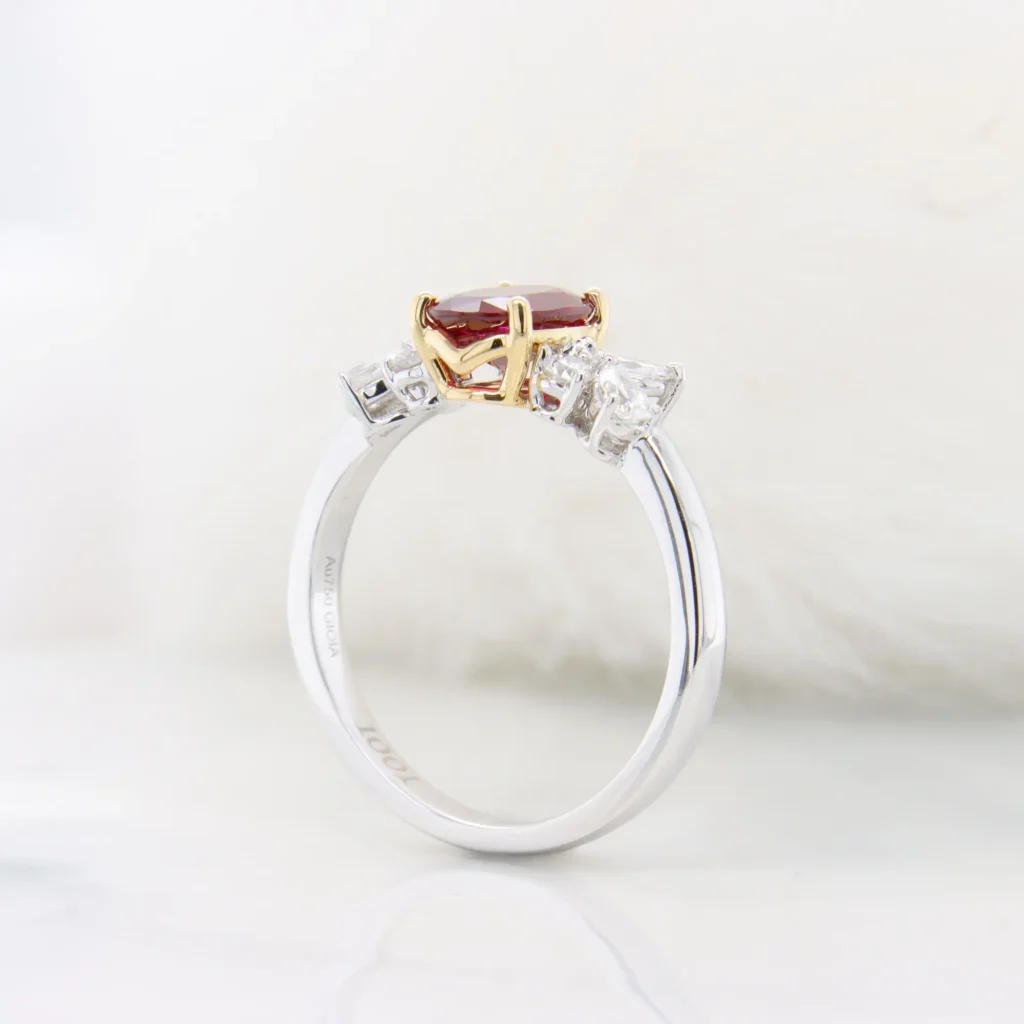
The ruby sits in four 18K yellow gold claws on an 18K white gold band. This is the principle described above in practice: yellow gold beneath a Burma ruby keeps its red warm and saturated, while white gold around the diamonds keeps them bright. Turn the ring on its side and you can see the yellow gold basket under the stone and the Au750 GIOIA hallmark inside the band.
Why a Burma Ruby Under One Carat Makes Sense
Many people assume a Burma ruby only makes sense at two or three carats. For an engagement ring worn every day, a fine stone just under one carat is often the better choice. It sits low enough for daily life, and at this size it is the colour, not the carat weight, that decides how the ring looks from across a room. It also costs far less than a stone of the same quality above one carat, where prices step up sharply. As with every GIOIA ruby, we go through the GRS report with you in person at our boutique, including what “pigeon blood” on the report means and how it describes heating.
| Centre stone | Ruby, oval, 0.83ct |
| Origin | Burma (Myanmar) |
| Colour type | Pigeon blood, per GRS |
| Treatment | Unheated, confirmed by GRS |
| Diamonds | 2 pear (0.09ct), 2 marquise (0.06ct), 2 round brilliant (0.04ct), 0.19ct in total |
| Metal | 18K white gold band, 18K yellow gold claws |
| Design | Cheryl Woon |
| Gemstone sourcing | Clarence Yee |
This ring was made for one of our clients as their engagement ring and is not for sale. We hold a range of fine rubies in different sizes and qualities, and we are happy to show you how they compare side by side in daylight.
Curating the Rarest of the Rare
Our approach to Burma ruby rings is the same as our approach to every significant commission, the stone comes first and the design follows from it. We hold what we believe is one of Singapore’s most carefully curated selections of GRS-certified unheated Burma pigeon blood rubies in the 1 to 2 carat range, selected in person rather than from catalogues or batch lots.
If you are considering a Burma ruby ring, whether as a gemstone engagement ring, an anniversary commission or a personal piece, the conversation starts at our showroom at International Plaza. Bring your questions about certification, origin, and setting options. We will bring the stones. You can see how a fine Burma ruby behaves in natural Singapore daylight before making any decision. Appointments can be arranged via WhatsApp or our contact page.
For those who want to see completed Burma ruby ring commissions before visiting, our custom rings portfolio has examples of ruby ring work across different design styles and carat weights.
Frequently Asked Questions
Find answers to commonly asked questions about our Burma ruby jewellery and gemstone.
Does it matter which part of Burma a ruby comes from?
Less than most people expect. Myanmar has three main ruby sources: Mogok in Upper Myanmar, Mong Hsu in Shan State and Namya in Kachin State. A laboratory report normally states the origin simply as Burma (Myanmar), and what decides beauty and value is the stone itself: its colour, its clarity and whether it has been heated. Treatment is where the sources really differ. Mong Hsu rough, found in the early 1990s, usually has dark blue or violet cores. In an unheated stone that blue reads as a darkness inside the red, something we see ourselves when we compare stones side by side, which is why almost all Mong Hsu ruby is heated to remove it. So rather than chasing the name of a valley, we look at what the report says about heating and at how the stone looks in daylight.
What is the price difference between Burma and Mozambique Rubies?
For fine quality unheated stones (1.0ct+), a Burma ruby typically commands 1.5x to 2.5x the price of a Mozambique ruby. This premium is due to the historical scarcity of Burmese material and its unique fluorescence. However, for sizes above 3.0ct, the price gap widens significantly as large Burmese crystals are exceptionally rare.
Why can two Burma rubies be so different in price?
Origin is only part of the price. Quality and treatment matter just as much. A fine unheated Burma ruby sits at the top. Heated stones cost less, and the laboratory report shows how far the treatment went. GRS, for example, writes H for heating alone, and H(a), H(b) or H(c) when traces of glass-like residue remain in fissures from heating with a flux. These are still genuine rubies with a disclosed treatment, but each step down the scale lowers the value. H(d) is a different matter. These are low grade, heavily fractured stones whose cracks have been filled with lead glass, which GRS calls “composite ruby” and GIA treats as a manufactured product rather than a ruby. The glass is far softer than ruby and can be damaged by a jeweller’s torch or even lemon juice, which is why these stones sell for a small fraction of the price of an untreated ruby. It is also one reason we specialise in unheated rubies: an unheated GRS report rules out heating residues and glass filling altogether. You can read more in our ruby treatment guide.
Why are Burma Ruby Rings so expensive?
The cost comes down to three things: scarcity (Mogok produces very little fine material today), fluorescence (the internal glow) and demand. We would always suggest choosing a Burma ruby because you love it rather than as an investment, as no one can promise future prices.
My Burma ruby has silk inclusions. Is this bad?
No, in fact, it is often a good sign. Burmese rubies naturally contain “silk” (rutile needles) which scatter light and create a soft, velvety glow. Unlike diamonds where inclusions are flaws, fine silk in a ruby can actually enhance its colour. Intact silk can also be one sign that a ruby has not been heated, because high heat breaks it down, although only a laboratory report can confirm this. However, the silk should not be so heavy that it makes the stone opaque.
Why do some Burma rubies look pinkish?
Burmese rubies often have a lower iron content, which allows for a purer red, but if the chromium saturation is not high enough, the stone can appear pink. While “Hot Pink” rubies are beautiful and valuable in their own right, they are not “Pigeon Blood.” True Pigeon Blood requires a deep, saturated red with a hint of fluorescence, not a washed-out pink tone.