What Makes a Burma Ruby?
Not all red stones are rubies. Not all rubies are gem quality. And among gem-quality rubies from every corner of the world, those from Burma carry a weight of history, geology, and market premium that no other origin has managed to replicate, not fully, and not consistently.
The Mogok Valley in upper Myanmar sits roughly 200 kilometres northeast of Mandalay, at an altitude where the air is thin and the ground gives up stones in shades that gemologists still struggle to describe accurately in writing. For over a thousand years, this valley has been the world’s primary source of fine ruby. Emperors, Mughal courts, and European royal houses all wanted what came out of Mogok. That demand has not disappeared. If anything, it has intensified as the supply has declined.
At GIOIA Fine Jewellery, we hold what we believe is one of the largest curated selections of GRS-certified unheated Burma pigeon blood rubies in Singapore, concentrating specifically on the 1 to 2 carat range where gem quality, certification, and wearability intersect. This page explains what Burma ruby actually is, how the gemological grading works, and what separates a fine stone from one that merely carries a Burma origin report.
Ruby From Burma
Burma Ruby: A Legacy of Excellence
The reason Burma ruby looks the way it does comes down entirely to how it formed. Mogok’s rubies are marble-hosted, meaning the corundum crystals grew inside calcium carbonate marble that was subjected to extreme heat and pressure during regional metamorphism. This geological environment is chromium-rich and, critically, almost entirely free of iron.
Iron is the single biggest suppressor of ruby’s optical character. It absorbs light and kills fluorescence. Because Mogok’s marble formation contains almost no iron, the chromium in Burmese rubies is free to do exactly what chromium does best: absorb blue-green wavelengths and re-emit the energy as red light. In direct sunlight or under UV light, this causes the stone to fluoresce, to emit a secondary red glow from within, above and beyond the red it reflects passively. The result is what traders have called “the fire” or “the glow” for centuries. It is not a metaphor. It is a measurable optical phenomenon.
Compare this to Mozambique rubies, which form in iron-rich basaltic rocks in the Montepuez region. The iron content dulls fluorescence in most Mozambican stones, the colour can be every bit as saturated, but the internal glow is typically weaker or absent. This is precisely why gem labs distinguish between front page and appendix pigeon blood designation, a distinction we will cover below.
The other geological character of Mogok that defines Burma ruby is the presence of rutile silk. We observed fine needlelike inclusions of titanium dioxide that form during crystal growth. In fine-quality stones, this silk scatters light softly through the body of the stone, contributing to the velvety, sleepy quality that experienced buyers recognise immediately. It is also one of the key indicators that a stone has not been heat-treated, since high-temperature treatment dissolves silk. Paradoxically, the presence of well-formed silk in a Burma ruby is often considered a feature, not a flaw.
Pigeon Blood: What the Grade Actually Means
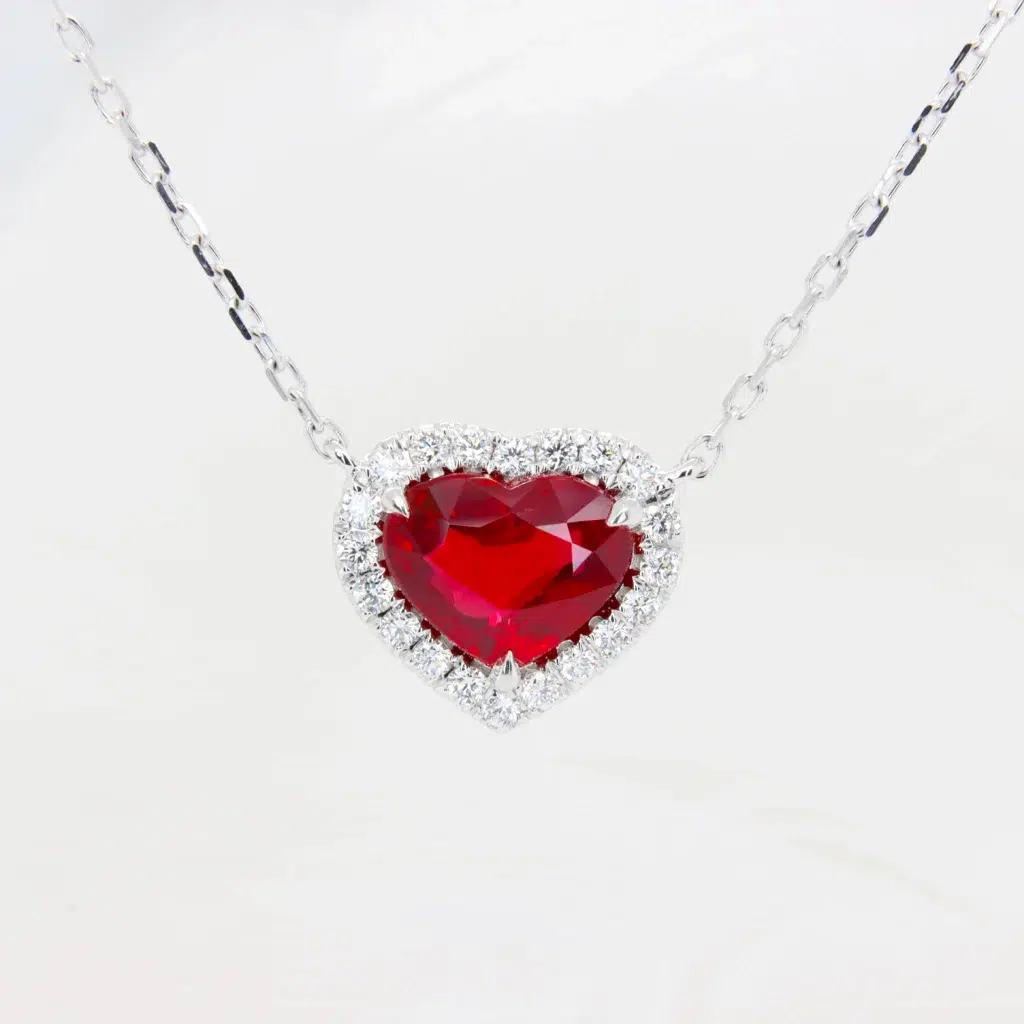
The term “pigeon blood” has been used in the Mogok trade for centuries. The Burmese word is ko-twe, referring to the vivid red of a freshly killed pigeon’s blood, and historically it applied exclusively to the finest rubies from Mogok. In the modern market, it is a formal gemological designation awarded by laboratories, not a general description a seller can apply freely.
GRS, Gem Research Swisslab, introduced the standardised “pigeon blood” colour term onto the market in 1996, creating what became the industry benchmark across auction houses and the trade. Their definition is precise: a qualifying stone must exhibit a chromium content of approximately 0.3 to 0.5 weight percent or higher, with a chromium-to-iron ratio greater than 1, and the colour must fall within a specific vivid red range under standardised lighting.
The full designation appears on the front page of a GRS report, and it requires the stone to exhibit medium-strong to strong fluorescence under UV light at 365nm alongside the correct colour. Because Burma’s Mogok rubies form in marble deposits that are naturally low in iron, chromium fluoresces freely and strongly, a fine Burma ruby almost invariably qualifies for this front page designation. When a GRS report states “vivid red (GRS-type ‘pigeon blood’)” on the main certificate, that is the complete, unqualified award.
In 2012, GRS introduced a separate provision for rubies, primarily Mozambican stones, that display the correct vivid red colour face-up but do not produce the same level of fluorescence. These stones do not receive the designation on the front page. Instead, they receive an appendix comment reading: “This vivid red Mozambican ruby is reminiscent in color saturation of a GRS-type pigeon blood ruby (without strong fluorescence).” That parenthetical carries significant weight. It is an acknowledgement of colour similarity, not an equivalent certification. A buyer reading carefully will recognise that a front page designation and an appendix comment are two different documents describing two fundamentally different stones.
It is worth knowing how rare the front page designation actually is. Among fine-quality Burma rubies of any grade, roughly 5 to 10 percent qualify. Among all rubies globally, the figure is far lower. A certificate stating “Origin: Myanmar (Burma)” alone does not mean pigeon blood. A stone can be Burmese, certified, and still be a pale pink, heavily opaque, or carry a washed-out purplish tone. Origin proves geography. A front page pigeon blood designation proves colour quality. You need both on the same report to know you have a genuinely fine stone.
Burma Ruby vs Mozambique Ruby: An Honest Comparison
The question we get asked most often is whether a Mozambique ruby is “as good” as a Burma ruby. The honest answer is: it depends on what you are measuring, and it depends enormously on the individual stone.
Mozambique’s Montepuez deposit came into large-scale commercial production around 2009 and quickly became the world’s most significant source of ruby rough by volume. For much of the past decade, the narrative around Mozambican material was one of scale, large production, consistent supply, and stones available in sizes that Mogok’s declining output could no longer provide reliably.
That narrative is shifting. The fine quality end of the Mozambican market is tightening in ways the trade is only beginning to acknowledge openly. Fura Gems, the largest ruby licence holder in Mozambique by area, presented a 3.50 carat rough as a standout lot in their Bangkok auction of March to April 2026. After cutting, a 3.50 carat rough yields a finished stone of roughly 1.5 to 2.2 carats depending on crystal shape and the cutter’s decisions. When that is the headline piece at a major mining company’s auction, it tells you where the ceiling of readily available fine Mozambican material currently sits. The era of consistently large, clean, vivid Mozambican ruby arriving in volume is behind us.
This does not diminish Mozambican ruby as a category. The finest Mozambican stones are genuinely exceptional, and some have received GRS pigeon blood designation and sold at auction at prices that were unthinkable for African material a decade ago. But the supply compression at the top end of both origins is now a shared reality. Burma has been declining for decades. Mozambique is beginning to show the same pressure at the fine quality level. For a buyer acquiring a GRS-certified unheated pigeon blood ruby in 2025 or 2026, the scarcity argument applies to both origins, not just Burma.
| Factor | Burma (Mogok) | Mozambique (Montepuez) |
|---|---|---|
| Host rock | Marble (low iron) | Basalt/amphibolite (higher iron) |
| Fluorescence (UV) | Medium-strong to strong (Type 1) | Weak to medium (usually Type 2 or none) |
| Colour saturation | Vivid red, purer hue | Vivid red, sometimes slightly purplish |
| Silk inclusions | Common in fine material | Less common |
| Supply of fine unheated 1ct+ | Scarce and declining | More available |
| Price premium (fine unheated) | Higher (origin + fluorescence premium) | Lower relative to Burma at comparable grade |
| Certification benchmark | GRS / Gübelin / SSEF | GRS / Gübelin / SSEF |
One point worth making clearly: a commercial-grade Burma ruby with heavy opaque silk, poor transparency, and a pinkish tone is not superior to a crystalline, vivid, transparent Mozambique ruby just because it has a Burma origin report. Origin alone does not determine quality. The combination of origin, colour grade, transparency, treatment status, and certification is what determines where a stone sits in the market. This is the evaluation process we apply to every stone we consider.
GIOIA’s Burma Ruby Inventory
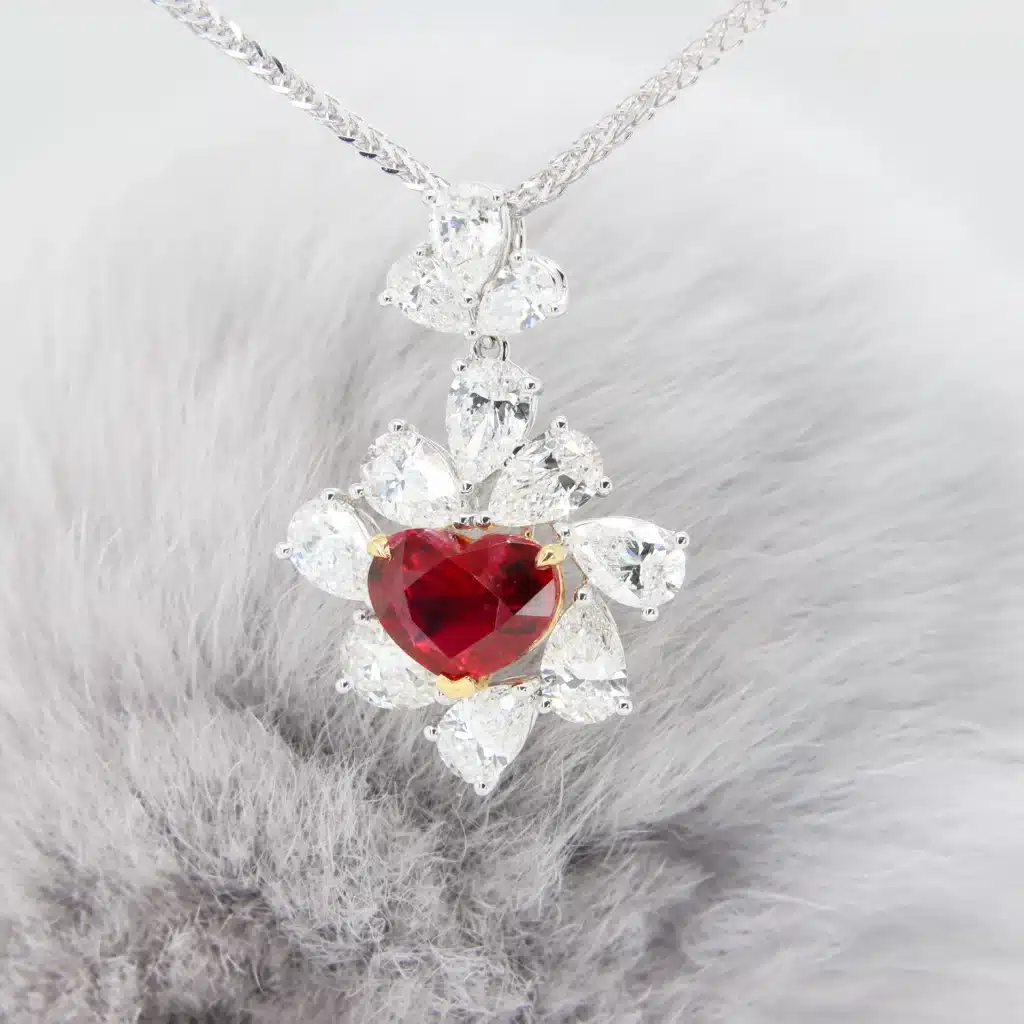
We have spent years building what we believe is one of Singapore’s most focused inventories of GRS-certified unheated Burma pigeon blood rubies, concentrating on the 1 to 2 carat range. This is a deliberate choice. Stones in this weight class represent the point where gem quality, certificate credibility, and practical wearability all align. A 1.5 carat unheated Burma pigeon blood ruby with a clean GRS report is a genuinely rare object, far more so than most buyers realise when they first start looking.
Every stone in our inventory has been selected in person by Clarence, not sourced from a catalogue or a batch lot. This matters because Burma ruby quality varies enormously even within a single parcel from Mogok. Two stones of identical carat weight with identical GRS reports can look completely different in hand, one alive with fluorescence and crystal transparency, the other opaque and flat. The certificate confirms origin and colour grade. It does not guarantee the visual character you are actually buying. Our role is to have done that filtering before the stone reaches our showroom.
We work mainly on unheated Burma material, and we are transparent about the distinction for every stone. Many clients prefer unheated stones because they want a ruby exactly as it formed, with a report that shows exactly what they are buying. At GIOIA, we have the certified material and the documentation to support that decision.
Crafting Unique Jewellery with Burma Ruby
If you’re considering a coloured gemstone for a bespoke or customised piece, such as a gemstone engagement ring or an everyday statement jewellery. A Burma ruby bespoke jewellery is a magnificent choice. At GIOIA Fine Jewellery, we believe that every piece should be as unique as the person wearing it. Each ruby is carefully selected and designed to complement your individual style, ensuring a timeless creation that tells your story.
If you are considering setting a Burma ruby into a ring, we have a dedicated page on our Burma ruby ring design process covering setting styles, gold choices, and completed commissions.