What Is a Muzo Emerald?
A Muzo emerald, in the strict sense, comes from the Muzo mining district in western Boyacá, Colombia. In the trade the name also describes a colour: the warm, intense, grassy green that Muzo made famous, which comes from chromium and vanadium in the crystal. GRS, the Swiss gemmological laboratory, uses Muzo green as its top colour grade for Colombian emeralds.
At GIOIA Fine Jewellery we only use a trade name like Muzo green when the lab report states it. When we call one of our emeralds Muzo green, it is a Colombian emerald that GRS has graded Muzo green, with minor oil or better. We never use the name on looks alone.
Table of Contents
The History of the Muzo Mines
The Muzo people worked these deposits long before Europeans arrived. Spanish forces arrived in the mid 1500s and took close to five decades to subdue them. By then Colombian emeralds had already begun to reach the royal courts of Europe. Muzo is not the oldest emerald source in the world, since Egypt’s mines were worked in Roman times, but it is the most famous, and its name is still the benchmark for fine Colombian colour in fine jewellery.
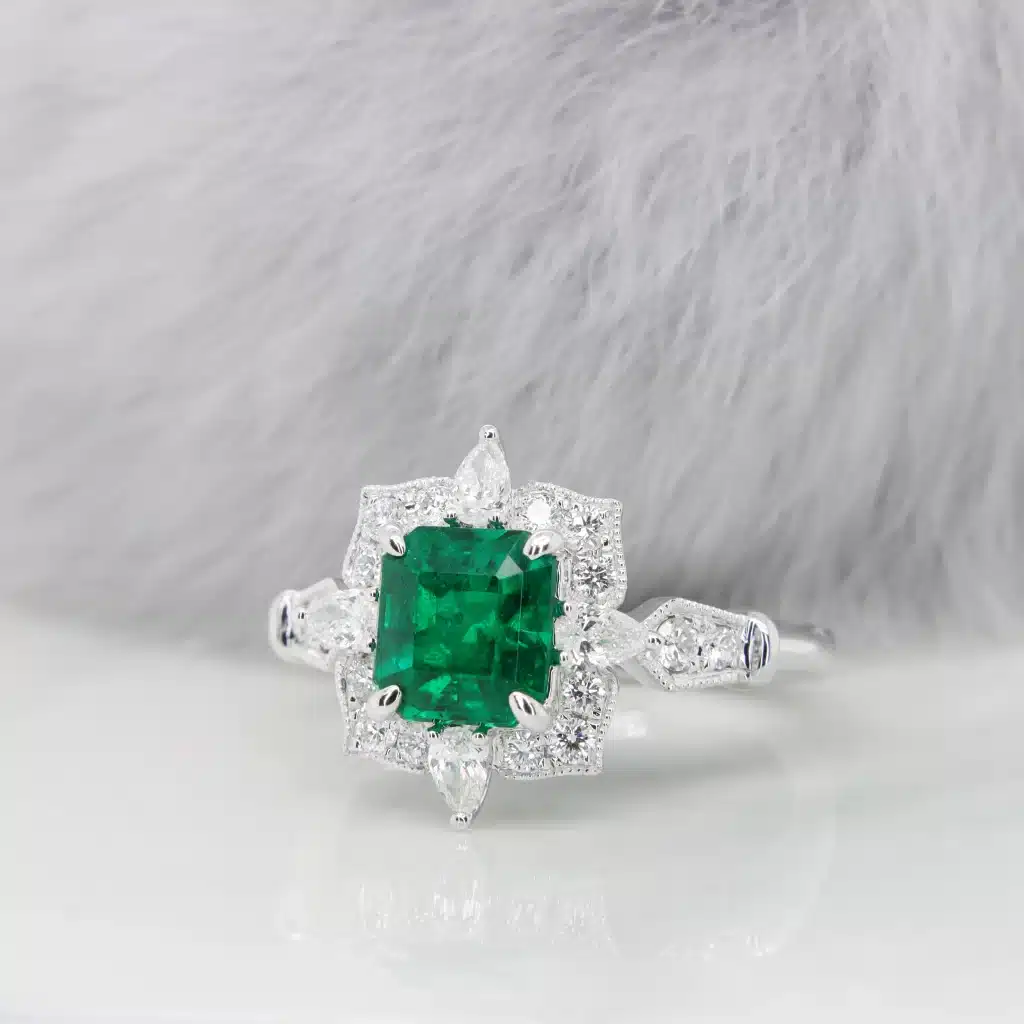
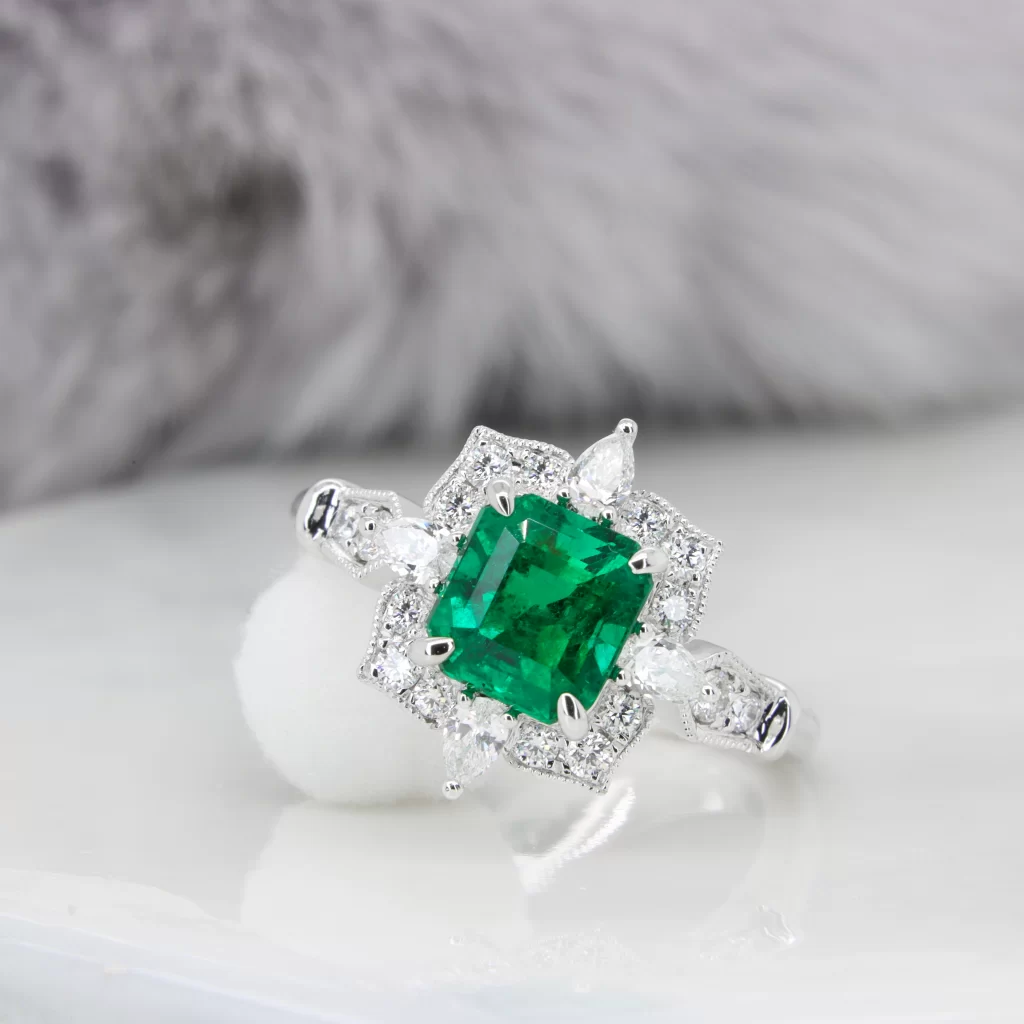
The ring above is one of ours, an Art Deco style proposal ring. Its emerald carries a GRS Muzo green grade, and a halo of diamonds follows the shape of the stone so the white of the diamonds sharpens the green rather than competing with it.
What Makes a Muzo Emerald Special?
Colour: Warm, Pure Green
Fine Muzo material shows a warm, pure green with very little blue or grey. The trade measures Colombian colour against it, although fine emeralds from Zambia and Afghanistan can rival it. Zambian stones often show a slightly bluer green.
Clarity and the Jardin
Almost every emerald has inclusions, which the trade calls jardin, French for garden. A few give a stone character, but too many cloud the colour. We look for transparency first, a stone that light passes through cleanly so the green stays bright face up. In practice that means emeralds with minor oil or better on the lab report.
Rarity
Colombia is not the largest producer by weight. Zambia’s Kagem mine alone produces about a quarter of the world’s emeralds. Colombia leads on value and reputation, and stones of top Colombian colour with good transparency are a small part of what any mine yields. Our guide to rare gemstones covers how this compares with other stones.
Quality Beyond Carat Weight
Size matters, but colour and transparency matter more. A smaller emerald with strong, even green and good transparency can be worth more per carat than a larger stone that is pale or cloudy.
We often see emeralds sold with informal grades such as AAA, AA or A. These grades are not used by international gemmological laboratories such as GRS or GIA. You are welcome to see our emeralds in person, in daylight, with their lab reports beside them.
Muzo, Coscuez and Chivor: Colombia’s Emerald Districts
Colombian emeralds come from two belts on either side of the Eastern Cordillera. The western belt includes Muzo, Coscuez, La Pita and Peñas Blancas. The eastern belt includes Chivor, Somondoco and Gachalá. In the trade, Muzo and Chivor are often used to describe colour and quality rather than the exact mine, which is why a lab report matters: one that states Colombian origin tells you the country, not the individual mine.
What Muzo Green Means on a Lab Report
GRS introduced its type Muzo green grade at the first International Emerald Symposium in Bogotá in October 2015, for Colombian emeralds of exceptional saturation and hue. It later adjusted the wording to make clear that several Colombian mines can produce this colour. So a GRS Muzo green report describes the colour of a Colombian emerald. It is not, on its own, proof that the stone was mined at Muzo. That is exactly how we use the name: only when it is on the report, and only in the sense the report gives it.
Are Muzo Emeralds Oiled?
Most emeralds, Colombian stones included, have fissures that reach the surface filled with oil or resin to improve clarity. It is a long accepted trade practice, and labs report how much has been done, from none through minor and moderate to significant. We choose emeralds with minor oil or better, which stay bright and need less care over the years. Our guides to minor oil emeralds and no oil emeralds explain each grade.

We made this necklace for a client who wanted an heirloom piece. At its centre is a Colombian emerald of close to 3 carats, graded Muzo green by GRS, with a strong, even green.
A frame of baguette diamonds follows the outline of the emerald, and eight round brilliant diamonds sit across its four corners. The straight lines of the baguettes keep the frame clean and let the colour do the work.
Muzo Emerald Jewellery
Emeralds have been worn by royalty for centuries, and a fine Colombian stone is still the one most collectors measure others against. We design high jewellery pieces and customised engagement rings around the emerald itself, so the setting supports its colour rather than competing with it.
For an engagement ring worn every day, we usually suggest a protective setting such as a bezel or a diamond halo. Emerald is 7.5 to 8 on the Mohs scale and more brittle than sapphire, so its edges benefit from the extra protection.
Caring for Your Emerald
Emeralds need a little more care than sapphires or diamonds, mainly because of the oil in their fissures.
- Clean your emerald gently with mild soap, warm water and a soft brush.
- Avoid ultrasonic and steam cleaners, harsh chemicals and sudden temperature changes.
- Bring it to us for cleaning, which is free for life on GIOIA pieces, and we will look over the setting at the same time.
How Much Does a Muzo Emerald Cost?
Bespoke rings set with a GRS Muzo green Colombian emerald start from SGD 6,500 and take about 10 to 12 weeks from an approved design. Our emerald rings in general start from SGD 3,900, but a Muzo green stone costs considerably more than other emeralds of the same size. Above that starting point, the price depends mostly on the emerald: colour first, then the oil grade, transparency and size. Centre stones above about SGD 1,000 come with a lab report from GRS, GIA or NGI, and every emerald we describe as Muzo green has a GRS report saying so.
Frequently Asked Questions
What is a Muzo emerald?
Strictly, an emerald from the Muzo district in Boyacá, Colombia. In the trade, Muzo green also describes the warm, intense green Muzo is famous for, and GRS uses it as its top colour grade for Colombian emeralds.
Does Muzo green on a report mean the stone came from the Muzo mine?
No. GRS uses it as a colour grade, and several Colombian mines can produce that colour. The report states Colombian origin separately.
Are Muzo emeralds oiled?
Most emeralds are, Colombian stones included. Check the oil grade on the lab report. We choose stones with minor oil or better.
Is Colombia the largest emerald producer?
Not by weight. Zambia’s Kagem mine alone produces about a quarter of the world’s emeralds. Colombia leads on value and reputation.
Is an emerald suitable for an engagement ring?
Yes, with a protective setting. Emerald is 7.5 to 8 on the Mohs scale but more brittle than sapphire, so a bezel or halo helps protect its edges in daily wear.
How much does a Muzo emerald ring cost?
Bespoke rings set with a GRS Muzo green emerald start from SGD 6,500. The final price depends on the colour, oil grade, transparency and size of the stone you choose.
See Our Emeralds in Daylight
We hold emeralds from Colombia, Zambia and Brazil, and show every stone loose, in daylight, with its lab report on the table. Come and compare them at our International Plaza boutique, or start with a bespoke emerald ring or a gemstone engagement ring. Book a consultation to arrange a visit.