Parrot Fine Jewellery Singapore
Bird motif fine jewellery carries a quiet sentiment that most clients don’t articulate until they’re commissioning the piece. Parrots in particular sit at a meaningful intersection, they signal positivity, resilience, and a certain joyful confidence that resonates with the women who commission them. Most of the bird pieces we’ve crafted at GIOIA were not impulse buys. They marked something: a milestone, a personal chapter, or simply a long-held wish to wear something with a story attached to it.
At GIOIA Fine Jewellery, our parrot pieces have become quietly recognisable within our customised collection. Each one is built around a centre gemstone the client chose for personal reasons, with the parrot form constructed in diamond pavé around it. The result is a piece that reads as fine jewellery first and animal motif second, design discipline that keeps the work elegant rather than novelty.
Parrot & Bird Motif Fine Jewellery
Why Bird Motif Jewellery Resonates
Bird symbolism in fine jewellery has deep history, from Cartier’s parrots in the 1920s to Van Cleef & Arpels’ Oiseaux de Paradis collection. The motif endures because birds carry meanings that translate cleanly into wearable form: freedom of movement, resilience through migration, and the kind of bright, alert presence that suits a piece worn close to the collarbone.
Parrots specifically carry their own associations. Their vivid plumage and intelligent gaze make them symbols of positivity and joy. In design terms, they give a jeweller an excuse to work with intense gemstone colour, Paraiba tourmaline, vivid spinel, tanzanite, pink tourmaline. Colours that need a confident form to hold them. A parrot’s silhouette gives those stones a home rather than just a setting.
The pieces in our parrot fine jewellery collection were each commissioned with a particular gemstone at the centre, and the parrot form built outward from that. The stone leads. The motif supports.
Tanzanite Parrot Pendant and Earring Set
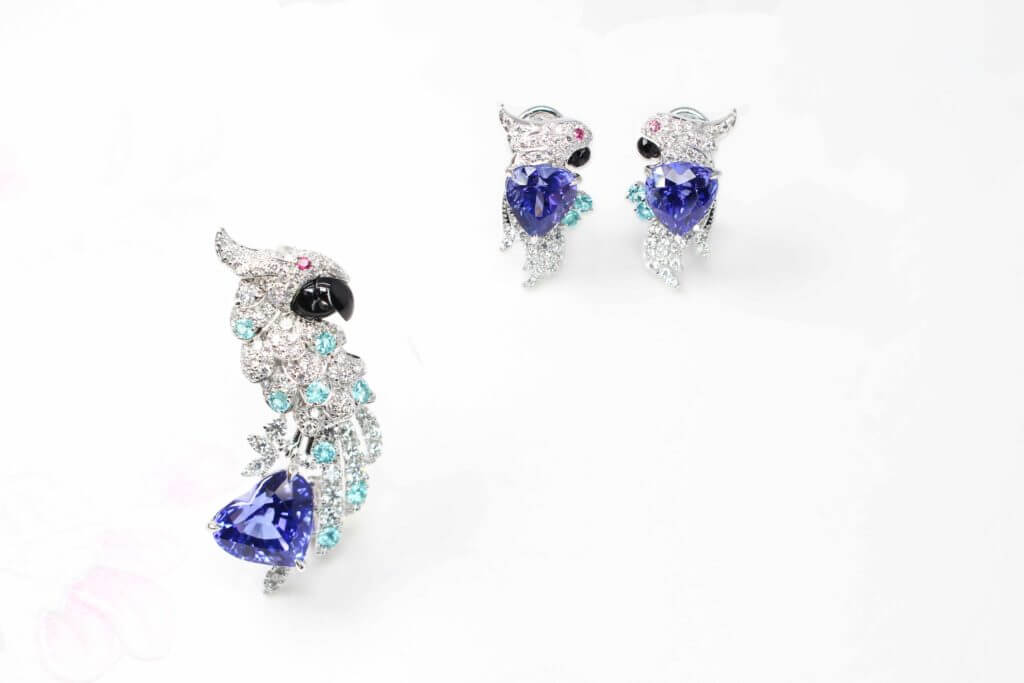
The first piece centres on a heart-shaped tanzanite, set as both the pendant’s focal point and echoed in matching earrings. Tanzanite is mined exclusively in the Merelani Hills of Tanzania, and its violet-blue trichroism gives the stone shifting tones depending on how light catches it. Setting it as the parrot’s body let us use the colour as the bird’s plumage signal, vivid, but unmistakably refined.
Around the tanzanite, the parrot’s form is built in diamond pavé. The eye is set with a small red spinel, chosen over a ruby for its higher saturation at small carat sizes. The beak is carved from onyx, the only stone in the piece that isn’t transparent, a deliberate contrast that gives the bird its sharp expression. Paraiba tourmaline accents complete the wing detail, the same Brazilian neon-blue we use on the second parrot piece.
The matching earrings carry the same parrot form in scaled-down proportions, designed to be worn together with the pendant or independently. Pendant and earrings can each anchor a look without the full set, which extends the piece’s actual wearability, important for jewellery at this price point.
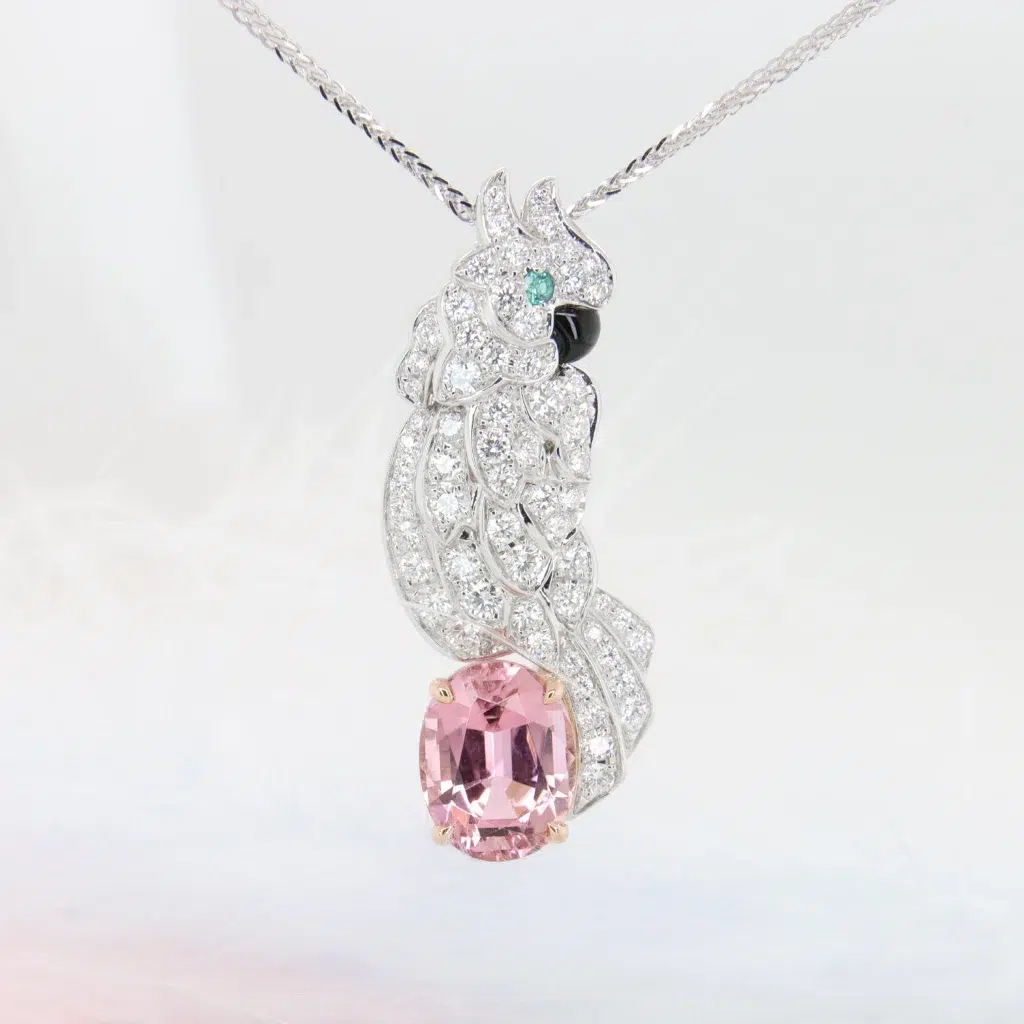
Pink Tourmaline Parrot Pendant
The second piece took its starting point from somewhere unexpected. A ladies’ watch the client owned, which featured a pink parrot motif on the dial. She wanted a pendant that referenced the same spirit without copying the watch. We worked outward from there.
The centre stone is a 4.48ct oval pink tourmaline, set in rose gold prongs deliberately chosen to deepen the stone’s blush tone. Pink tourmaline benefits from a warm metal contact; the rose gold prongs reflect into the stone and add saturation that white gold prongs would mute. The stone hangs at the base of the parrot, taking the visual role of the bird’s body.
The head, wings, and tail are paved in 64 individually-set round brilliant diamonds totalling 1.31ct. Each stone was selected for matched colour and clarity so the pavé reads as a continuous diamond surface rather than a scatter of mismatched stones, the difference between a piece that looks handcrafted and one that looks mass-produced. The total set used 18K white gold for the diamond pavé sections and 18K rose gold only on the centre prongs, the kind of two-tone choice that’s invisible until you look closely.
The eye is a single Brazilian Paraiba tourmaline. This origin matters more than it sounds, Brazilian Paraiba carries the electric neon-blue saturation that Mozambique material genuinely cannot replicate at calibrated sizes. At small carat weights for an accent stone like a bird’s eye, Brazilian Paraiba glows in a way that gives the parrot a lively, alert expression. The beak is carved from black onyx, deliberately opaque so the bird’s face has a clear focal point against all the surrounding sparkle.
The Craft Behind Parrot Pave Jewellery
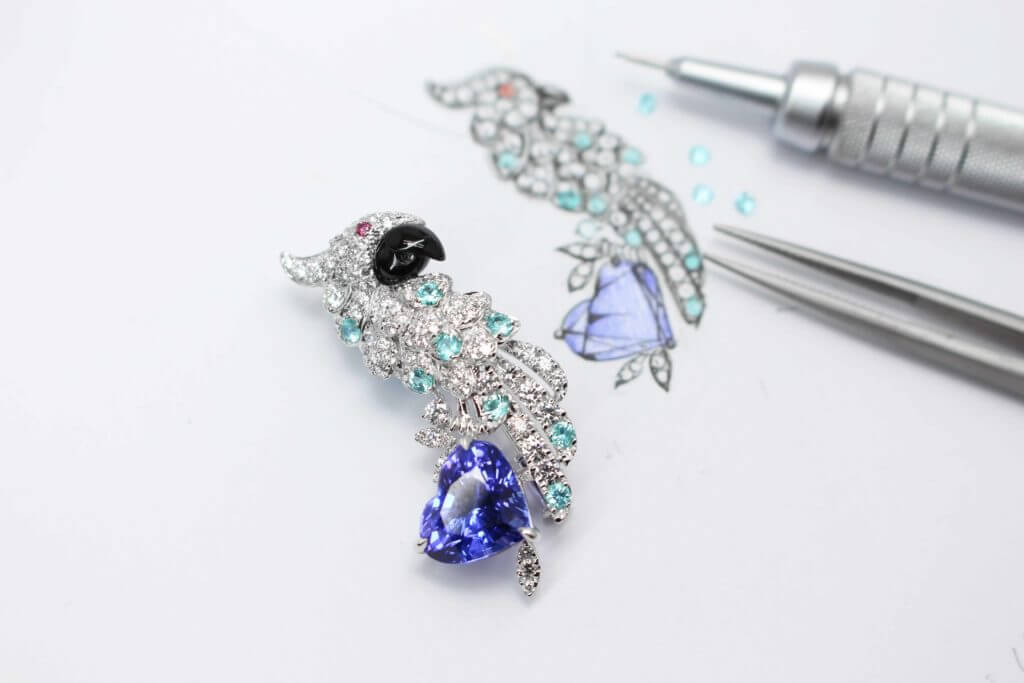
Pavé bird forms are among the harder shapes in fine jewellery to execute well. The wing curve, the tilt of the head, and the cascade of the tail all force the setter to vary diamond size and spacing across the piece. A flat pavé band has uniform stones, but a parrot’s plumage needs graduated sizing to read as feathers rather than chips.
For a piece like this pink tourmaline parrot fine jewellery, the 64 individual diamonds each had to be drilled, seated, and bead-set by hand. The setter works under magnification, securing each stone with tiny prongs of the host metal pushed over the diamond’s girdle. A misplaced stone in a flat band can be re-set without disturbing the design. A misplaced stone in a parrot’s wing throws off the visual flow of the entire piece.
The colour-matching of those 64 stones happens before any setting begins. Round brilliants of the same nominal grade can still vary in tint and brilliance when placed side by side. For pavé to read as one surface, the stones are sorted in trays and selected for visual continuity, not just paper grade. This sorting step is what separates fine pavé from production pavé.
A parrot commission like these typically takes 14 to 16 weeks from sketch approval to final polish. The bulk of that time is the wax modelling and setting stages, casting itself is relatively quick, but the setting work cannot be rushed without showing in the final piece.
Beyond Parrots: Animal-Inspired Fine Jewellery
Parrots are part of a broader body of animal commissions we’ve taken on. Clients have asked us to design dragons, butterflies, and other meaningful animal forms, each piece carrying personal significance for the wearer. The dragon pieces tend to favour bold structural design built around a personal birthstone; butterfly pieces lean toward lightness and movement, often featuring multiple smaller gemstones across the wings.
If you’d like to explore our broader bespoke work, our customised jewellery collection covers the full range of commissions we’ve completed across animal jewellery, floral pieces, and structural designs.
Bird-themed and animal-inspired fine jewellery is rarely the obvious choice for a first jewellery commission. Most clients come to it after they’ve already commissioned a gemstone engagement ring or wedding band, when they want something with more personality and storytelling. It’s not jewellery designed to be discreet. It’s designed to be wearable art, a piece with a story, a meaning, and a purpose. Featured by Tatler Asia, these are the kinds of commissions that mark a chapter rather than fill a gap.