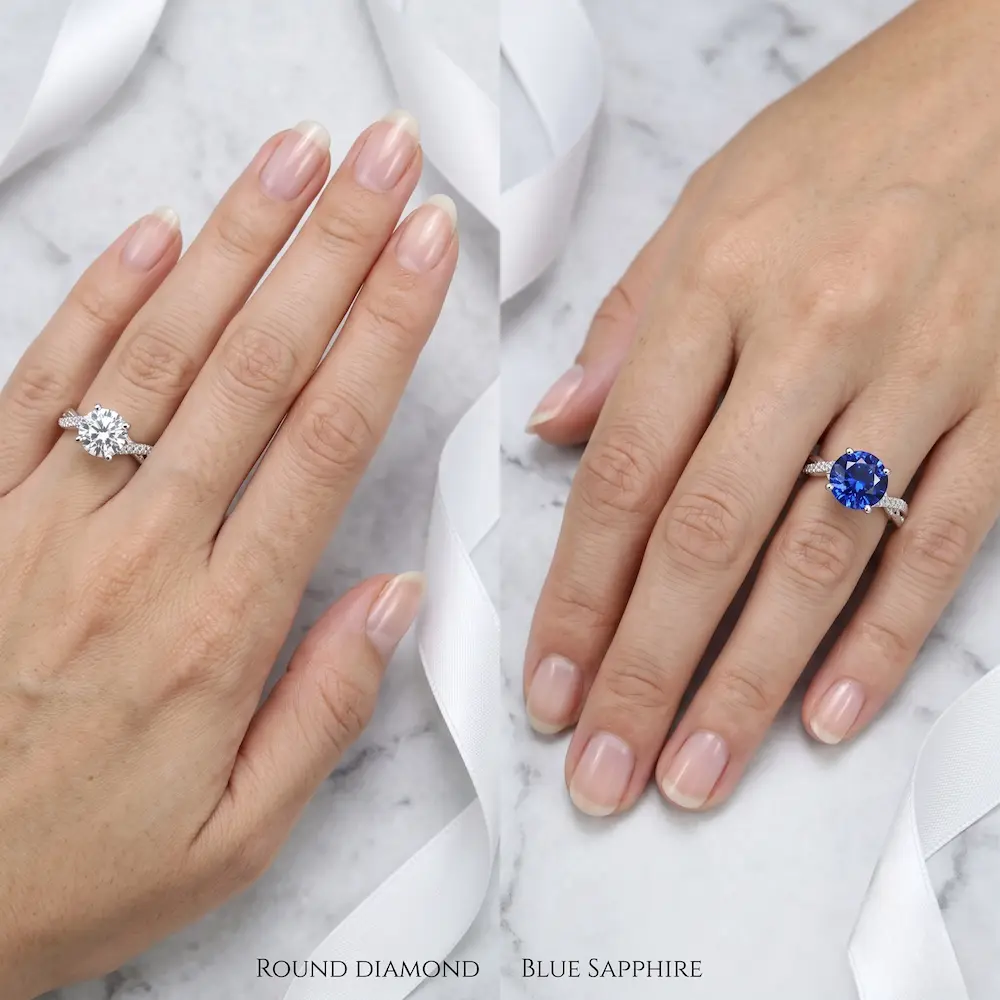

When you walk into a jewellery boutique to design your engagement ring, the first question, for many clients, is rarely about the gemstone. It’s about the design itself. Solitaire or halo? Simple band or elaborate detailing? Three stones or one? For many couples, this is where the real confusion starts. Not because there’s a wrong answer, but because there are so many right ones, each telling a completely different story about what matters to you.
This guide breaks down the engagement ring design styles Singapore couples are actually choosing between right now: solitaire, halo, trilogy, cluster, and toi et moi. It’s built around one simple principle: design isn’t decoration. It’s a conversation between what your gemstone can do and how you want to live with it. We’ll walk through every major engagement ring design structure, show you real examples from our own commissions, and help you understand not just what each style looks like, but why couples choose it and what that choice actually means for daily wear, durability, and the feeling you get when you look down at your hand.
Table of Contents
At a Glance: Engagement Ring Design Styles Compared
Before the full breakdown, here’s how the five structures compare side by side.
| Style | Best For | Key Advantage | Key Trade-off | Sparkle Level |
|---|---|---|---|---|
| Solitaire | Couples who want the gemstone itself to be the whole statement | Classic, durable, budget goes into the stone | Can read understated under 1.5ct | Low to Moderate |
| Halo | Couples who want maximum size impression without a huge centre stone | Amplifies the centre stone and protects its edges | Needs occasional prong checks, snagging risk if oversized | High |
| Trilogy | Couples drawn to the past, present, future symbolism | Balanced silhouette, flexible for contrast stones | Pricier than it looks, less brilliance than a halo | Moderate |
| Cluster | Couples who want texture, rarity, and an artistic feel | Can cost less than one large solitaire stone | Needs skilled design, visually busy | High |
| Toi et Moi | Couples who want the ring to represent two people directly | Direct storytelling, highly personalisable | Two main stones cost more, less sparkle without added pavé | Low to Moderate |
The Solitaire: When Less Speaks Louder
A solitaire is one gemstone, held by four or six prongs, on a clean band. That’s it. There’s nowhere for your eye to go except to the stone itself, which is precisely why some couples love this design and others are terrified of it.
When you choose a solitaire, you’re making a statement: this gemstone is enough. You’ve chosen something rare or beautiful enough to not need accompaniment, and the setting is there to serve the stone, not to distract from it or protect it by hiding it under a crowd.
A solitaire’s strength comes down to the stone’s own geometry.
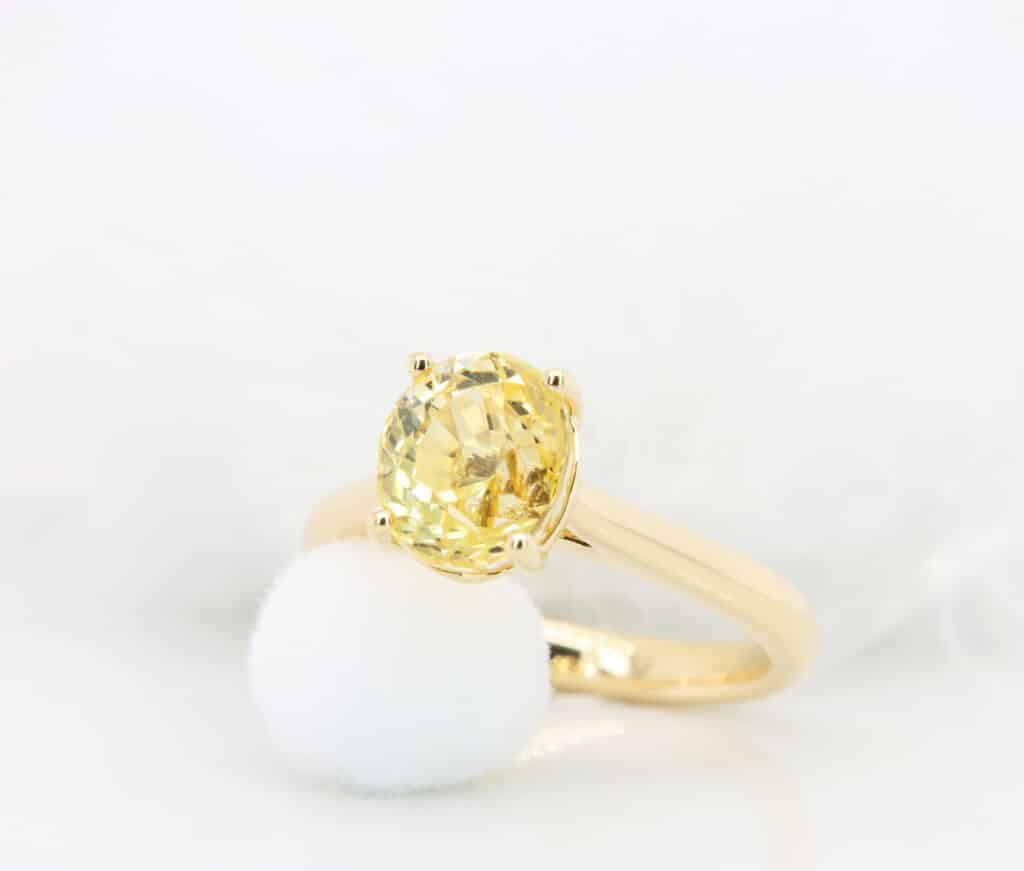
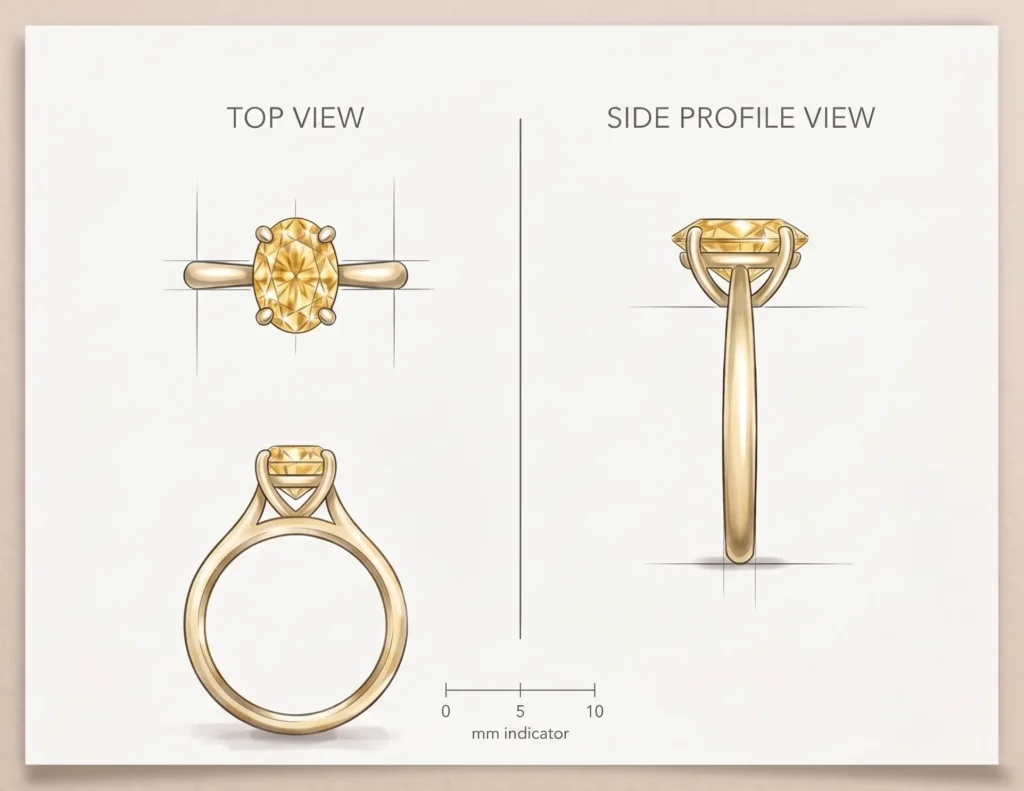
Take the vivid yellow sapphire above: a round brilliant cut catches light in discrete, warm flashes with nothing surrounding it to compete for attention. The band stays simple, a plain four-prong setting in 18k yellow gold, so the focus remains entirely on the centre gemstone. Place the same stone in a halo and you’d gain a size impression, but you’d also fragment the light into smaller pieces. A solitaire keeps it whole.
Advantages of a Solitaire Ring
- A classic look. A solitaire doesn’t date. It was the default fifty years ago, and it will be the default fifty years from now. If you’re not sure what you want aesthetically, a solitaire gives you permission to just choose the gemstone and let that be the decision.
- Durability advantage. No side stones means no stones to come loose, no pavé to wear down, no delicate details to catch on fabric. The band takes less structural stress because all the load is concentrated through the centre setting.
- Gemstone clarity. If you’ve chosen an exceptional stone, a sapphire with rich colour saturation or a paraiba with electric luminosity, a solitaire shows it off completely. There’s no competition for light or attention.
- Budget clarity. What you spend goes into the gemstone, not into the setting’s complexity. That’s a real advantage if the stone itself matters most to you.
Disadvantages of a Solitaire Ring
- Can read understated. If your gemstone is smaller than 1.5 carats, or if you prefer maximum visual impact on the finger, a solitaire can look modest in a way that’s either perfect or frustrating depending on your taste.
- Nowhere for a lesser stone to hide. Because the centre stone carries the entire design with no side stones or halo to distract, any weakness in cut, clarity, or colour saturation is fully exposed. A solitaire only works as well as the stone itself.
- Less sparkle overall. With no pavé, halo, or side stones adding faceted surface area, a solitaire simply throws less total light than a halo or cluster of the same carat weight. If maximum brilliance is the priority, this is the trade-off.
Stacking Wedding Bands with a Solitaire
A solitaire’s simplicity is also what makes it the easiest structural style to build a stacked look around later. Because there’s minimal metalwork surrounding the centre stone, a contoured or curved wedding band can sit flush against the prongs without any custom notching, and a straight pavé band sits cleanly alongside a plain shank without competing with existing detail. Many couples start with a solitaire specifically because it leaves that door open, adding a diamond band at the wedding, then another for an anniversary, without ever needing to redesign the original ring. If you’re drawn to a solitaire but also want the option to build a fuller look over time, this is worth discussing early with your jeweller so the prong height and band profile are planned to accommodate it. Explore customised wedding bands designed to stack seamlessly.
The Halo: Amplifying Presence Without Compromise
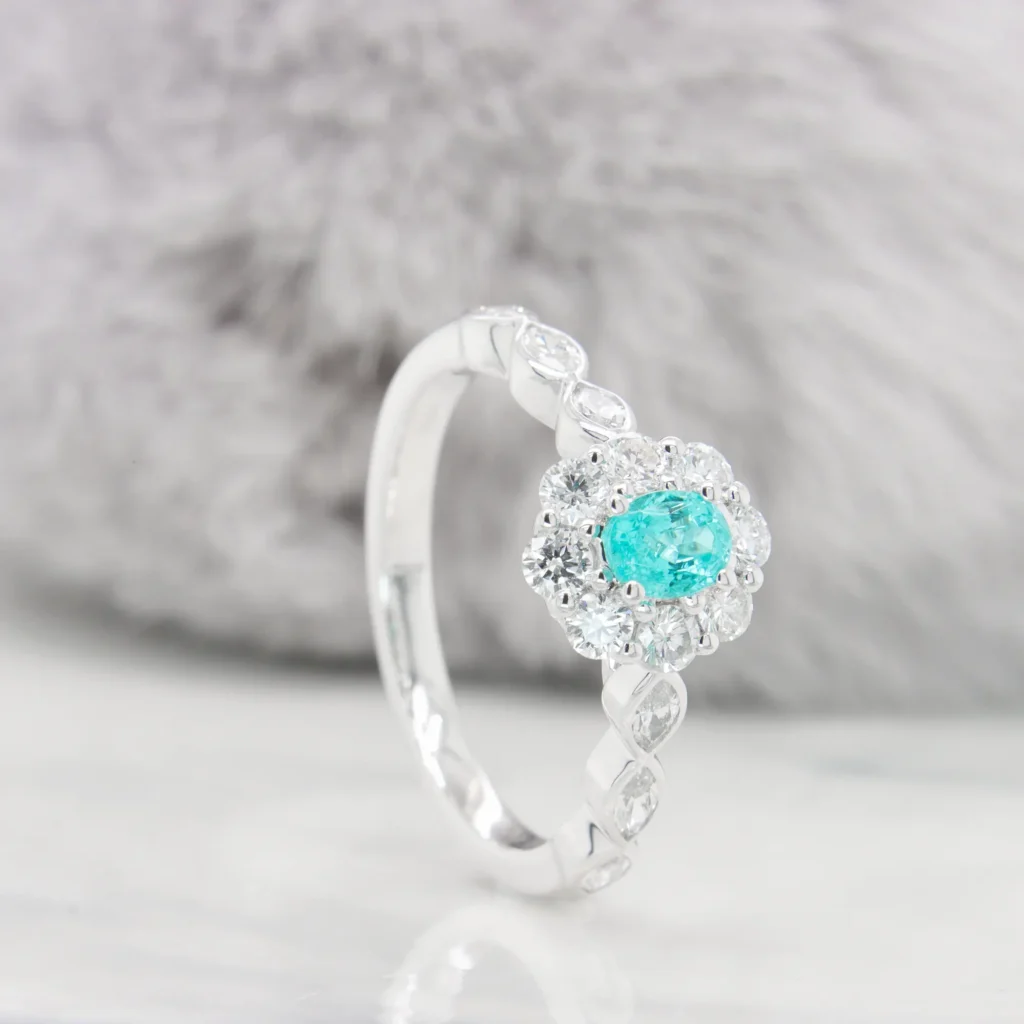
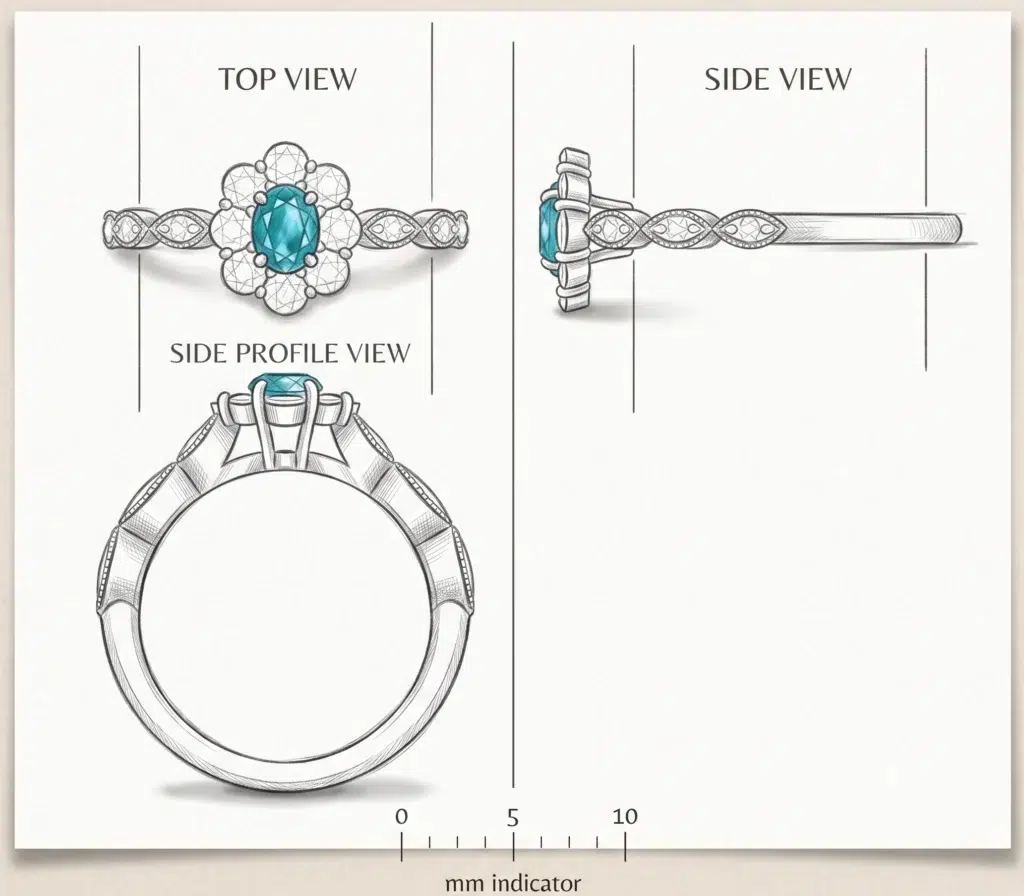
A halo is a ring of smaller gemstones or diamonds surrounding a centre stone. The optical effect is that the centre stone appears larger, and the overall ring appears to have far more brilliance than it would alone.
Structurally, a halo serves a real purpose: it protects the centre stone’s edges from bumps. Emotionally, it announces itself. You can see why halos have become the second most popular design after solitaires. They deliver visual drama without requiring you to commit to an enormous centre stone.
Take the Paraiba tourmaline halo diamond ring above. The electric blue-green of the tourmaline gets amplified by the surrounding diamonds, and the pear-shaped accents at the shoulders carry that brilliance down the band. The stone almost glows because of the contrast. A halo doesn’t just make things look bigger. It changes how the gemstone’s colour reads, which is a real design consideration, not just a size trick.
Halo structural variations
The Classic Round Halo. Smaller diamonds sit closely around the entire perimeter of the centre stone. This is the most common halo form, and for good reason. It distributes light evenly and works with almost any centre gemstone shape.
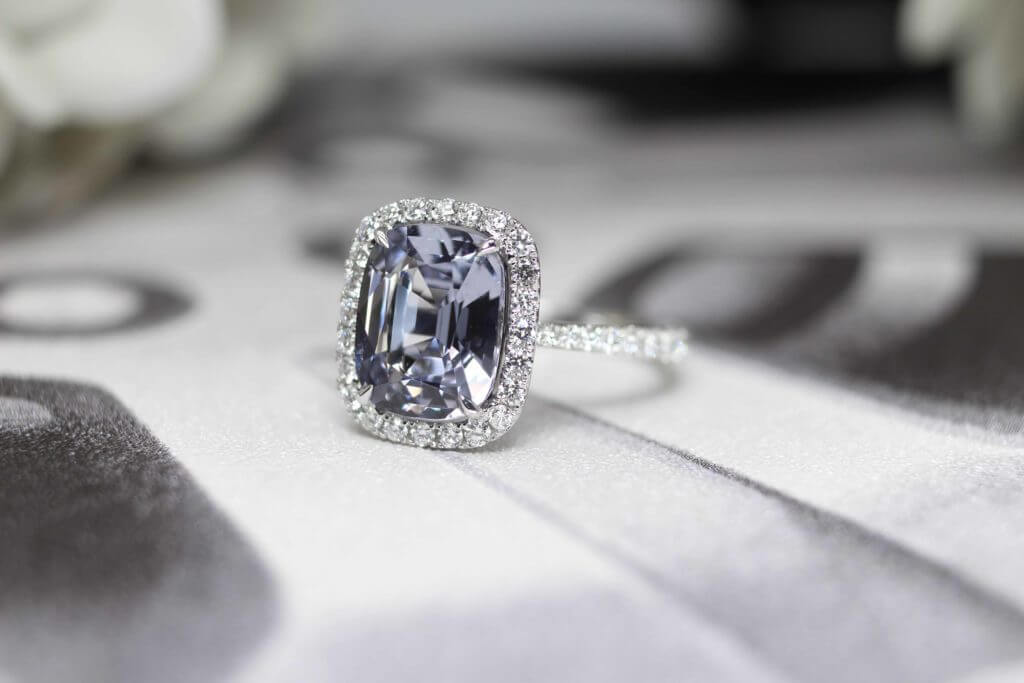
The Cushion Halo. The halo itself is cushion-shaped, mirroring the centre stone’s geometry. This creates visual continuity and a more formal, intentional look than a round halo does. The lavender violet spinel above shows this well. The cushion halo echoes the cushion centre, and the result reads as more cohesive, almost like a single geometric unit rather than a stone with an addition around it.
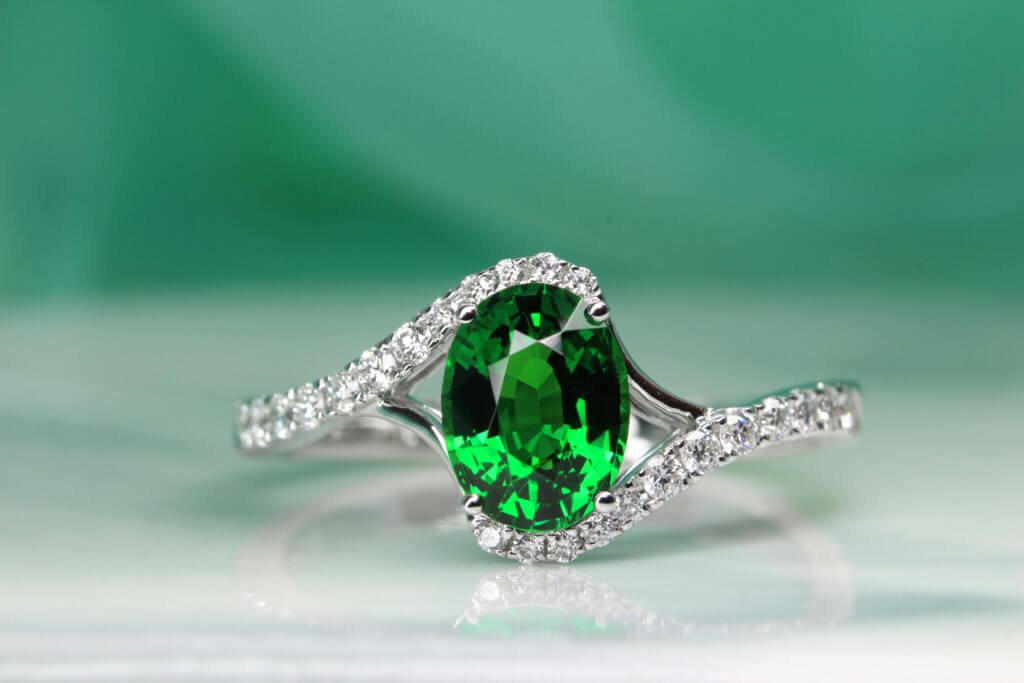
The Artistic or Asymmetrical Halo. The halo isn’t a perfect ring but instead extends into the band, creating a visual flow. This is less common and requires more skilled execution, but the result is distinctive. You see less of this in ready-made jewellery, which is why it suits a custom engagement ring.
Size and thickness change the effect as much as shape does. A slim, single row of small diamonds closely follows the centre stone’s outline and amplifies it modestly, a subtle lift rather than a dramatic one. A thicker halo, or a double halo with two concentric rows, pushes the size impression much further, but it also demands a centre stone substantial enough to anchor it visually. Match the halo’s scale to the centre stone, not to how much sparkle you want in the abstract.
Advantages of a Halo Ring
- Visual amplification. A 0.8ct centre stone in a halo often reads larger than a 1.2ct solitaire. If size on the finger matters to you, this is the design leverage point.
- Brilliance and sparkle. Halos catch more light because there’s more surface area of faceted gemstones. If you love that sparkle feeling, halos deliver it.
- Gemstone protection. The surrounding stones act as a bumper for the centre stone. If you live an active life and worry about edge wear or chipping, a halo is genuinely more protective than a solitaire.
- Aesthetic drama. Halos work beautifully with coloured gemstones because the white diamonds create contrast and make the colour pop.
Disadvantages of a Halo Ring
- Prongs need occasional attention. The pavé or melee diamonds around a halo can loosen slightly with daily wear, especially in an active lifestyle. There’s no fixed schedule to worry about here. If a stone ever feels loose or sits differently against your finger than usual, that’s simply your cue to bring it in so we can check it.
- Proportion risk. A halo sized too large for its centre stone throws the whole ring out of proportion. The eye reads the halo first and the centre stone second, which undercuts the exact effect a halo is meant to create. This is a common mistake when a smaller stone is paired with an oversized halo to compensate for its size.
- Snagging hazard. The raised profile of a halo, especially a thicker or double halo, catches more easily on clothing, hair, and fine fabric than a low-profile solitaire. If you wear delicate knits often or work with your hands, this is worth considering before committing to the style.
The Trilogy: Three Stones, Three Chapters
A trilogy is traditionally three stones: a centre stone with one smaller stone on each side. It’s sometimes called a “three-stone ring,” and the concept carries deep symbolic resonance: past, present, future. Where you’ve been, where you are, where you’re going.
Structurally, the trilogy is elegant because it draws the eye from left to right, creating a sense of movement and storytelling. The side stones don’t need to match the centre stone. In fact, many of the most interesting trilogy rings deliberately use contrasting stones for dramatic effect, the way our blue sapphire commission below pairs a vivid royal blue toned centre with bright white diamond accents.
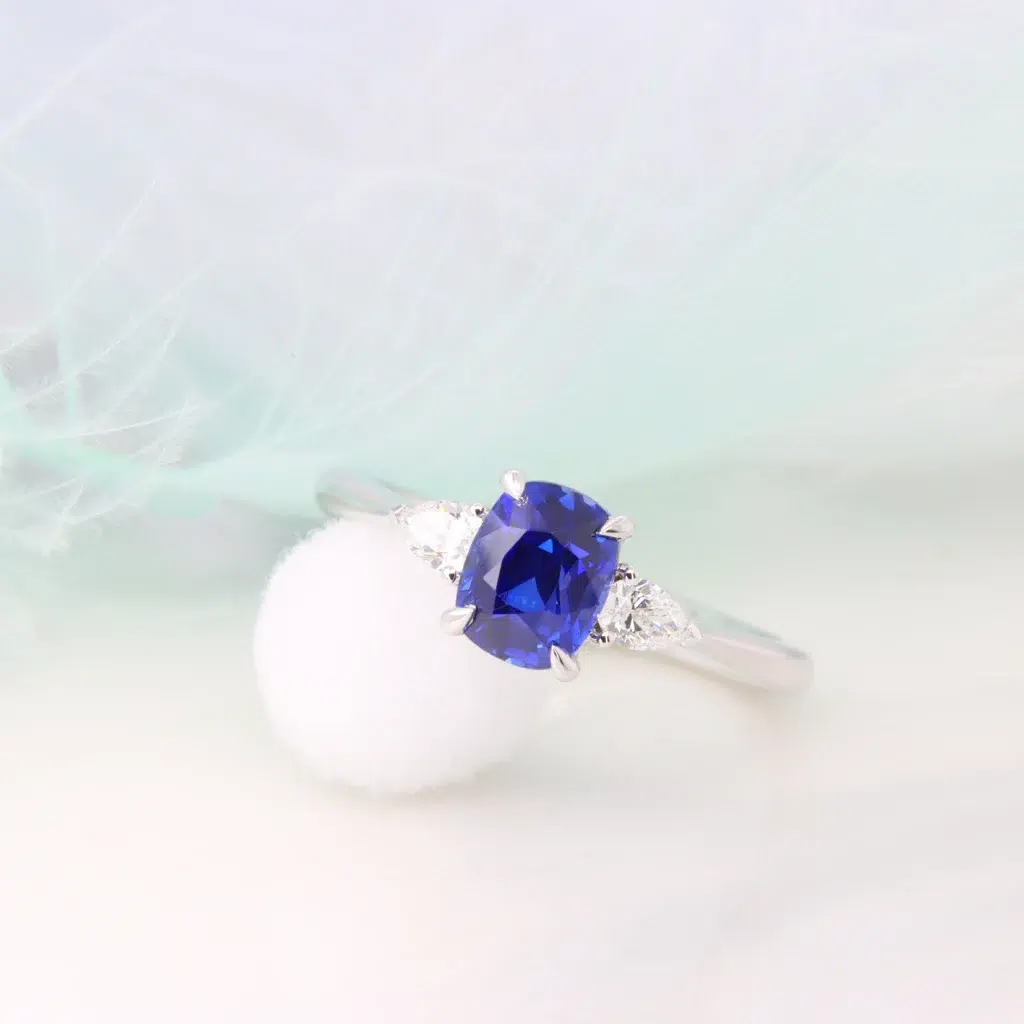
Trilogy structures
The Classic Three-Stone. Equal visual weight on all sides, centre stone larger, sides noticeably smaller but still substantial. This is the traditional “three chapters” symbolism.
The Asymmetrical Trilogy. Different side stones, one diamond, one gemstone, or two different coloured gemstones. This is more modern and creates visual interest through variety rather than symmetry.
The Coloured Trilogy. All three stones are coloured gemstones, a red spinel in the centre with sapphire or pink tourmaline on the sides, for instance. This is rarer but striking for couples who want to move away from the diamond-as-accent visual language entirely.
Advantages of a Trilogy Ring
- Symbolic meaning. The three-stone concept resonates emotionally. It’s a narrative structure, not just a gem structure.
- Visual balance. Three stones create a more complex silhouette than a solitaire, but less visual competition than a cluster. It’s the middle ground.
- Flexibility in stone choice. You can use the side stones to introduce a secondary colour or to create contrast with the centre stone.
- Durability. Unlike the many small stones in a halo, the two side stones in a trilogy are held by their own prongs, so they usually need no more than normal care.
Disadvantages of a Trilogy Ring
- Higher cost than it appears. The band has to accommodate three setting points, which means the metalwork is more complex and typically costs more than a solitaire. If budget is the primary constraint, a trilogy is pricier than a single-stone design of similar visual size.
- Less brilliance than a halo or pavé band. With only three stones, a trilogy simply has less total faceted surface area throwing light than a halo or a side-pavé band delivers. If maximum sparkle is what you’re after, a trilogy reads as more restrained than dazzling.
Stacking Wedding Bands with a Trilogy
A trilogy’s three setting points make stacking more particular than with a solitaire. A straight wedding band will sit proud of the side stones rather than flush against them, leaving a visible gap. The style that solves this is a wishbone band, a curved, V-shaped design that notches around the trilogy’s side stones so the two rings sit seamlessly together, as though they were made as one piece. If a trilogy is your chosen structure and you already know you want to stack a wedding band against it, raise the wishbone shape with your jeweller at the design stage. It’s far simpler to plan the trilogy’s side-stone spacing around a wishbone band from the start than to commission one afterward to fit an existing ring. Explore stackable wedding rings for a wishbone fit.
The Cluster: Texture, Rarity, and Visual Complexity
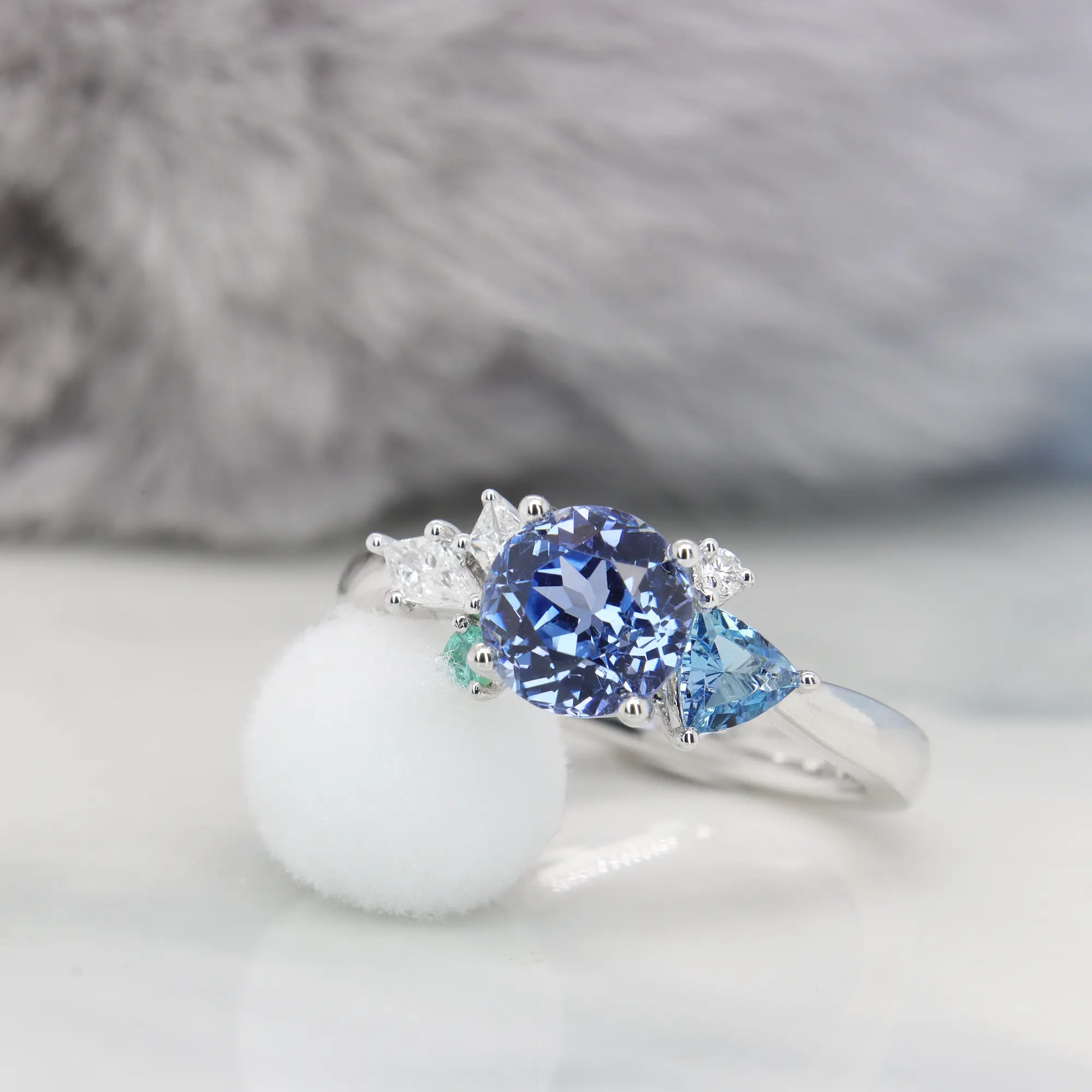
A cluster is a design where multiple gemstones of varying sizes and sometimes colours are set tightly together to create a single focal point. There’s no single “centre stone.” The cluster as a whole is the focal point.
Clusters are modern vintage. They reference Victorian and Edwardian jewellery, where clusters were the default, but they’re designed with contemporary aesthetic sensibility. They appeal to couples who don’t relate to the “one stone equals commitment” symbolic language and instead want something with texture, movement, and visual depth.
The blue sapphire cluster above shows the power of this approach. The centre sapphire is joined by paraiba tourmaline, aquamarine, and fancy diamond accents, each with slightly different colour and saturation, and the result is far more visually interesting than any single stone could be. It reads as collected, intentional, artistic.
Cluster variations
The Geometric Cluster. Stones arranged in a deliberate pattern, hexagon, oval, abstract shape. Very modern, very intentional-looking.
The Organic Cluster. Stones arranged to look almost random, as though they grew together. More romantic, less structured.
The Gradient Cluster. Stones arranged by colour, from dark to light or vice versa, creating a visual flow.
Advantages of a Cluster Ring
- Uniqueness. Clusters are rarely identical. Even two clusters with the same gemstone types will read differently because the arrangement is custom.
- Artistic expression. If you think of your ring as art rather than as a symbol of commitment, a cluster lets you approach it that way.
- Rarity storytelling. Clusters allow you to incorporate multiple rare gemstones in a single ring. A paraiba tourmaline, an aquamarine, and a sapphire working together tells a more complex story than “I found one exceptional stone.”
- Visual impact. Clusters read large and important on the finger. A cluster that’s technically 3.5 carats total can read as substantial as a 2.5ct solitaire.
- Cost efficiency. A gemstone’s price per carat rises sharply as size increases, since large, high-quality stones are far rarer than small ones. Several smaller stones combined to the same total visual size as one large solitaire often cost meaningfully less, because you’re not paying that same size premium on every carat. A cluster gemstone ring can be a genuinely practical choice, not just an artistic one.
Disadvantages of a Cluster Ring
- Requires skilled design. Clusters require skilled design and execution. A poorly designed cluster looks chaotic rather than intentional.
- Visually busy. Clusters are inherently more detailed and less minimal than a solitaire or trilogy, which some people love and others find overwhelming. If you prefer visual simplicity, a cluster will feel like the opposite of that.
The Toi et Moi: Two Stones, One Story
Toi et moi means “you and me” in French, and the structure is exactly that literal. Two gemstones of equal size and standing sit side by side on the band, with neither one playing second to the other. It’s a different logic from a trilogy, where two smaller side stones support a dominant centre stone. Here, there’s no hierarchy at all, just two stones, together.
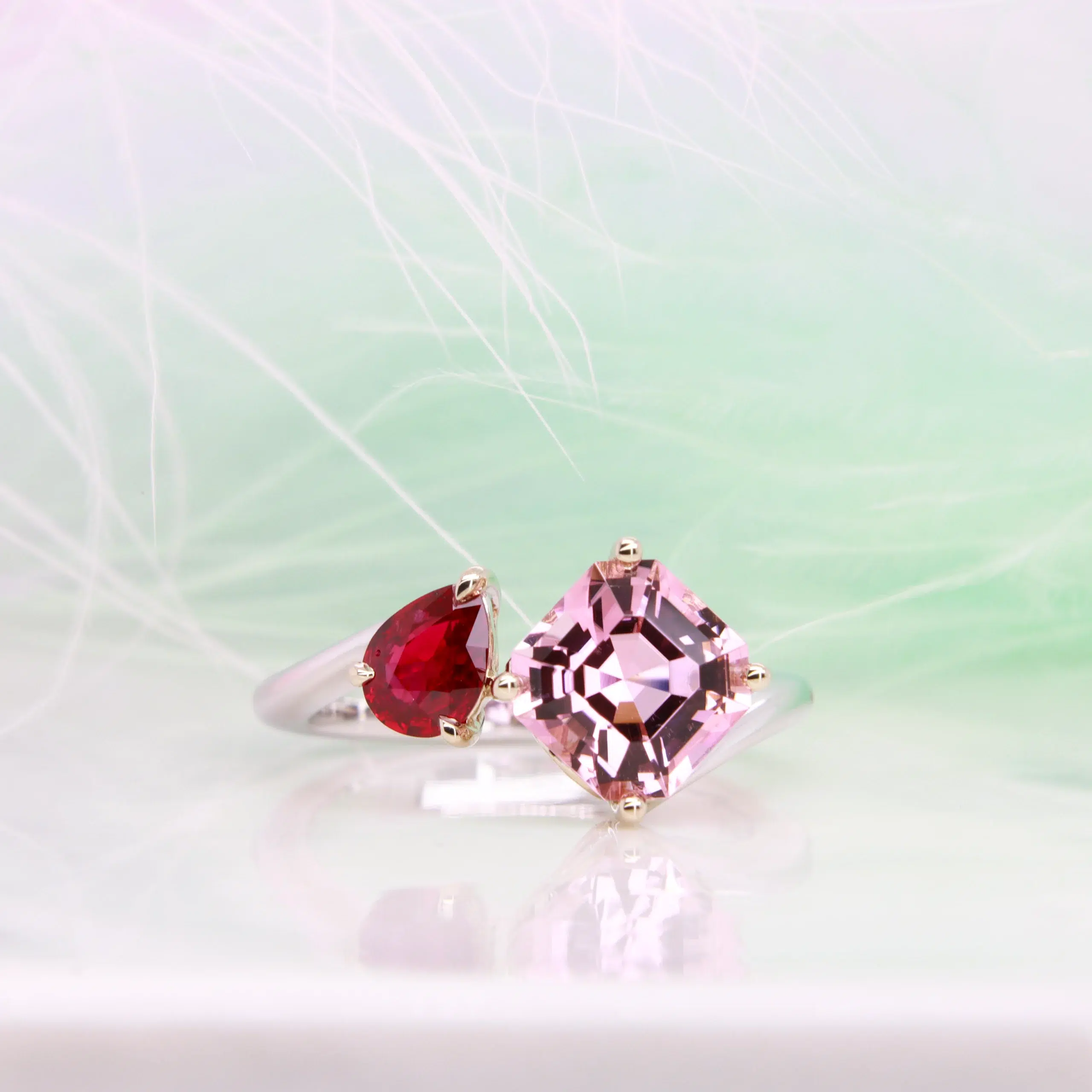
The ruby and pink tourmaline pairing above shows why couples choose this structure. Two distinct gemstones, two distinct colours, set to be read as a pair rather than one dominant stone with support. This particular commission carries engraved initials inside the band, a detail toi et moi designs lend themselves to especially well, since the format itself is already built around representing two people. It’s become one of the most requested two-stone formats in recent years, precisely because it gives couples a direct, visual way to tell their own story rather than following a single-stone tradition.
Advantages of a Toi et Moi Ring
- Direct storytelling. Two gemstones read naturally as two people. Many couples choose each partner’s birthstone, or two stones that each hold personal meaning, so the ring tells a specific story rather than a general one.
- Personalisation potential. Mixing shapes, a pear beside a cushion, an oval beside an emerald cut, creates individuality that’s hard to replicate with a single-stone design. Engraving inside the band, as in the piece above, extends that personal meaning further.
- Genuinely distinctive. Because neither stone dominates, a toi et moi ring reads differently from every other structure in this guide. It doesn’t compete with a solitaire, halo, trilogy, or cluster for the same visual language.
Disadvantages of a Toi et Moi Ring
- Higher cost, generally. Two main gemstones instead of one usually means a higher total cost than a comparable solitaire, though this depends heavily on which gemstones you choose and how their sizes are balanced against each other.
- Less brilliance unless you add diamonds. Structurally, a toi et moi is close to two solitaires set side by side, so on its own it won’t sparkle the way a halo or pavé-heavy design does. Adding pavé diamonds along the shared shank is the usual way to bring more brilliance into the design without changing the two-stone structure itself.
See more in our toi et moi ring collection.
Side Diamonds Explored: Pavé, Milgrain, and Beyond
The term “side diamonds” or “accent diamonds” covers a range of setting techniques that add detail and sparkle to the band itself, separate from any halo. Understanding these variations helps you know which level of detail you actually want.
Pavé (pronounced “pah-vay”). Tiny diamonds set closely together across the band, creating an unbroken field of sparkle. The diamonds are held in place by metal shared between them rather than individual prongs, so the eye doesn’t see individual stones, just a continuous gleam. The padparadscha sapphire below shows multi-row pavé, with a visible line running between each row of diamonds along the shoulders. Pavé comes in two densities: full pavé, where diamonds cover the entire visible band, and partial pavé, where diamonds cover only sections of the band, typically near the centre setting.

Micro-pavé. Essentially pavé with extremely tiny diamonds, often 1mm or smaller. The pigeon blood ruby ring below shows the difference clearly against the padparadscha above: no visible lines or rows between the diamonds, just a smooth, continuous shimmer along the shoulders. The effect is more refined, less visually heavy, and reads as more modern and minimalist than traditional pavé.
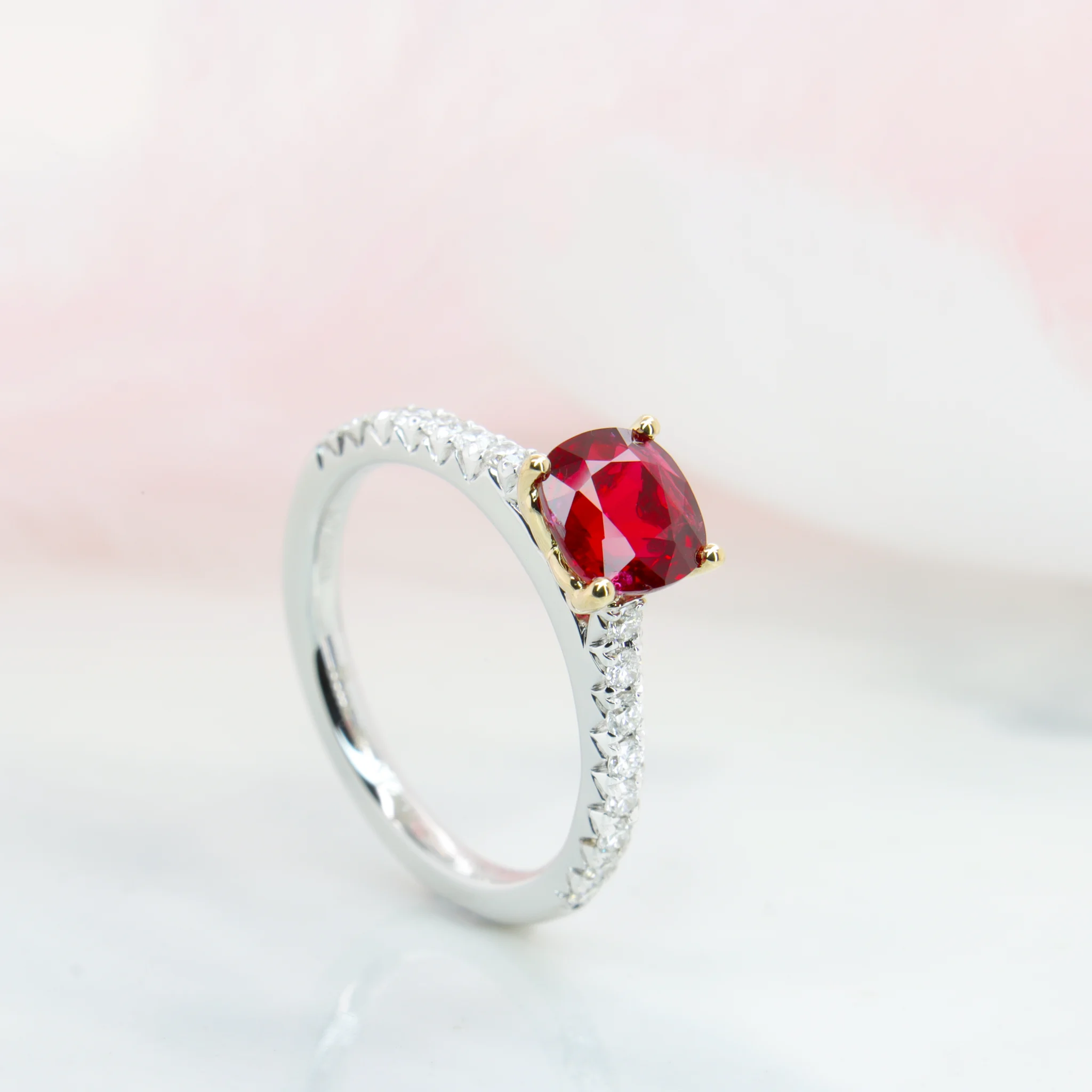
Both pavé and micro-pavé also solve a practical stacking problem. A pavé or micro-pavé band with a cathedral profile, where the metal arches up slightly toward the centre setting, is designed to sit flush against an engagement ring without needing a fully custom-made contoured band. You can select one directly rather than commissioning a bespoke shape, which makes pavé and micro-pavé among the easiest structural details to stack seamlessly straight off the shelf.
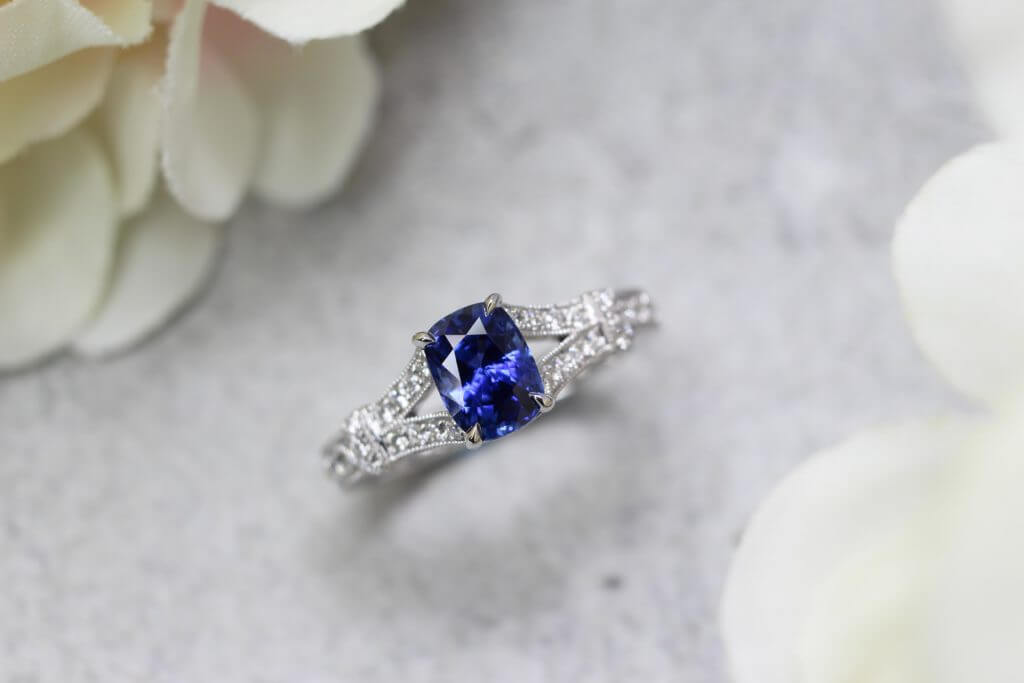
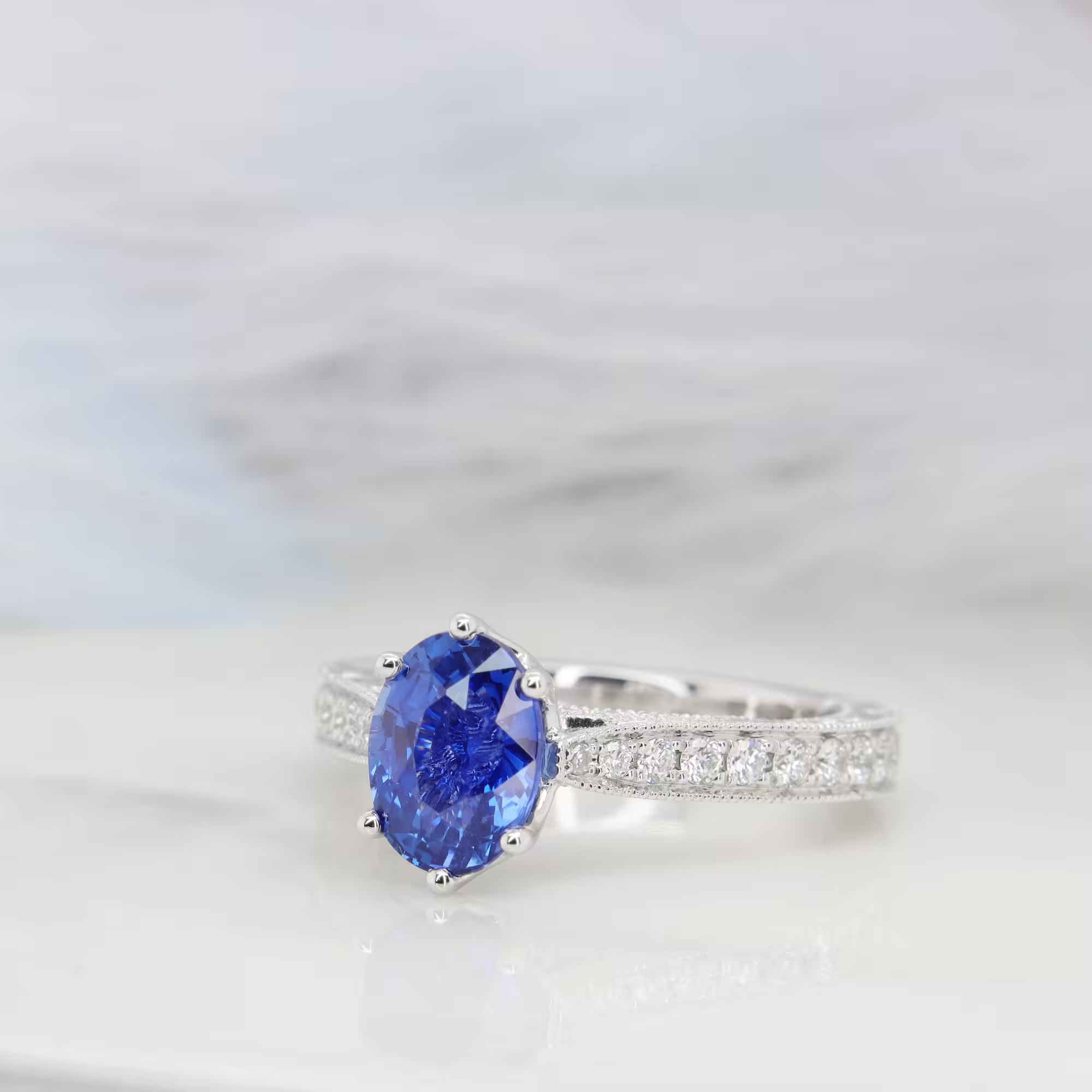
Milgrain. A fine beaded detail along the edges of the band, usually created by machine-rolling tiny indents into the metal and then setting even tinier diamonds or leaving the metal bare. The name comes from “mille” (thousand) and “grain,” since it looks like a thousand tiny grains. The cornflower blue sapphire below shows it clearly along the pavé shoulders. That fine beaded edge gives a ring an art deco sensibility and reads as considerably more intricate than a polished band, but without the visual weight of pavé alone.
Baguette Side Stones. Thin, rectangular diamonds set vertically along the band, typically flanking the centre setting. These are less common now but create a very graphic, geometric look.
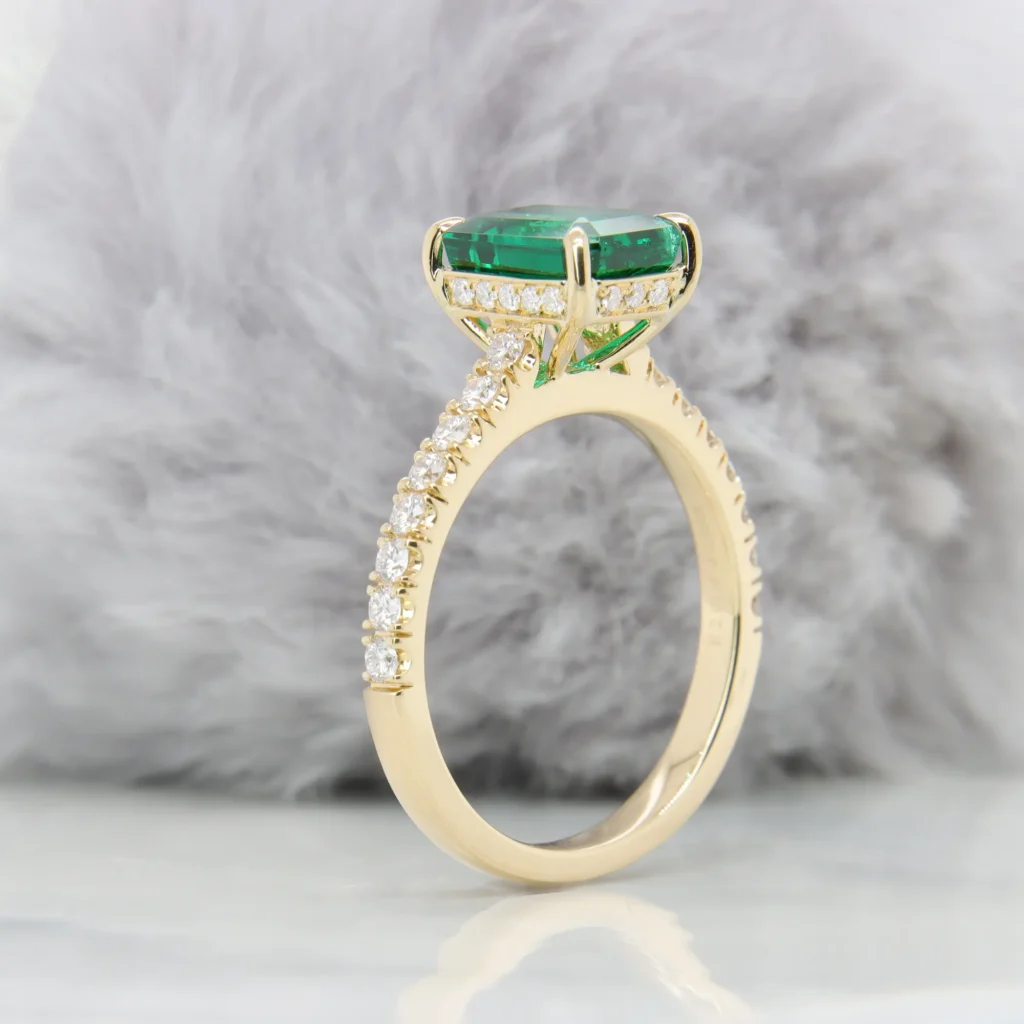
Horizontal Hidden Halo. A row of tiny diamonds set flat beneath the centre stone’s girdle, positioned so they stay out of sight when you look straight down at the ring. From above, the emerald below reads clean and uninterrupted, almost solitaire-like. Tilt your hand even slightly and the hidden halo catches the light along the side profile, adding a layer of brilliance that a regular halo would announce from the first glance instead of revealing gradually. It’s a detail designed as much for the wearer as for anyone admiring the ring, a bit of sparkle that’s yours to discover every time you turn your hand.
Why couples add side details
- Visual continuity. A pavé or milgrain band creates visual flow from the centre setting down the band, so the entire ring reads as one cohesive piece rather than a stone on a plain band.
- Sparkle preference. If you love that sparkly, high-shine aesthetic, pavé and milgrain deliver it throughout the entire ring, not just in the centre.
- Vintage reference. Milgrain especially references historical jewellery and appeals to couples drawn to vintage aesthetics without actually wearing a vintage piece, which carries its own durability risks.
- Craft signal. Pavé and milgrain are technically demanding techniques, and visible pavé or milgrain signals that the ring was made with intention and skill, not mass produced.
- Dual-angle character. A hidden halo reads differently depending on the angle. Clean and understated from above, more brilliant the moment the hand tilts. It’s a detail that rewards a closer look rather than announcing itself immediately.
The trade-off: pavé requires maintenance. Diamonds can loosen, and the shared-metal setting means a loose diamond can sometimes go unnoticed until it’s actually lost. Milgrain is more durable but can wear down over time if the ring is worn daily and lives an active life. If you prefer low-maintenance, a plain polished band is more forgiving.
Prong Count and Craft: Why the Number Matters
The prongs are the metal fingers holding your centre stone in place. The number of prongs affects both how secure the stone is and how much of the stone remains visible.
Three Prongs. Minimal metal around the stone, maximum visibility of the gemstone itself. The stone is held by three metal points, which creates a visual illusion that the stone is almost floating. Modern, minimalist, graphic. A well-made three-prong setting can hold a stone securely, but there is less margin: if one prong is knocked or worn, less is left holding the stone. Prong thickness, exact placement, and how precisely each one grips the stone all come down to experienced craftsmanship, which is why this style rewards working with a setter who genuinely knows what they’re doing.
Certain shapes suit it particularly well too. A pear or heart shaped stone can start to look cluttered once you add a fourth or sixth prong around its points and curves, so three carefully placed prongs often reads cleaner and more intentional than more would on that same outline.
Four Prongs. The classic balance point. Four prongs provide solid security while leaving significant gemstone visible. Most solitaires default to four prongs, and for good reason. It’s both practical and aesthetically neutral, and it’s the dominant choice across our own commissions for exactly that reason.
Six Prongs. The most secure choice, often used for round stones. The stone is held at more points, so it stays in place even if one prong is damaged. Six prongs also create a slightly more ornate, intentional look. The metal becomes more visible, which some people love and others find visually heavy.
Why the number matters
- Security. This comes down to craftsmanship as much as prong count. Six prongs hold the stone at the most points, so they suit active wear or anyone who wants the most security. Four is a practical balance for everyday wear. Three can be secure with experienced setting work, but it leaves the least room for error.
- Aesthetic. Three prongs look modern and minimal. Four is neutral. Six reads as more formal or ornate.
- Gemstone visibility. Fewer prongs mean more stone visible. More prongs mean more metal visible. If you’ve chosen an exceptional stone, fewer prongs let it shine.
Aesthetic Overlay: Sleek Modern, Vintage, Flora
Beyond the structural choices (solitaire, halo, trilogy, cluster), there’s a stylistic layer that determines the overall feeling of the ring. This is about era-inspired aesthetic and design philosophy, not about the setting type itself.
Sleek Modern (Contemporary). Clean lines, minimal ornamentation, high polish or matte finish, often with modern alloys or white metals. Sleek modern appeals to couples who want their ring to feel current and refined rather than tied to any historical period, with a slim band and balanced proportions and no visual excess.
Vintage (Art Deco, Art Nouveau, Victorian, Edwardian). Ornate detailing, often with milgrain or filigree, softer proportions, often in warmer metals like rose gold or champagne gold. A fine beaded milgrain edge and a reference to 1920s to 1940s design language creates a romantic, collected-over-time feeling rather than a just-designed feeling.
Flora or Botanical. Leaf, petal, vine, or flower motifs integrated into the band or setting itself, often in mixed metals, often asymmetrical. This aesthetic appeals to couples who want nature references in their jewellery without choosing a shape that’s explicitly floral, like a lotus-cut centre stone.
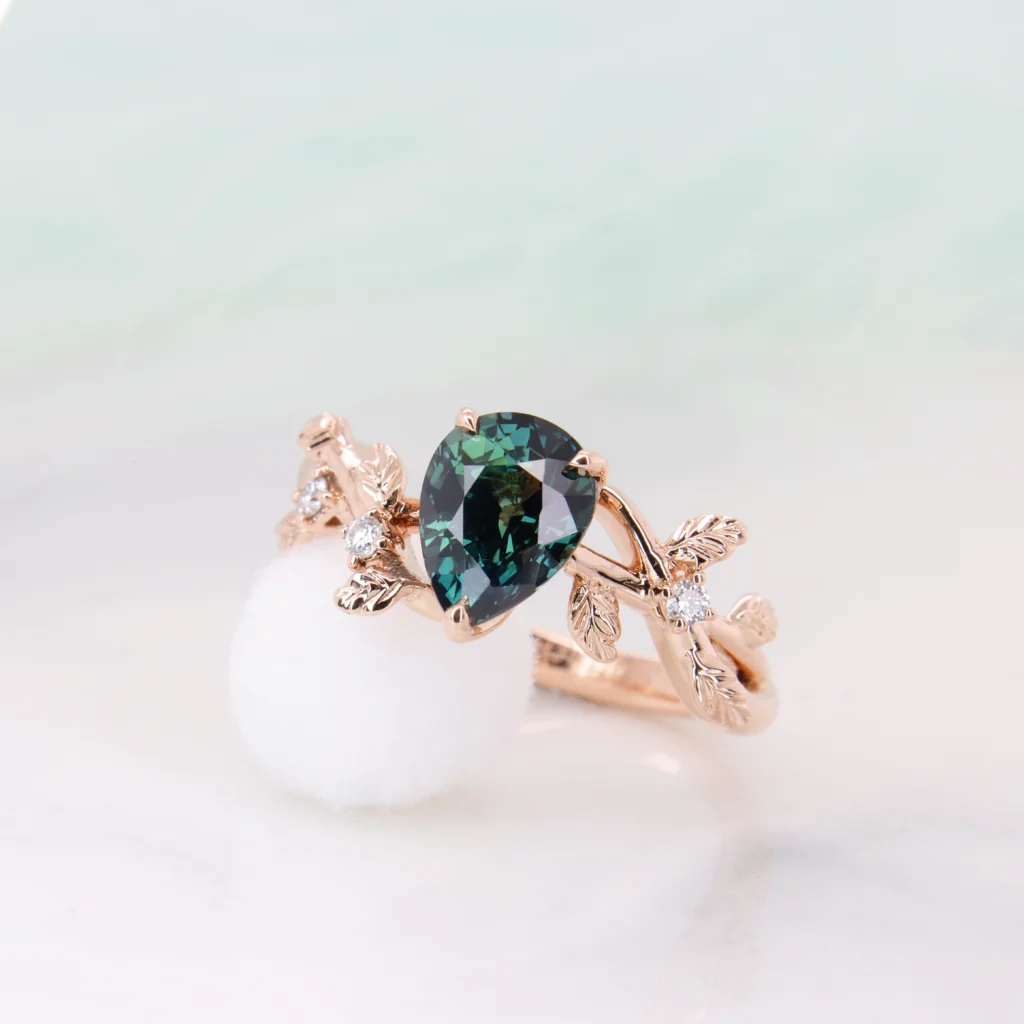
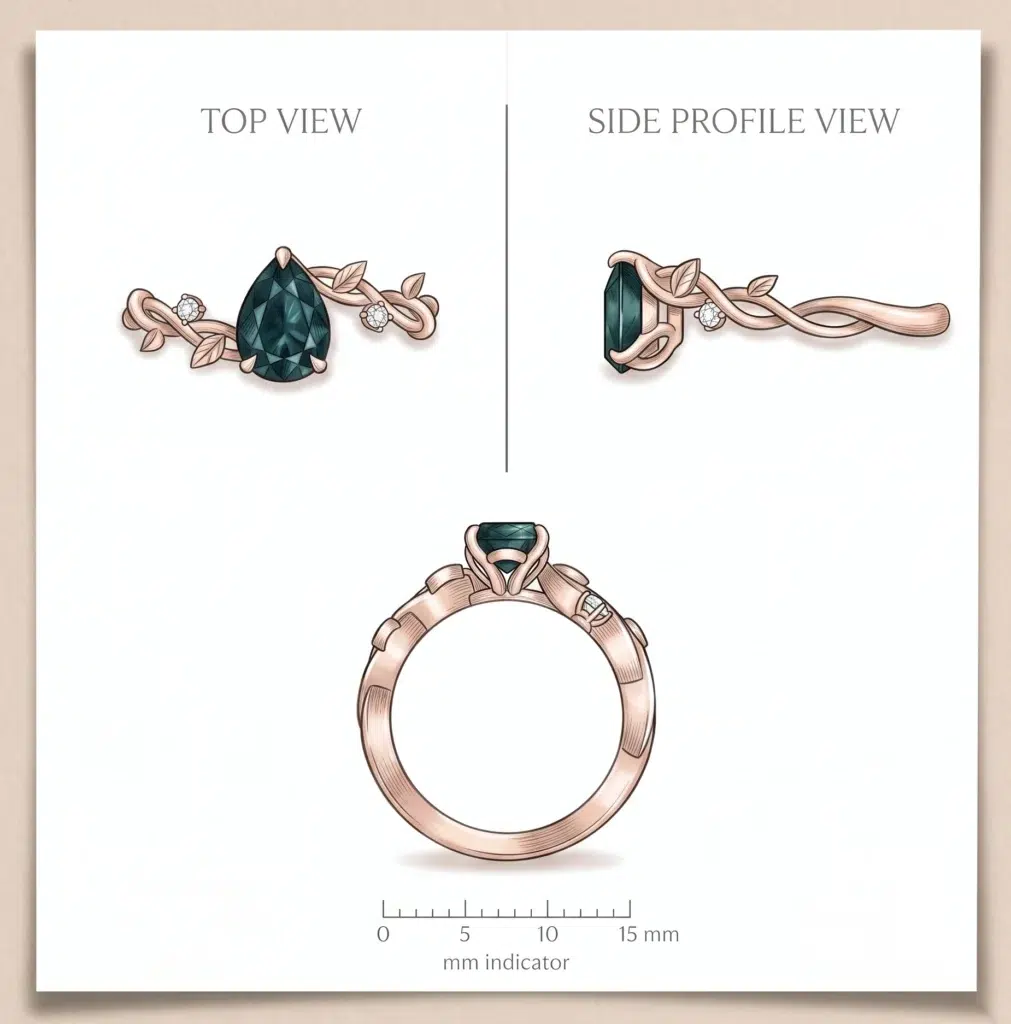
The teal sapphire above shows what this aesthetic looks like fully realised. The band itself becomes a branch, with individual leaves and small diamond buds growing along the shank and up around the centre stone’s claws, rather than a botanical motif simply stamped or engraved onto an otherwise plain setting.
Advantages of a Floral or Botanical Design
- True uniqueness. Because the leaves, vines, and branch lines are hand-formed rather than stamped from a mould, no two botanical settings turn out identical. Each one carries small, natural irregularities in how the vines intertwine, the same way no two real branches grow the same way.
- Distinctive silhouette. A botanical setting reads as sculptural and intentional from across a room, not just up close, since the asymmetry and organic line work is visible even in the ring’s overall outline.
- Pairs naturally with coloured gemstones. Green, teal, and earthy stone tones feel especially at home in a botanical setting, reinforcing the nature reference rather than competing with it.
Disadvantages of a Floral or Botanical Design
- Snagging and discomfort risk if poorly proportioned. Leaf and vine details that extend down toward the base of the finger or between adjacent fingers can catch on clothing or gloves, and if the metalwork isn’t shaped and filed correctly for how you actually hold your hand, those same details can feel uncomfortable against neighbouring fingers during daily wear. This is a design detail that needs to be fitted in person, not chosen from a photo alone.
- More delicate than a plain band. Fine leaf and vine work is thinner in places than a standard shank, so it needs a bit more care than a simple polished band, similar to milgrain or filigree detailing.
Your structural choice (solitaire, halo, trilogy, cluster) determines the mechanics and durability profile. Your aesthetic choice (sleek, vintage, flora) determines how the ring feels and whether you’ll still love it in ten years. The aesthetic preference is sometimes more important than the structural choice.
Metal Pairing: White Gold, Rose Gold, and the Feeling They Create
The metal you choose affects both how the gemstone reads and the overall era and mood of the ring. This isn’t trivial.
White Gold. Creates contrast and makes coloured gemstones appear more saturated. A sapphire in white gold reads more intensely blue than the same sapphire in rose gold. White gold also reads more contemporary and formal, which is why the majority of our commissions default to it. It lets the gemstone be the star without the warmth of rose or yellow gold competing for attention.
Rose Gold. Warmer, more romantic, more forgiving of less-saturated stone colours, because the warmth of the metal complements gentler colours. A pink or coral tourmaline in rose gold reads softer and more integrated than the same stone in white gold. Rose gold also signals a different era. It’s associated with vintage aesthetics even though it’s been hugely popular in contemporary jewellery for the past decade.
Yellow Gold. Warm, traditional, classic. Yellow gold never goes out of style but does feel more formal and traditional than white or rose. It’s becoming less common in contemporary engagement rings, which is partly aesthetic trend and partly practical, since yellow gold is softer and shows wear more visibly than white.
Mixed Metals. White and rose gold in one ring, or white and yellow, creates visual complexity and allows different metal effects on different parts of the ring. This is more niche but can be striking.
The gemstone’s colour interacts with the metal’s colour. A blue gemstone in white gold feels cool and intense. The same blue in rose gold feels softer and more romantic. Neither is objectively better, but they create different moods, and your choice should align with what mood you want to carry every day.
Design and Daily Life: Durability Per Style
Here’s something no one tells you: the most beautiful design for your lifestyle might not be the most beautiful design you see in pictures. Daily wear durability is a design choice, and it starts with the gemstone itself. Different stones sit at very different points on the hardness scale, which is worth understanding before you fall in love with a specific design. If you have not settled on a centre stone yet, our guide to choosing between a gemstone and a diamond works through that decision first.
Lowest Maintenance. A solitaire or trilogy with four prongs, no pavé or side diamonds, on a thick band in white gold or platinum. This design has maximum durability because there’s minimal intricate metalwork, no small stones to loosen, and nothing delicate to catch on fabric. If you have an active lifestyle (gym, gardening, sports, work with your hands), this is the structural category to stay in.
Medium Maintenance. A halo, a pavé band, or a cluster (multiple stones mean multiple potential loose-stone points). These designs are entirely durable enough for daily wear. The one thing worth knowing is that with more stones set close together, there’s a slightly higher chance that one day a stone feels loose or catches differently than usual. That’s not a fault, and there’s no maintenance schedule to keep to, just pay attention to how the ring feels, and bring it in whenever something seems off so we can take a look.
Lower Tolerance for Active Life. Designs with fine filigree, milgrain detail, very thin bands, or very delicate side stone settings. These are beautiful and often vintage-inspired, but they require careful wear. If you’re going to wear your ring to the gym, while washing dishes with your hands submerged, or while gardening in soil, fine-detail designs will wear and potentially fail. That’s not a design flaw. It’s just reality.
Choose a design structure that aligns with how you actually live, not how you imagine living. If you think you’ll wear your ring to the gym but never actually do, ignore this section. If you actually do live actively, pick a design that tolerates it. A cluster in a delicate filigree setting is beautiful, but if you’re going to be frustrated by loose stones and repairs within two years, it’s the wrong choice.
Making Your Choice: A Framework for Decision
You’ve now seen every major structural category, every aesthetic overlay, and every durability consideration. How do you actually decide?
Start with lifestyle, not aesthetics. The most common regret people have about engagement rings isn’t “I wish I’d chosen a different style.” It’s “I wish I’d chosen a design that tolerated how I actually live.” Be honest about your life. Do you work with your hands? Do you exercise in your ring? Do you wear jewellery to bed? Do you garden or cook daily? Your answers should narrow your structural options before you fall in love with an aesthetic.
Then choose stone count. Do you want one exceptional gemstone (solitaire) or multiple stones creating a narrative (trilogy, cluster)? This is emotional and symbolic more than practical. Think about what speaks to you.
Then choose aesthetic. Sleek and contemporary? Romantic and vintage? Nature-inspired? This determines the era and mood.
Then choose metal. What colour interaction do you want between your gemstone and its setting?
Then choose details. Pavé, milgrain, or plain band? Three prongs or four?
You’ll know you’ve landed on the right design when you can picture yourself wearing it daily for ten years without getting tired of it. Not the version of it in photographs. The actual version of it, doing dishes, going to work, hiking on a Sunday. Can you see it? If yes, you’ve found your design.
Explore Your Gemstone Options
Now that you understand design structures, the next step is choosing which gemstone will live in your chosen setting. Sapphires, rubies, emeralds, and paraiba tourmalines each have different durability profiles, colour saturation capabilities and price ranges.
Learn about gemstone engagement rings to explore your options by stone type, or dive deep into specific gemstones:
- Sapphire engagement rings, the most durable coloured gemstone choice
- Ruby engagement rings, for couples who want warmth and intensity
- Emerald engagement and proposal rings, for those drawn to green and willing to accept its delicacy
- Paraiba tourmaline engagement rings, for couples seeking something genuinely rare
Ready to Design?
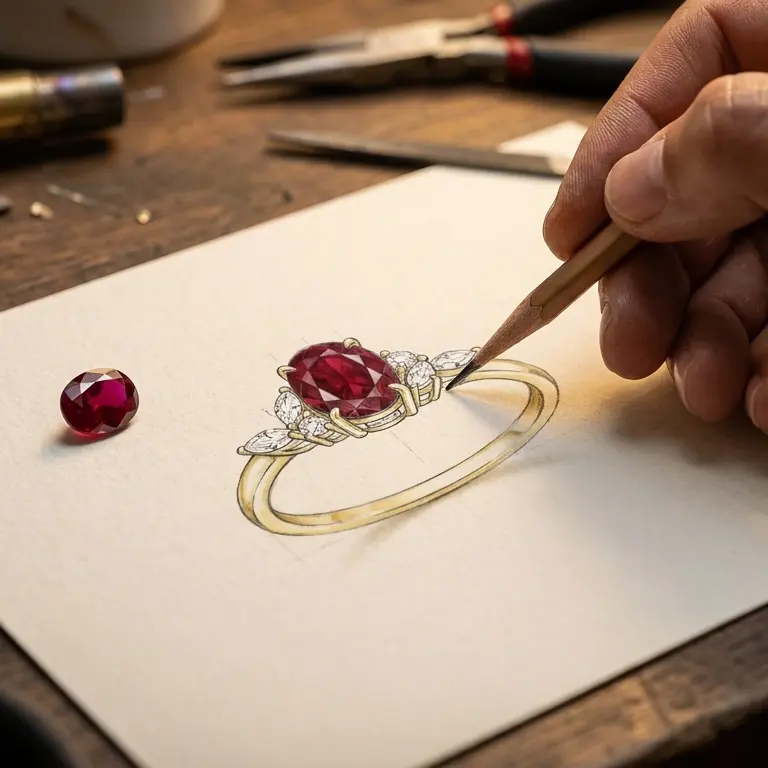
Once you’ve settled on your design style and gemstone preference, the next step is customising your engagement ring. This is where your design vision meets a jeweller who can actually execute it. Where you decide on metal, confirm proportions, choose your specific gemstone, and set the timeline.
The design research you’ve done here forms the foundation for that conversation. You’ll know what questions to ask, what matters to you, and what trade-offs you’re making. That clarity is worth more than any single design choice.
Frequently Asked Questions
How do I know if a design will work with my hands?
The best test is to try on similar designs in person. If you don’t have access to comparison rings, ask a jeweller to show you examples of the prong count, side-stone arrangement, or band detail you’re considering. How it feels on your hand matters more than how it looks in pictures.
Is a halo worth the maintenance commitment?
That depends on whether you’re actually willing to maintain it. If routine professional tightening feels like a chore, a solitaire or trilogy without pavé will give you fewer maintenance headaches. If you’re committed to professional care, halos are worth it for the visual impact they deliver.
Can I change my mind about design after I’ve chosen?
Yes, but not easily or cheaply. The band, the setting, and the prong structure are all integrated. You can’t usually swap a solitaire setting into a halo band, for example. The time to be certain is before you commit, which is why the research you’re doing now is important.
What’s the most durable design?
A solitaire with four prongs, no side details, a thick band, and a robust gemstone (sapphire or ruby rather than emerald or paraiba). It’s also typically the most affordable and the most classic. If durability is your top priority, this is your answer.
Do I need to choose between beauty and durability?
Not entirely, but there are real trade-offs. A cluster is more visually interesting than a solitaire, but a solitaire tolerates daily life better. A halo amplifies your gemstone’s presence, but pavé requires maintenance. Understanding the specific trade-offs your design involves lets you make an intentional choice rather than a surprised discovery two years in.