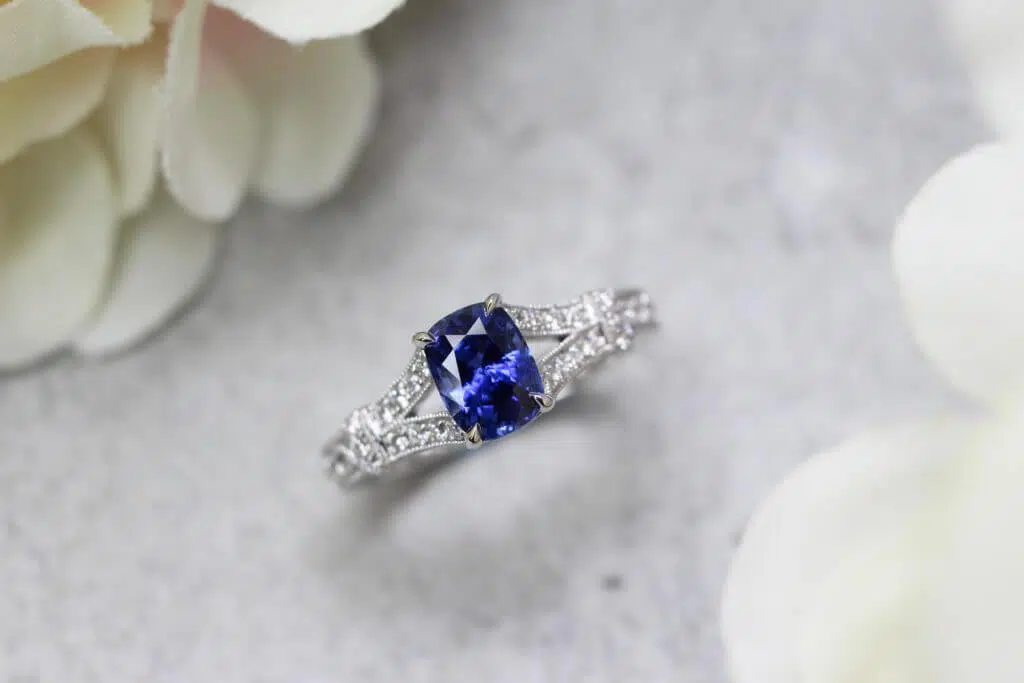
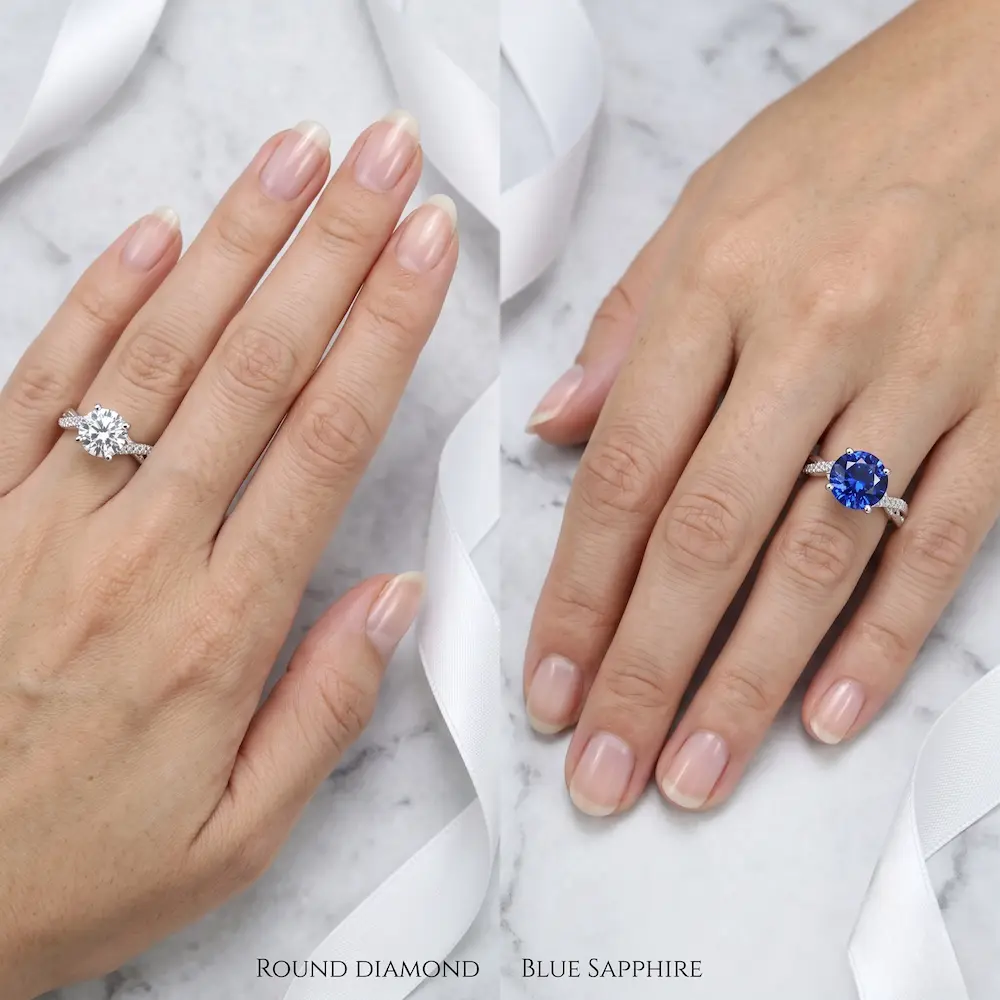
Written by Clarence Yee, co-founder and gemstone specialist at GIOIA.
We get asked this question almost every week in our boutique, usually right after a couple has finished looking through the gemstone collection: “So… would you actually recommend a coloured stone over a diamond?”
Honest answer? This gemstone vs diamond engagement ring decision depends entirely on what you’re optimising for. We rarely make diamond engagement rings at GIOIA Fine Jewellery. That’s a deliberate business decision, not a marketing angle, and we’ll explain exactly why further down, because the reason isn’t “diamonds are bad.” It’s that the diamond market itself has changed underneath everyone’s feet in the last few years.
So let’s go through this properly. Not which one is “better” in the abstract, since that’s a meaningless question, but which one makes sense for you once you understand what you’re comparing.
Table of Contents
Durability: Yes, Diamond Wins the Number. It’s Not the Whole Story.
Everyone knows diamond sits at 10 on the Mohs hardness scale. It’s the hardest natural material there is, full stop, and for a ring you wear every single day, knocking against door frames, gripping shopping bags, all of it, that matters.
Where people get it wrong is assuming every coloured gemstone is somehow “softer” and therefore fragile. That’s not true. Ruby and sapphire are corundum, sitting at 9 on the same scale, one point below diamond, and more than hard enough for daily wear. Cheryl has worked in bespoke jewellery since 2010, and in that time sapphires and rubies have held up well to daily wear. They can still pick up light scratches over the years, but far less readily than softer stones.
Where we do tell clients to slow down is with the softer, more romantic-sounding stones. Tanzanite, for instance, has a gorgeous violet-blue colour and is genuinely one of the most beautiful gemstones there is. It sits at 6 to 7 on the hardness scale, and it can chip or split if knocked at the wrong angle. We still set tanzanite for clients who want it. We just make sure it goes into a protective setting, and we tell them honestly that it’s a “special occasion” stone more than a “gardening on Saturday morning” stone. The same goes for some of the more delicate organic gemstones. Emerald is a slightly different case: decent hardness on paper (7.5 to 8), but most emeralds carry natural inclusions and fractures, which is why they are routinely oiled, and those fractures make the stone less tough in practice than the number suggests. None of this means “don’t buy it.” It means set it properly, by someone who really knows the stone, which is exactly what our workshop does all day.
The 4Cs Were Built for Diamonds. Gemstones Play a Different Game Entirely.
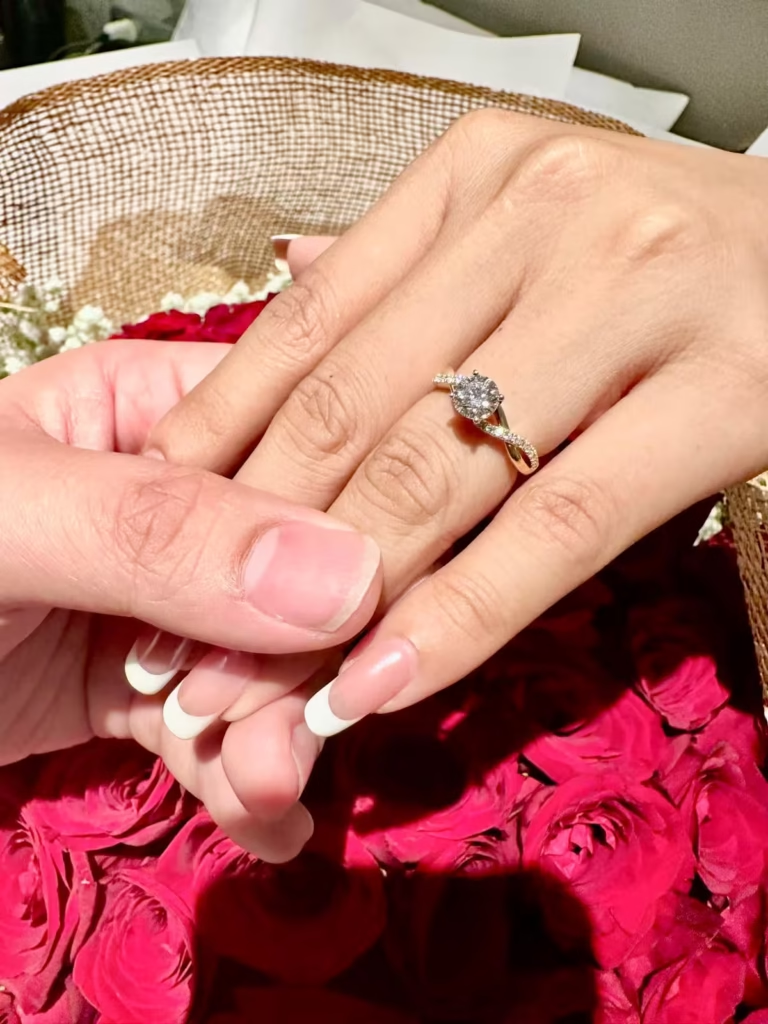
Every diamond buyer eventually learns the 4Cs, as defined by the GIA: Carat, Cut, Clarity, Colour. It’s a tidy framework, and it works because diamond is graded against a single benchmark: colourless and “flawless” is the ideal, and everything is measured as a deviation from that.
Coloured gemstones don’t work like that, and this trips people up constantly. At GIOIA we grade gemstones on six factors: Rarity, Colour, Origin, Enhancement, Clarity, Cut (you can read the full breakdown on our gemstone guide). The honest truth is that a technically “excellent” semi-precious stone, even with great cut and clarity, will never touch the value of a genuinely fine, unheated ruby or an exceptional Brazilian Paraiba tourmaline. Rarity and origin do more heavy lifting in a gemstone’s value than any single grading number does. A well-cut amethyst with perfect clarity is still an amethyst. A ruby with a couple of natural inclusions and the right “pigeon blood” colour from the right origin will still outprice it many times over.
This is the part people find counterintuitive: with diamonds, the grading report basically is the value. With gemstones, the grading report is one input among several. Colour and rarity usually matter more in any gemstone vs diamond engagement ring comparison.
Value and Resale: This Is Where the Story Actually Gets Interesting
Here’s the part we think every couple shopping for a ring in 2026 deserves to know, and it’s the actual reason diamond centre stones are not our focus.
Lab-grown diamonds hit the retail market hard from around 2018 onward, and the effect on price has been brutal: not a gentle correction, closer to a market collapse. Wholesale prices for lab-grown diamonds are down about 96% since July 2018, according to the price index kept by diamond industry analyst Edahn Golan. On his figures, a one-carat lab-grown stone that traded at about US$1,800 a carat in mid-2018 was about US$80 a carat by mid-2026. That’s not a typo, and it’s not a fringe opinion. Once something can be manufactured to order in a factory, the laws of scarcity simply stop applying to it, and diamond as a category is still working out what that means for both lab-grown and natural stones sold alongside them.
Rare coloured gemstones are the opposite story. Synthetic rubies and sapphires have been made for more than a century, but a gemmological laboratory can tell them from natural stones, so they have never taken the place of the real thing. The supply of fine natural stones is set by nature, not by a factory schedule. In our experience, fine stones that are truly scarce, not just “marketed as rare”, have held their value well, though nobody can promise future prices.
We’ll add one important caveat, because we’ve watched this go wrong for other gems: rarity claims only hold up when they’re real. A few years back, we saw Tanzanian cobalt blue spinel pushed to US$10,000 to 15,000 a carat, and prices have dropped significantly since. We’ve written about that on our gemstone page too. The lesson isn’t “avoid coloured gemstones,” it’s “buy from someone who tells you the truth about what’s actually rare versus what’s being marketed as rare.” That’s the whole reason independent certification (GRS, GIA, NGI) matters as much for a gemstone of SGD 5,000 as it does for one of SGD 50,000.
Perception vs. Reality: Why Coloured Gemstones Don’t Look Cheap
We’ll be direct: this is the single most common worry we hear, and it’s almost always from someone who hasn’t seen a fine coloured gemstone in person yet.
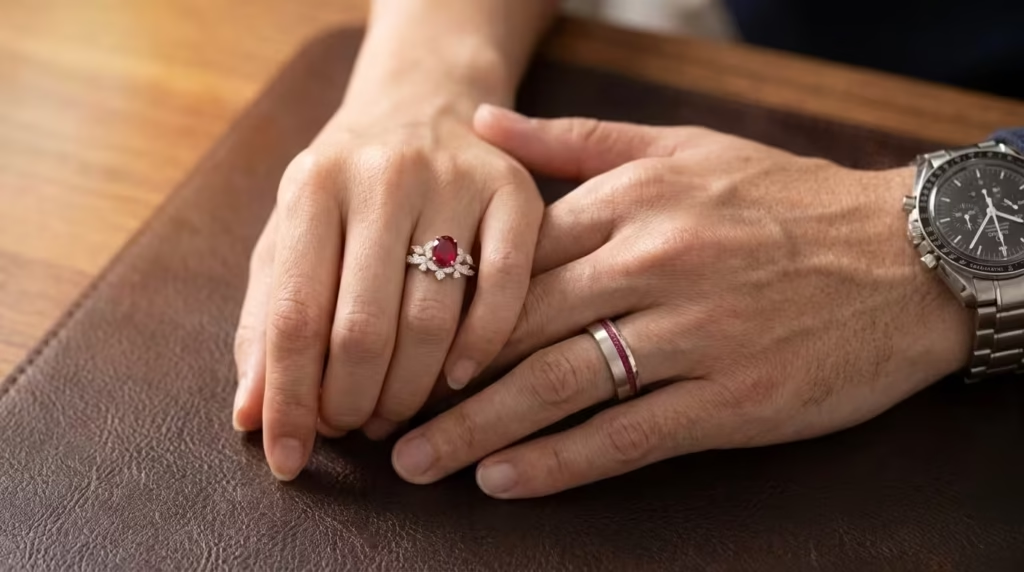
A diamond’s appeal is brilliance: light bouncing straight back at you, colourless, classic. That’s real, and for some people that clean sparkle is exactly what they want, no argument there. But a fine coloured gemstone works on a completely different register: depth of hue, saturation, the way the colour shifts slightly as it catches light. It’s not “trying to be a diamond and falling short.” It’s a different kind of beautiful entirely, and on a good stone, it comes across as deliberate and rare, not cheap.
We had a client come back into our boutique last year for a routine cleaning on her padparadscha sapphire ring. She’d had it a couple of years by then, and she mentioned, almost as an aside, that she still gets stopped and complimented on it more than she ever did wearing diamonds before. That colour simply doesn’t exist anywhere else. Nobody mistakes it for “the affordable option.” They ask what it is.
Ethical Sourcing: Not Just a Diamond Problem, Not Just a Gemstone Problem
Diamonds carry the well-known “blood diamond” history, which is real and part of why the Kimberley Process exists and why lab-grown diamonds appealed to a lot of ethically-minded buyers in the first place. Fair point, and fair concern.
What doesn’t get said enough: coloured gemstone mining has had its own responsible-sourcing questions too, particularly around artisanal mining conditions in some regions. The straightforward, current answer for both categories is the same: buy through established channels. On the coloured gemstone side, much of the fine ruby and emerald on the market today starts as rough sold at the auctions of licensed mining companies such as Gemfields and Fura Gems. Our rubies come through trade partners who buy rough at these auctions, and our sapphires through partners in Sri Lanka we have worked with for over ten years. It’s not a diamond problem or a gemstone problem. It’s an “ask where your stone came from” problem, and that applies whichever category you’re buying into.
Setting Considerations: Where Craftsmanship Actually Matters
One place diamond’s hardness genuinely earns its keep is in setting flexibility. Because it’s so hard and dimensionally consistent, diamond calibrates beautifully into tight pavé work, delicate claw settings, thin bands: designs that would put more stress on a softer stone.
That doesn’t rule coloured gemstones out of those designs. It just means the setting has to be built around the stone’s specific hardness and cleavage properties, by someone who’s done it before: bezel or halo protection for softer stones, appropriately reinforced prongs for larger centre stones, that sort of judgment call. The engagement ring design styles guide covers how solitaire, halo, bezel and cluster settings each behave with a coloured centre stone. This is exactly where more than fifteen years of experience pays off. We’ve set tanzanite, spinel, and emerald into daily-wear rings plenty of times. It’s just never a “one setting fits every stone” job the way it can be for diamond.
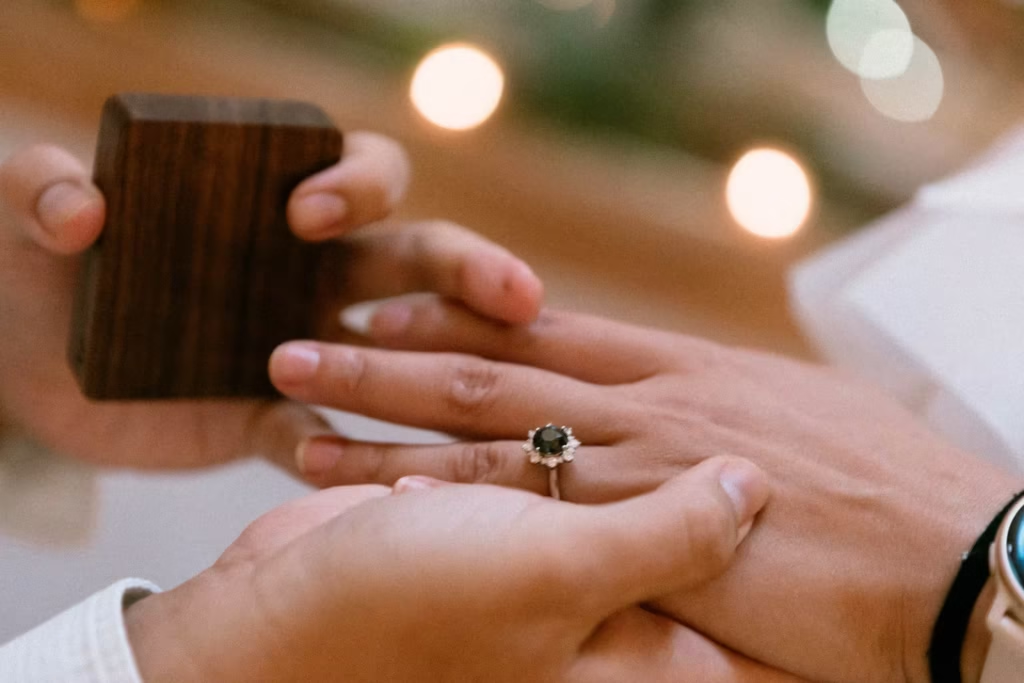
Gemstone vs Diamond Engagement Ring: Making the Final Decision
| Factor | Diamond | Coloured Gemstone |
|---|---|---|
| Hardness (Mohs) | 10, the hardest natural material | 9 for ruby and sapphire, 6 to 8 for softer stones like tanzanite or emerald |
| Price trend, 2018 to 2026 | Lab-grown wholesale prices down about 96% (Edahn Golan index) | Rare, unheated stones have held their value well in our experience |
| Grading system | 4Cs: Carat, Cut, Clarity, Colour | Six factors incl. rarity, origin, enhancement |
| Everyday durability | Excellent for any setting | Excellent for ruby and sapphire. Softer stones need protective settings |
| Ethical sourcing | Kimberley Process | Established channels, such as the Gemfields and Fura auctions |
| Best for | Classic, colourless brilliance | A colour that’s genuinely yours |
If you want maximum hardness, a well-worn cultural script, and a stone whose grading is entirely spelled out on a report, diamond still does that job, and there’s nothing wrong with wanting it.
If you want a piece where the colour is genuinely yours, where rarity is doing real work rather than marketing, and where you’re not buying into a category that’s currently in the middle of a historic price correction, that’s the coloured gemstone conversation, and it’s the one we have with most of our clients at GIOIA. If that’s the direction you’re leaning, our gemstone engagement ring collection is a good next stop.
And if your partner already has their heart set on a diamond, that’s completely fine too. This isn’t about talking anyone out of what they want. It’s simply about making sure the choice is an informed one.
Either way, come sit down with us and hold a few stones under natural light before you decide anything. That’s the one part of this decision no article, including this one, can make for you.
Frequently Asked Questions
Is a gemstone engagement ring a good idea, or should I stick with diamond?
Both are legitimate choices. Diamond offers maximum hardness and a familiar grading system. A fine natural coloured gemstone offers genuine rarity and a colour that’s entirely yours.
Which coloured gemstones are safest for daily wear?
Ruby and sapphire (corundum) sit at 9 on the Mohs scale, just below diamond, and hold up extremely well to daily wear. Softer stones like tanzanite or fine emerald can still be worn daily, but need a protective setting and a bit more care.
Will a coloured gemstone engagement ring hold its value?
In our experience, fine, unheated, rare gemstones have held their value well, because supply is set by nature rather than manufacturing. Common or heavily treated stones do not carry the same long-term value. Nobody can guarantee future prices, which is why we suggest choosing the stone you want to see on your hand every day.
Does GIOIA sell diamond engagement rings?
Rarely. We have made one on request, but we deliberately focus on natural coloured gemstones. We choose every centre stone ourselves, and centre stones above about SGD 1,000, which covers almost every engagement ring, come with a report from an independent laboratory. We’ll walk you through why a coloured gemstone might suit your engagement ring better than diamond.
Have questions about choosing between a diamond or a coloured gemstone for your engagement ring? Get in touch with our team, or read more about our customised engagement ring process and our natural gemstone collection.