
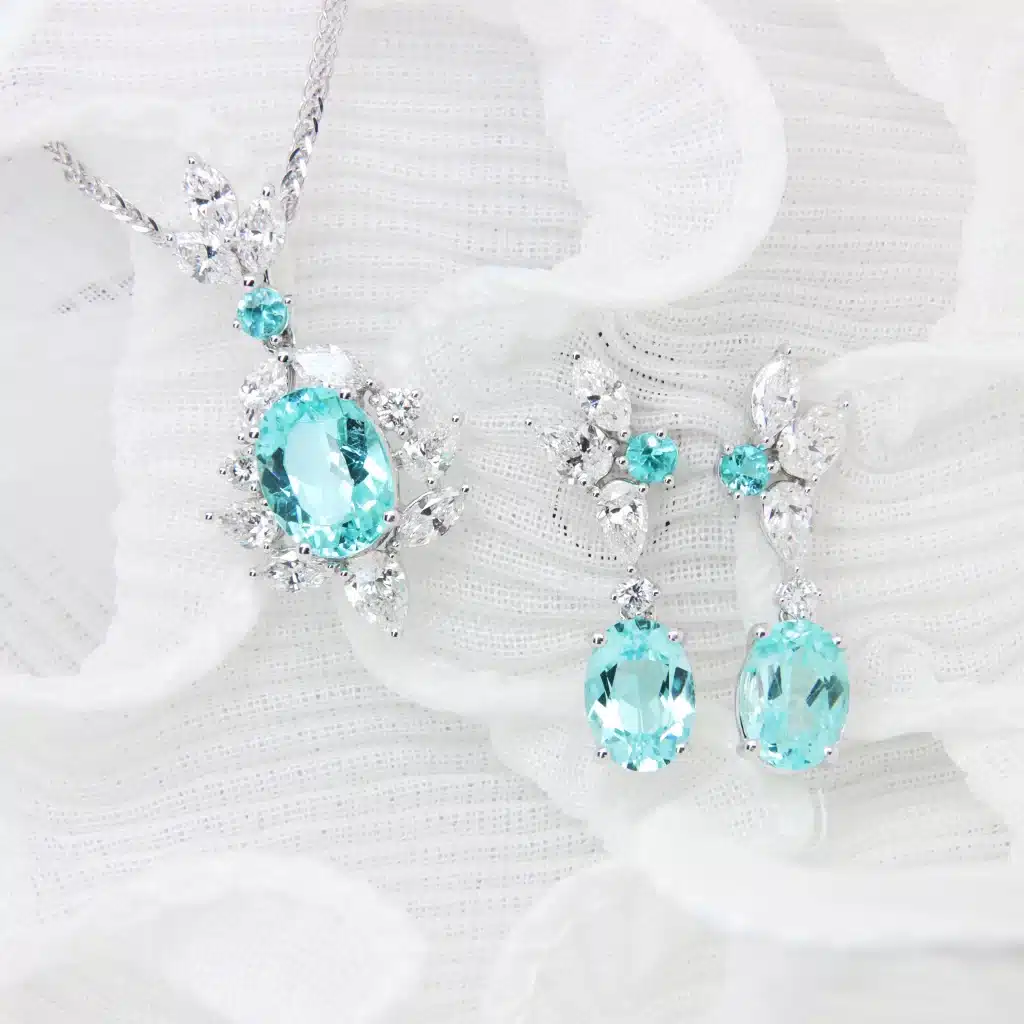
The Neon Glow: What is Paraiba Tourmaline?
Paraiba tourmaline is a rare, copper-bearing tourmaline known for its intense neon blue to green colour. It was first found in the Brazilian state of Paraíba in the late 1980s, then in Nigeria and Mozambique in the early 2000s, and in 2026 Ethiopia was confirmed as a fourth source. Gem-quality material is so scarce that a fine Paraiba can cost more per carat than a diamond, and it is often chosen as the centre stone for a Paraiba tourmaline engagement ring.
Gemmologists class most Paraiba as cuprian elbaite, with copper giving the blue and green. At GIOIA in Singapore we keep loose Paraiba in stock and set them into bespoke rings, pendants and earrings.
Last updated 19 October 2026. Reviewed by Clarence Yee, gemstone specialist and co-founder of GIOIA Fine Jewellery, who chooses and checks every Paraiba tourmaline we set.
Complete Guide to Paraiba Tourmaline Jewellery
Origins: Brazil, Mozambique, Nigeria and Ethiopia
The electrifying vibrance of a true Paraiba tourmaline is dictated by a highly specific chemical balance of copper (Cu) and manganese (Mn). While standard tourmalines occur in many shades, only those coloured by copper from specific pegmatite veins, first at the Batalha mine in Brazil and later at deposits in Mozambique, Nigeria and now Ethiopia, are classified as Paraiba. The supply of Brazil Paraiba tourmaline rough is critically low, driving prices for gem quality unheated material to between $15,000 and $50,000 USD per carat.
Mozambique material, which often yields larger carat weights with exceptional clarity, follows closely, ranging from $6,000 to $20,000 USD per carat. Every Paraiba we offer is checked by our gemstone specialist Clarence and comes with a report, mainly from GRS or GIA, confirming that it is copper-bearing tourmaline and stating its origin. We only offer Paraiba without clarity enhancement, and the report confirms this. Heating is a different matter. For many Paraiba stones a laboratory cannot tell whether a stone has been heated, so we only describe one as unheated when its report says so.
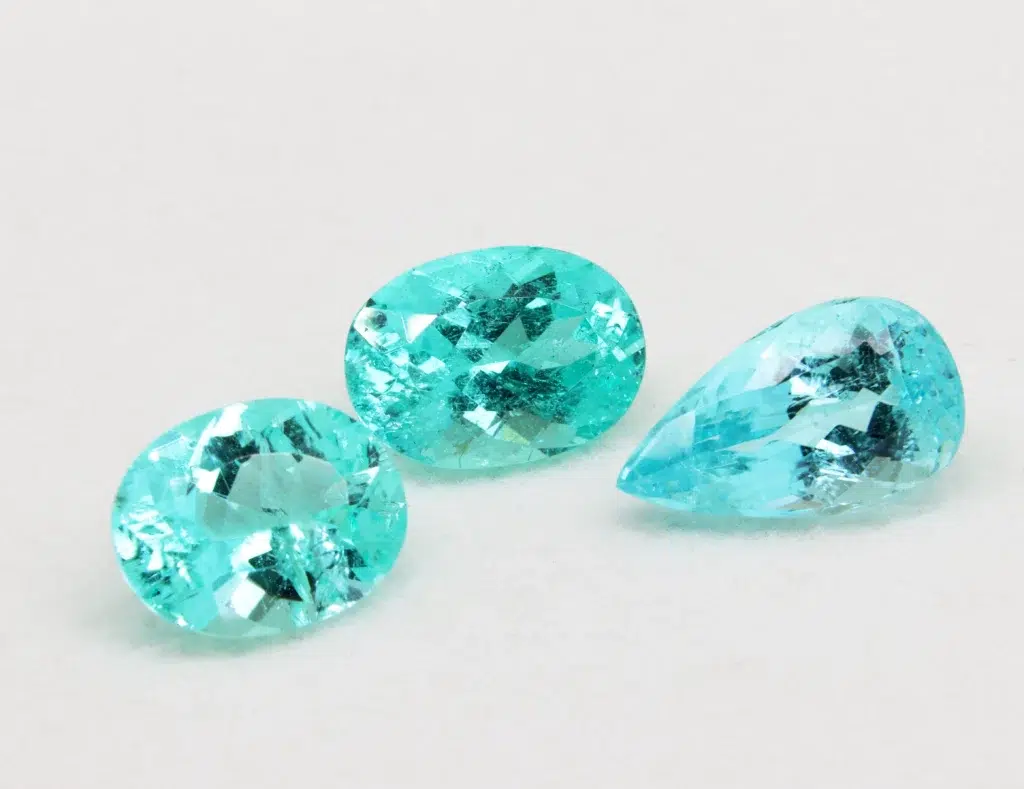
2026 Update: Ethiopia Confirmed as the Fourth Paraiba Tourmaline Origin
On 27 August 2026, GIA and the Gübelin Gem Lab announced together that Ethiopia is a confirmed new source of copper-bearing tourmaline that meets the LMHC definition of Paraiba. The two labs had been investigating separately for months. Gübelin noticed the unusual chemistry first, in stones sent in for reports around early May, and went on to build a reference set of roughly 300 rough and cut stones, some collected in person near the mine. GIA studied a parcel of more than a hundred rough and faceted samples. Ethiopia now sits alongside Brazil, Nigeria and Mozambique as an accepted origin. This replaces the earlier June note from SSEF, which had only been able to say that some stones were coming back “origin inconclusive”.
The Ethiopian material runs from blue and bluish green to violet and purple, with some rough that is close to colourless, and it is common to see colour zoning within a single stone. Where a stone qualifies as Paraiba, copper is doing most of the colour work, while manganese accounts for the violet and purple that heat treatment usually clears. Its trace chemistry helps: unusually high vanadium, along with raised lead and gallium, gives a well-equipped laboratory a useful marker, and Gübelin has said this is enough to separate Ethiopian stones from other origins without research-grade equipment. Even so, the picture is not fully settled. The reference data is still being assembled, and some stones overlap closely with material from other sources, Brazil in particular, and cannot always be told apart cleanly.
The part worth slowing down on is what this means at the buying end. A tourmaline deposit never produces one clean category of stone, and only the copper-dominant material can carry the Paraiba name. From what the trade is reporting so far, a good share of the Ethiopian output is iron-rich blue and green tourmaline, closer to indicolite or to the stones sometimes marketed as “lagoon”. Those can be lovely gems in their own right, but their colour comes from iron rather than copper, so they are not Paraiba and should not be sold or certified as such. The properly copper-bearing, neon stones look to be the smaller part of what is being mined.
Because of that, pricing has not moved the way many people assumed it would. Good Ethiopian rough has been changing hands close to, or above, comparable Mozambique material, partly because it is new and partly because collectors want a stone from the earliest production of a fresh source. A new origin does not automatically pull prices down. For the moment it has done the opposite of bringing certainty, with genuine Paraiba, borderline stones and iron-coloured tourmaline all trading side by side while the market works out what is what. For our own commissions we are staying with the Brazil and Mozambique material we know well, and watching how the Ethiopian supply develops before we source from it.
We have seen this pattern with other stones. Nigerian copper-bearing tourmaline appeared in the early 2000s and Mozambique followed soon after, yet fine Brazilian Paraiba kept climbing in value rather than losing it. Ruby did the same when Mozambique became a major source around 2009 and fine unheated Burmese ruby kept its premium regardless. More origins give buyers more to choose from, but the best material from an established source tends to hold its premium.
There is a real upside here for anyone who cares about the gemstone. Clean Paraiba has always been rare, and much of what reaches the market has been clarity enhanced as a result. If more untreated rough comes through from Ethiopia, collectors should have a wider choice of natural stones, and some of the pressure on prices may ease. That would be a good result both for the gem and for the people buying it.
None of this changes what makes Paraiba worth owning, which is the colour: that vivid, electric blue to green that no other stone quite reaches. Colour, clarity and cut still decide what a fine example is worth, with origin read alongside them. If you are buying one, whether for a collection or to wear, ask for a report from a laboratory whose name carries weight, such as GIA, Gübelin, SSEF or GRS. That was already the sensible approach with Paraiba, and it counts for more while a new origin is still being learned.
Four origins are now recognised for Paraiba tourmaline, and each has its own look and its own price level.
| Origin | Colour and character | Price and availability |
|---|---|---|
| Brazil | Electric, almost blue-white saturation, the benchmark other origins are judged against. Usually small stones. | Roughly US$15,000 to US$50,000 a carat for fine unheated material. The original source. Rough is now close to exhausted. |
| Mozambique | Blue, blue-green and neon green, often in larger and cleaner stones than Brazil produces. | Roughly US$6,000 to US$20,000 a carat. The main supplier since the mid-2000s, though output has fallen and average grade has softened in recent years. |
| Nigeria | Frequently greener or greyer, and more included. | Generally priced below Mozambique. Found in the early 2000s, with small and irregular production ever since. |
| Ethiopia | Blue to bluish green, with violet, purple and colourless rough and strong colour zoning. Only the copper-dominant minority qualifies as Paraiba. | Confirmed as an origin in August 2026. An early, thin market. The best rough is reported to trade at or above Mozambique levels. Laboratory reference data is still being built. |
Rarer Than Diamond
Paraiba tourmalines are found in small, pencil-thin veins. Miners use manual tools like wedges and hammers, avoiding machinery to prevent damaging these delicate crystals. This careful process makes Paraiba tourmaline both valuable and rare, ranking it among the world’s rarest gemstones. These stones often have natural inclusions like crystal and needle-like formations. However, their neon glow and exceptional brilliance make these inclusions acceptable in the gemstone trade.
Coloured gemstones can cost more than diamonds. It might be hard to believe, but it’s true. A fine Brazilian Paraiba, neon-bright blue and clean, can cost more per carat than a diamond of similar size, sometimes several times more. These stones are that rare. An often-quoted trade figure puts it at one Paraiba for every 10,000 diamonds mined in Brazil. The exact ratio is impossible to verify, but it captures how scarce gem-quality rough is.
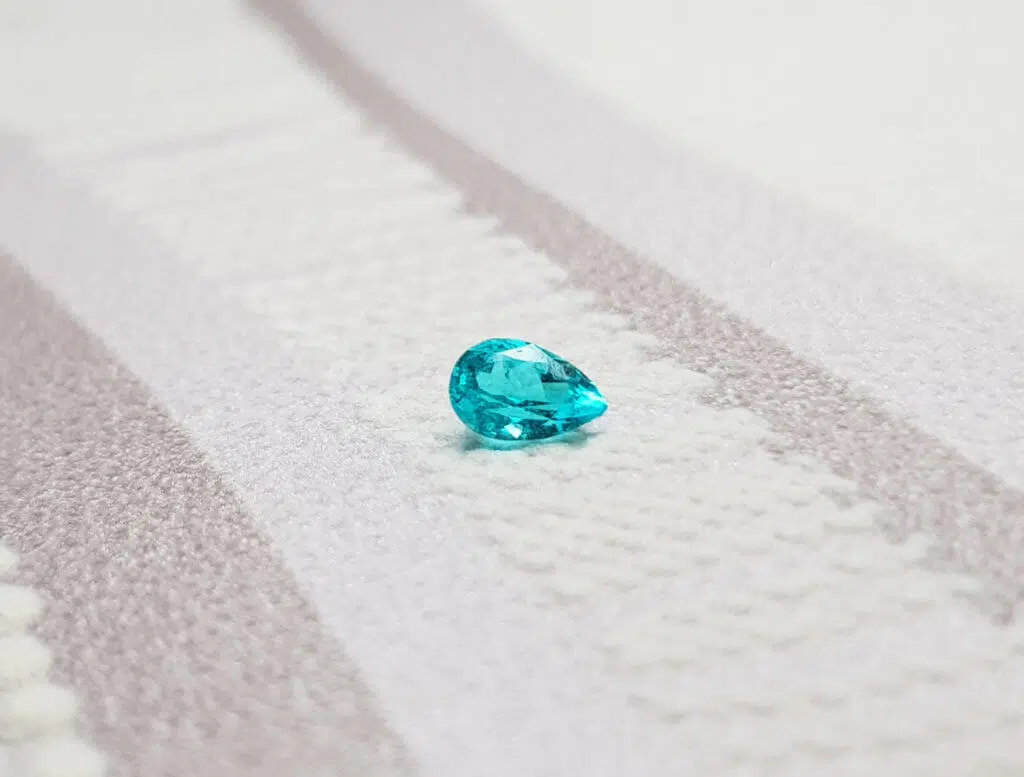
Paraiba Tourmaline Colour: Blue, Green and the Copper Line
What separates a neon Paraiba from the blue-green stones sold as indicolite or under names such as “lagoon” comes down to what is colouring the gem. In a true Paraiba, copper is the source of that vivid, almost lit-from-within glow, whether the stone leans electric blue or luminous green. In an indicolite or a lagoon tourmaline, however pretty, it is iron doing the work, and iron cannot produce the same inner fire. That is the line that matters: a Paraiba is coloured by copper, or it is not a Paraiba. The edge cases, where copper is present but iron still shapes the colour, are exactly why a report from a serious laboratory is worth having.
Within true Paraiba, colour becomes a matter of taste. Some buyers are drawn to the cool, electric blue associated with classic Brazilian material. Others prefer the warmer, neon green that Mozambique so often produces. Neither is more correct, and the difference is best judged by eye, against the light you will actually wear the stone in. This is why we keep Paraiba from both Mozambique and Brazil, so you can compare the two side by side rather than choose from a single parcel.
Colour is also the hardest thing to judge from a screen. No video quite captures the way a Paraiba shifts and lifts as it turns in daylight, so this is a stone worth seeing in person before you decide.
Tourmaline Gemstone Family
Tourmaline, the birthstone for the month of October has a variety of colours. It comes naturally in different shades and hues, determined by the chemical composition. In the world of tourmaline gemstone, different colours have inspired their own trade names:
Chromium-rich: a variety of green to intense green commonly known as Chrome Tourmaline.
Iron-rich: light to dark blue, or greenish blue commonly known as Indicolite Tourmaline.
Magnesium-rich: brown, red, pink, purplish, commonly known as Rubelite Tourmaline.
Copper-rich: neon-blue or green, commonly known as Paraiba Tourmaline.
Bi-coloured and multicolour are common, reflect variation of fluid chemistry during crystallisation.
As compared to the rest of tourmaline, this copper bearing tourmaline has more attractive hues and higher colour saturation, which makes it the most valuable and sought-after tourmaline of its class.
Understanding Enhancements & Treatments
Paraiba tourmalines, distinguished by their vibrant and electrifying colours, are highly prized in the gemstone market. These tourmaline gems are often subjected to enhancements that amplify their natural beauty and market appeal, making them even more desirable to collectors and international fine jewellers.
Heat Treatment
One of the most common forms of enhancement for Paraiba tourmalines is heat treatment. This process is performed to lighten darker shades within the gemstones and alter violet and purple tones to more desirable blues to greenish shades. The effectiveness of this treatment largely depends on the stone’s copper content. Stones with low copper or copper-to-manganese ratios may end up colourless or nearly so after treatment. This technique aims to enhance the stone’s natural neon effect, adding to its striking appearance.
Natural vs Clarity-Enhanced Paraiba Tourmaline
Although Paraiba tourmalines are primarily valued for their colour and rarity, clarity enhancement is in fact common, because clean material is so scarce. The usual method is fracture filling, where resin or a similar filler is worked into surface-reaching fissures to make them less visible, and laser treatment to reach and lighten dark inclusions is also seen. However, it’s important to recognise that stones undergoing clarity treatments typically hold less value than untreated gems of similar quality, as the natural integrity of the stone is compromised.
Major laboratories now note clarity enhancement on Paraiba reports as standard. Unlike emerald, where oiling is expected and graded by degree, a filled Paraiba is simply worth markedly less than a natural one. Where you have the choice, choose a stone that has not been clarity enhanced.
How Paraiba Tourmaline Is Certified
With Paraiba, the certificate is not a formality. It is the proof behind the price. A copper-bearing tourmaline of true neon quality is far rarer than ordinary tourmaline, and the premium it commands rests on two things a laboratory has to be able to verify beyond doubt.
The first is treatment. Filled stones are common in Paraiba, so a report has to state clearly whether a stone is natural or clarity enhanced. Filling is identified under magnification, by the tell-tale flash effect and the flattened bubbles it leaves inside the fissures, and confirmed where needed by infrared (FTIR) spectroscopy, which detects the organic resin itself. The second is identity. Chemical analysis, using ED-XRF for a first reading and LA-ICP-MS for precise trace levels, confirms the stone is genuinely copper-bearing, while UV-Vis spectroscopy shows that copper, with manganese, is what drives its colour rather than iron. Identity decides whether a stone is Paraiba at all, while treatment decides what it is worth. A serious report answers both, plainly and in writing.
This is why the choice of laboratory matters as much as the stone. A respected house such as GIA, Gübelin, SSEF or GRS holds the instruments and the experience to make both calls with confidence. A lesser laboratory, without that equipment, may overlook a filled fracture or wave through an iron-coloured tourmaline as Paraiba, and with a gem of this value that difference is measured in the thousands.
We say this from experience. Over the years we have examined Paraiba tourmalines that arrived with certificates from lesser-known laboratories, papers that looked reassuring at a glance yet made no mention of clarity enhancement, only for our own examination to reveal resin-filled fissures the report had quietly passed over. Sometimes the omission is a matter of equipment, since a laboratory without infrared analysis cannot confirm an organic filler. Sometimes it is a matter of standards. Either way it is the buyer who is left exposed, having paid an untreated price for a treated stone. We now read the name on the certificate as carefully as the gem it describes.
What a Report Protects You From
A full laboratory report is what stands between a buyer and the few ways a Paraiba can be misrepresented.
- A filled stone sold as untreated. The most common issue and the costliest, since an unenhanced stone can be worth several times a treated one of the same size and colour.
- Iron-coloured tourmaline sold as Paraiba. Indicolite, and the blue-green stones marketed as “lagoon”, sit close to the real colour, but iron rather than copper produces it and they do not meet the definition.
- Synthetic material sold as natural. Copper-bearing tourmaline has been grown in laboratories and sells for a small fraction of the natural price. It is chemically the same mineral, so only a report confirms a stone that formed in the ground.
- Glass and other imitations. Blue-green glass and synthetic garnet are sometimes cut to copy the neon look. Easy to identify, but only if the stone is examined.
- Origin overstated. Brazilian Paraiba carries the highest premium, and Mozambique or Nigerian stones are sometimes offered as Brazilian. A standard microscope and basic chemical readings cannot separate the three origins. We have had stones come back from the laboratory with the origin left open, and it takes spectrometry to read the small differences between them. A good report states its origin conclusion, and is just as clear where that conclusion is inconclusive.
Paraiba Tourmaline Jewellery Designs
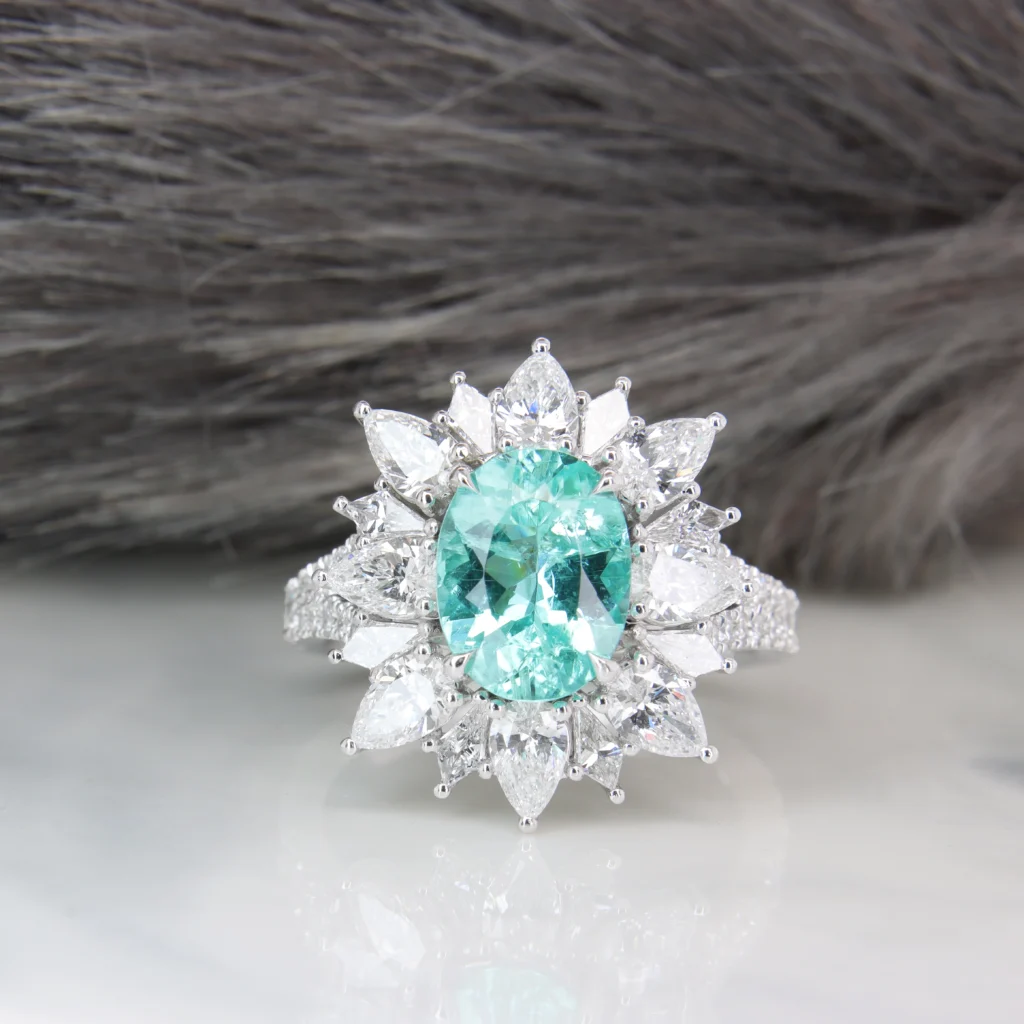
A Neon Paraiba Tourmaline High Jewellery Ring
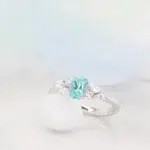
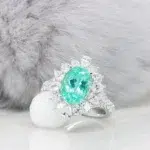
Paraiba stands out in any fine jewellery collection. This is a natural Paraiba tourmaline ring we designed and made. Pear-shaped and other fancy cut diamonds surround the centre stone in a starburst that draws out its neon colour.
The band carries two rows of pavé diamonds, which gives the ring a secure base.
Value and Rarity of Paraiba Tourmaline
Brazil Paraiba tourmaline is the most sought-after of the origins and sells at the highest price per carat, with Mozambique following and Nigerian material behind that. Because clean rough is so scarce, in our experience fine stones have held their value well over time, and demand has consistently run ahead of supply.
At the top end, it is natural, unenhanced material with a report from a recognised laboratory that has held its value best. A clarity-enhanced Paraiba can still be a beautiful thing to wear, but it should be bought, and priced, as what it is.
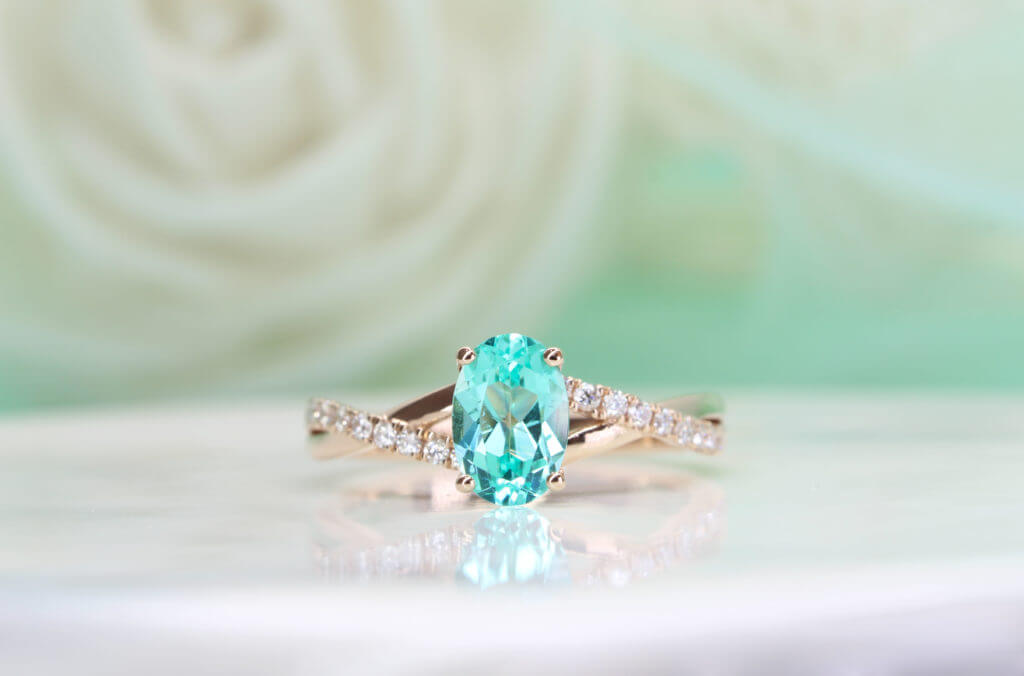
Nonetheless, the bright neon greenish-blue colour of Paraiba tourmaline is becoming more popular, especially because it is so rare. At GIOIA Fine Jewellery you can view loose Paraiba tourmalines at our boutique and judge the balance of blue and green for yourself before choosing one. Book a private viewing appointment with us.
In our experience, fine Paraiba has become harder to find over the years, as mining limits supply and demand keeps growing, and prices have risen with it. No one can promise future prices, though, so we always suggest choosing a Paraiba for the colour you love.
Paraiba Tourmaline Engagement Rings
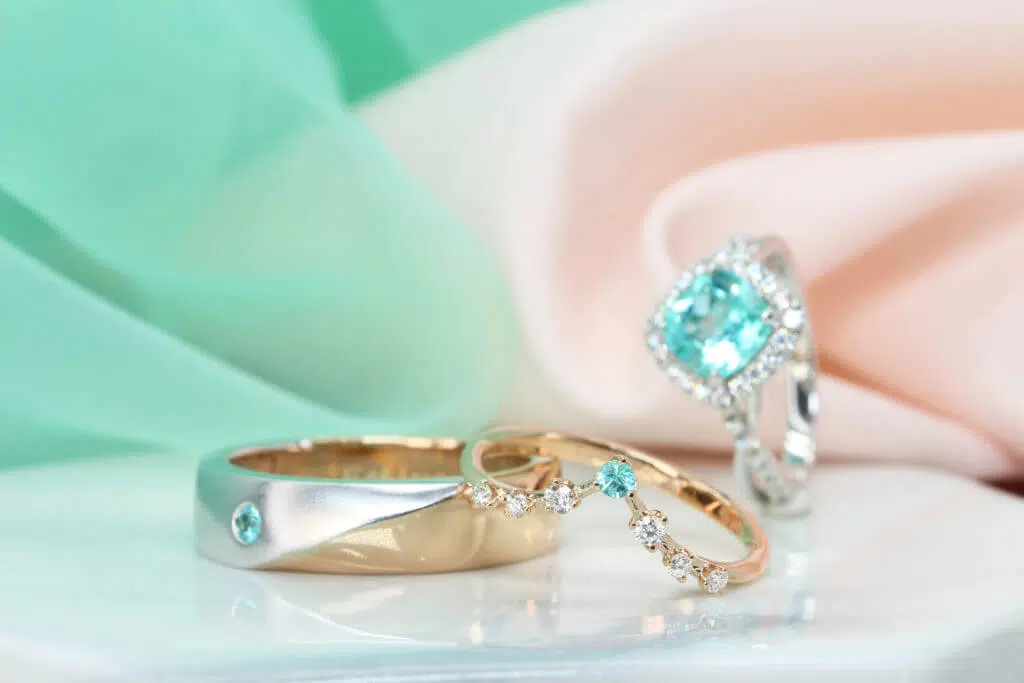
Unique gemstone engagement ring with paraiba tourmaline
Its blue-green, almost neon glow sets Paraiba apart from other gemstones, and it makes a distinctive centre stone for a gemstone engagement ring.
If you are planning a proposal, our gallery of customised Paraiba tourmaline engagement rings shows how we set these stones.
View Our Loose Paraiba Tourmaline Collection in Singapore
We keep a selection of loose Paraiba tourmalines, bought mainly from Mozambique and Brazil through our trade partners, in cuts such as cushion, pear and round brilliant. Sizes run from about 1 carat for a ring to about 3 carats for high jewellery. Fine stones sell quickly, so we show them by private appointment only.
Schedule a private consultation at our International Plaza boutique to view the neon glow of our certified Paraiba Tourmalines in person.

Frequently Asked Questions
Find answers to commonly asked questions about our Paraiba Tourmaline jewellery.
Are there synthetic Paraiba Tourmalines?
Yes, due to the rarity and exceptional beauty of natural Paraiba Tourmaline, synthetic versions have been created. Similar to lab-grown alexandrite, synthetic Paraiba Tourmalines are available in the market. However, they can look quite different from the natural ones. It’s important to have your Paraiba Tourmaline certified by a reputable gemological lab to ensure authenticity and confirm it’s natural.
Is Paraiba Tourmaline a birthstone?
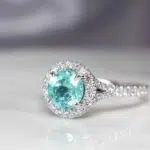
Paraiba Tourmaline is in the family of tourmaline gemstone, therefore it is considered as the birthstone for the month of October. If you are looking for a unique gemstone engagement ring, paraiba tourmaline will certainly add additional personalisation.
Where to buy Paraiba Tourmaline?
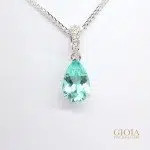
At GIOIA Fine Jewellery in Singapore, by private appointment. We keep Paraiba tourmalines mainly from Mozambique and Brazil, bought through our trade partners, and every stone comes with a laboratory report, mainly from GRS or GIA. Book a viewing to compare them in person.
What to look for when choosing a Paraiba Tourmaline?
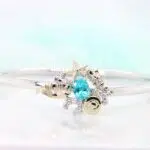
When choosing Paraiba Tourmaline stones, it’s crucial to ensure that the gemstone is properly certified as a genuine Paraiba Tourmaline. Some bluish-green tourmalines can closely resemble the distinctive Paraiba colour but may not be true Paraiba Tourmalines. Always look for certification from reputable labs to confirm the authenticity of the stone. Additionally, focus on factors like colour intensity, transparency, and origin, as these greatly affect the value and beauty of the gemstone.
Why can the prices for Paraiba Tourmaline vary so much?
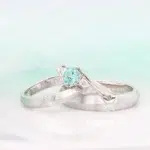
Prices for Paraiba Tourmaline can vary due to factors like colour, clarity, and whether the stone is truly a Paraiba. Clarity enhancements, such as fillers and oiling, can artificially improve appearance, which is why the price may be lower. Additionally, not all tourmaline that resemble Paraiba Tourmaline are authentic. Some may lack the copper and manganese that give Paraiba its distinct colour, affecting their price and classification.
Why is Paraiba Tourmaline so rare?
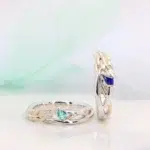
Paraiba Tourmaline mining methods are traditional and labor-intensive, requiring significant manpower. The rough stones are often found in small pockets, making them difficult to access and extract.
What is the best colour for Paraiba Tourmaline?
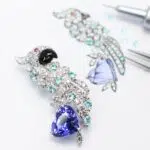
The best colour for a Paraiba Tourmaline strikes a perfect balance between blue and green. Too much blue can make the stone lose its neon vibrancy, while too much green can make it resemble a common green tourmaline. The most valuable Paraiba Tourmaline displays a vivid neon blue to turquoise or electric greenish-blue colour, which is both striking and highly sought after.
Does a Paraiba tourmaline need a certificate?
For any stone bought as a genuine Paraiba, yes. A report from a recognised laboratory confirms two things a buyer cannot check by eye: that the colour is caused by copper rather than iron, and whether the stone has been clarity enhanced. Both change the value considerably, so at this price level the certificate is part of what you are paying for.
Which laboratory is best for a Paraiba tourmaline?
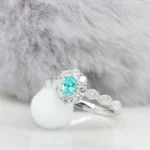
GIA, Gübelin, SSEF and GRS are the laboratories most respected for copper-bearing tourmaline. They hold the equipment to confirm copper as the colouring element, to detect fracture filling by infrared analysis, and to give a considered opinion on origin. A report from a lesser-known laboratory can look reassuring yet miss a filled fracture or an overstated origin.
How can I tell if a Paraiba tourmaline is real?
A true Paraiba is a tourmaline coloured mainly by copper, which is what produces its neon glow. Iron-coloured blue-green stones sold as indicolite or lagoon tourmaline can look similar but do not qualify, and there are also synthetic Paraiba and glass imitations in circulation. None of this is reliable to judge by eye, so the safe course is to buy only with a report from GIA, Gübelin, SSEF or GRS.
Many of these paraiba tourmalines find their way into a bespoke engagement ring, set exactly to the couple’s own design brief.More Paraiba from our workshop: our Paraiba engagement rings, Paraiba pendants and earrings, Brazil Paraiba rings, and an ocean-themed Paraiba tourmaline bangle.
Paraiba Tourmaline in Our Custom Work
A couple of recent commissions built around this gemstone’s signature glow.