Burma Ruby Rings: The Legend of Fluorescence
The “King of Gems” in its Purest Form
In high jewellery, origin drives value more than any other single factor. While ruby gemstones are found globally, those originating from Burma (Myanmar) are in a league of their own. Historically revered for their intense saturation and “electric” visual character, these stones are prized not just for their colour, but for their unique internal chemistry.
A Burma Ruby Ring is not merely a piece of jewellery; it is a legacy piece that, in our experience, has held and grown its value, and can be passed down across generations. (Searching for a proposal ring? View our dedicated Ruby Engagement Ring Collection for bridal designs).
Burma Ruby Jewellery
Every Burma ruby ring commission at GIOIA begins not with a design sketch but with the stone. Before we discuss settings, metal colours, or diamond accoutrements, we spend time understanding which loose Burma ruby is right for you, its carat weight, its cut, its GRS certification, and critically, how it performs in natural light when you hold it in your hand. That evaluation process is covered in full on our Burma ruby gemstone page, including how to read a GRS report and what separates a fine stone from one that merely carries a Burma origin report. We strongly suggest reading it before committing to any ring design.
The Science of “The Glow”: Why Burma is Superior
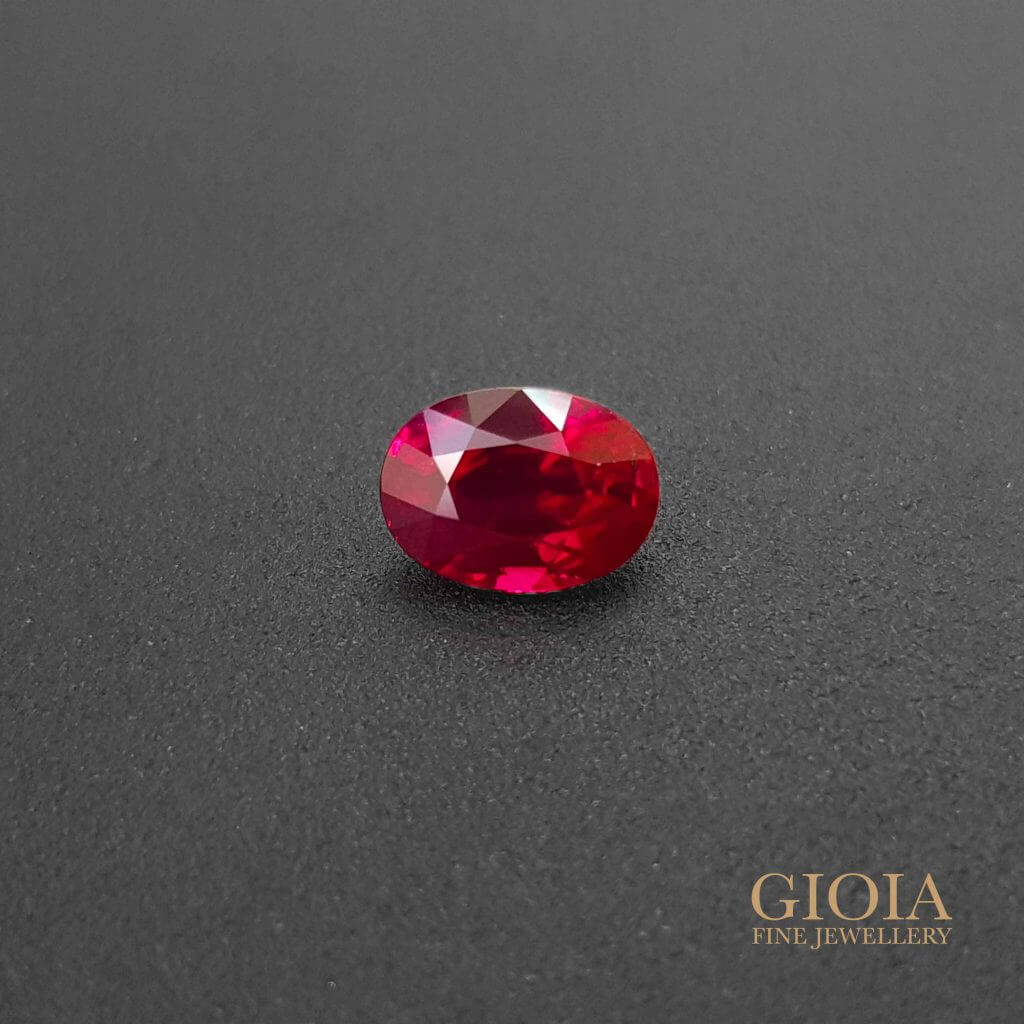
Burmese rubies form in marble deposits that are almost entirely free of iron, and iron is what dulls fluorescence in most rubies from other origins. Without iron suppressing the chromium, a fine Burma ruby does something other rubies cannot replicate consistently: it glows from within. In direct sunlight the stone does not just reflect red, it emits it. That optical character is the reason a Burma ruby ring looks alive in a way that even the finest Mozambican stone cannot always match. It also dictates every design decision we make when setting one. The stone is already doing something extraordinary. The ring’s job is not to compete with it but to present it.
The Market Reality: Pricing, Quality & The “Burma Myth”
For serious collectors and investors, understanding the valuation of a Burma Ruby is critical. The market does not follow a linear pricing structure; it follows an exponential one, driven by the extreme scarcity of “Gem Quality” crystals.
The Exponential Price Curve
When comparing a fine-quality Mozambique Ruby against a Burma Ruby, the price premium is significant but varies by weight:
- At 1.00 Carat: A Burma ruby will typically trade at 1.5x to 2.5x (Double) the price of a comparable Mozambique stone. This premium accounts for the “brand value” of the origin and the unique fluorescence.
- At 3.00 Carats & Above: The gap widens drastically. Because the geological conditions in Burma rarely allow for large, clean crystals to form, a 3-carat Unheated Burma Pigeon Blood ruby is an anomaly. At this weight, the price is no longer just “double”, it can be 5x to 10x the price of a Mozambique equivalent. These are considered “Auction Grade” assets.
Debunking the Myth: “Is Burma Always Best?”
There is a dangerous misconception in the market that any ruby with a “Burma” origin report is automatically superior to a Mozambique gem. This is a myth.
A certificate stating “Origin: Myanmar (Burma)” guarantees geography, not beauty. In fact, a large percentage of Burmese rubies circulating in the market are of commercial or inferior quality.
The “Opaque” Trap
Burmese rubies are famous for their “silk” (rutile needle inclusions). In fine quality, this silk scatters light to create a soft glow. However, in lower grades, this silk is so heavy that it blocks light entirely, making the stone look opaque, sleepy, or dead. An opaque Burma ruby lacks the fire and brilliance that defines a precious gemstone. In these cases, a crystalline, transparent Mozambique ruby is visually superior and a better purchase.
The “Pinkish” Issue
Not all Burmese rubies are red. Many stones mined in Mogok have low chromium saturation, resulting in a “Pinkish-Red” or even “Hot Pink” hue. While these are beautiful, they do not qualify for the prestigious “Pigeon Blood” grading.
The pigeon blood designation is a formal laboratory assessment awarded by GRS on the front page of the certificate, not a seller’s claim, and not awarded to every Burmese ruby regardless of colour. For a full explanation of what the GRS report actually says and how to read it, see our Burma ruby gemstone grading page.
Our Curation Standard
At GIOIA Fine Jewellery, we reject the majority of Burmese stones offered to us. We prioritise Crystal Transparency above all else. A GIOIA Burma Ruby must possess that elusive combination: the soft, fluorescent glow of Myanmar, but with enough crystal clarity to allow light to dance within the stone.
Designing the Ring Around the Ruby
When the stone is this rare, the design cannot be an afterthought. Every Burma ruby ring commission at GIOIA follows the same principle, the setting exists to serve the stone, not to compete with it. That sounds obvious but it produces very specific design decisions in practice.
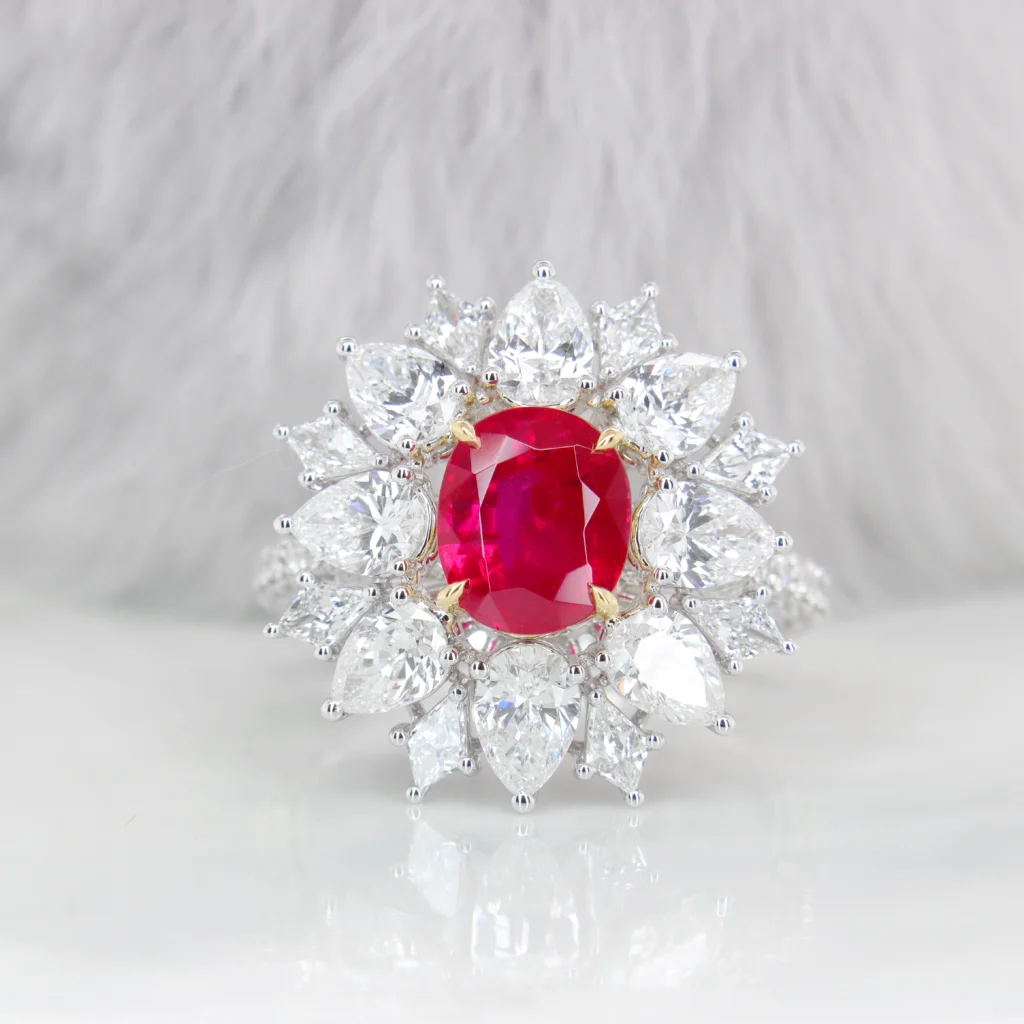
Yellow gold prongs are our default choice for cradle settings on Burma rubies. The warm colour temperature of 18K yellow gold blends with the red of the ruby rather than contrasting against it, which intensifies the perceived saturation of the stone. White gold or platinum prongs can introduce a cooler reflective tone into the base of the stone that slightly dilutes the red. For a Burma pigeon blood ruby where the colour is the entire point, yellow prongs are not just aesthetic, they are gemologically correct.
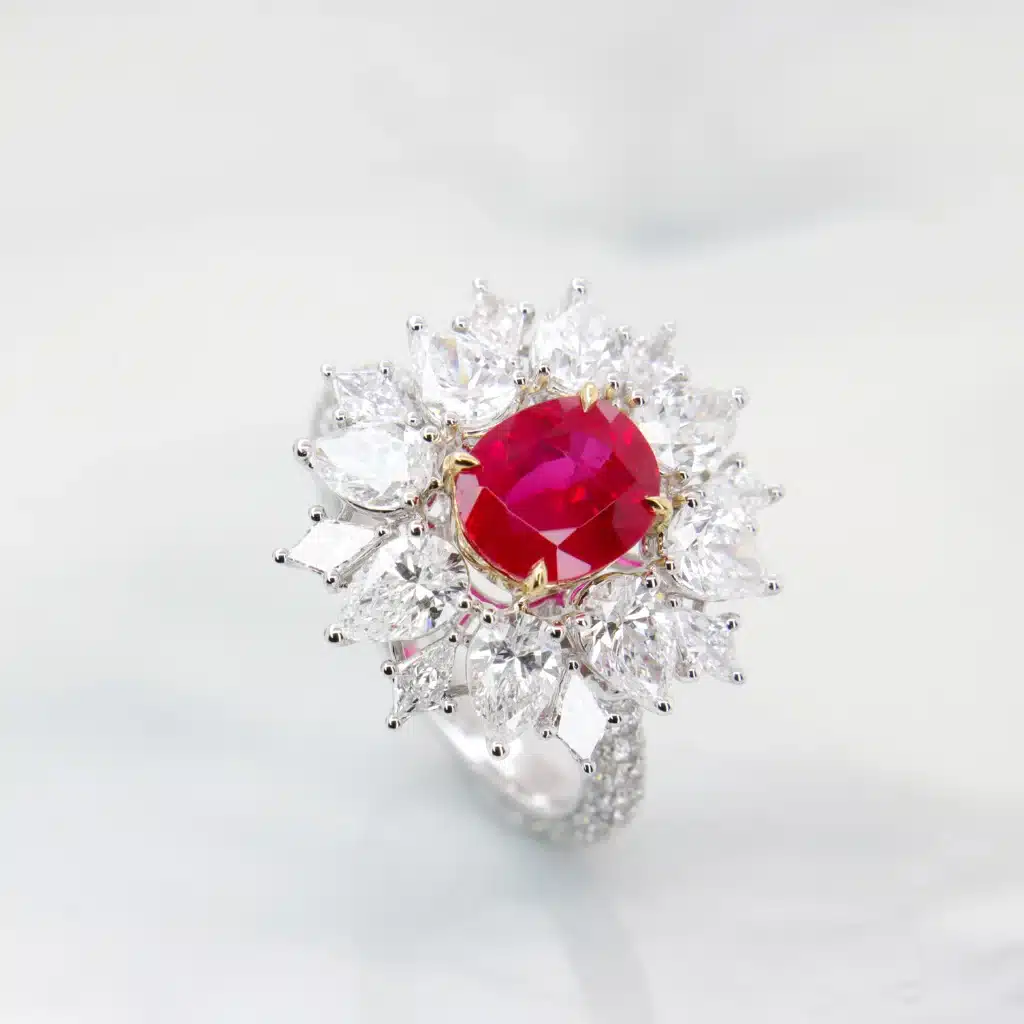
The halo design we are most associated with uses fancy diamond cuts: pear shapes and marquise cuts arranged as petals around the ruby. This is a deliberate choice rather than the more common round brilliant halo. Round brilliant diamonds in a halo all point toward the centre stone and their brilliance can visually compete with it. Pear and marquise cuts arranged as a flower create movement around this Burma ruby ring without drawing the eye away from it.
For clients with a significant Burma ruby above 2 carats, we often recommend considering a solitaire or minimal setting rather than a full halo. A stone of that quality does not need decoration. We know that the fluorescence and colour do the work entirely. Adding complexity around it can actually reduce the visual impact of the gem.
The commission shown here centres on an unheated Burma ruby ring set in exactly this high jewellery halo style. The ring was built over approximately thirteen weeks from stone selection through to final polish, which is typical for a commission at this level of detail.
Curating the Rarest of the Rare
Our approach to Burma ruby rings is the same as our approach to every significant commission, the stone comes first and the design follows from it. We hold what we believe is one of Singapore’s most carefully curated selections of GRS-certified unheated Burma pigeon blood rubies in the 1 to 2 carat range, selected in person rather than from catalogues or batch lots.
If you are at the stage of considering a Burma ruby ring – whether as a gemstone engagement ring, an anniversary commission, or a personal acquisition – The conversation starts at our showroom at International Plaza. Bring your questions about certification, origin, and setting options. We will bring the stones. You can see how a fine Burma ruby behaves in natural Singapore daylight before making any decision. Appointments can be arranged via WhatsApp or our contact page.
For those who want to see completed Burma ruby ring commissions before visiting, our custom rings portfolio has examples of ruby ring work across different design styles and carat weights.
Frequently Asked Questions
Find answers to commonly asked questions about our Burma ruby jewellery and gemstone.
What is the price difference between Burma and Mozambique Rubies?
For fine quality unheated stones (1.0ct+), a Burma ruby typically commands 1.5x to 2.5x the price of a Mozambique ruby. This premium is due to the historical scarcity of Burmese material and its unique fluorescence. However, for sizes above 3.0ct, the price gap widens significantly as large Burmese crystals are exceptionally rare.
Why are Burma Ruby Rings so expensive?
The cost is driven by three factors: Origin Scarcity (the mines are depleted), Fluorescence (the internal glow), and Market Demand. A certified Unheated Pigeon Blood Burma Ruby is, in our experience, a rare, tangible asset that has grown in value, with prices historically rising over time.
My Burma ruby has silk inclusions. Is this bad?
No, in fact, it is often a good sign. Burmese rubies naturally contain “silk” (rutile needles) which scatter light and create a soft, velvety glow. Unlike diamonds where inclusions are flaws, fine silk in a ruby can actually enhance its colour and prove that the stone has not been heat-treated (as heat would melt the silk). However, the silk should not be so heavy that it makes the stone opaque.
Why do some Burma rubies look pinkish?
Burmese rubies often have a lower iron content, which allows for a purer red, but if the chromium saturation is not high enough, the stone can appear pink. While “Hot Pink” rubies are beautiful and valuable in their own right, they are not “Pigeon Blood.” True Pigeon Blood requires a deep, saturated red with a hint of fluorescence, not a washed-out pink tone.