Platinum Wedding Bands: The Standard That Outlasts Everything Else
When a couple chooses platinum for their wedding bands, the decision rarely comes down to trend or impulse. It comes down to a very clear understanding of what they want from a piece of metal that will sit on their finger every single day for the rest of their lives. Platinum earns that trust. It is one of the rarest naturally occurring metals on earth, mined in quantities so modest that all the platinum ever refined would fill a modest living room. That scarcity is not a marketing point, it is the foundation of everything platinum represents in fine jewellery.
At GIOIA, we work with platinum in its purest commercially available form: 950 platinum, composed of 95% pure platinum alloyed with ruthenium or iridium for strength. Compare that to 18K white gold at 75% gold content, heavily alloyed and rhodium-plated to achieve its white appearance, and the material difference becomes quickly apparent. Platinum earns its white naturally. It never needs plating. It never reveals a yellow cast as years pass. What you commission on your wedding day is what you wear on your anniversary decades later.
Case for Platinum Wedding Bands
Durability That Improves With Age
Platinum is extraordinarily dense, nearly twice the weight of 18K gold at equivalent volume, and this density is one of its most practical virtues. When platinum scratches, the metal displaces rather than removes. A tiny furrow appears on the surface, but the mass of the metal remains intact. Jewellers call this a patina, and over time it develops into a satiny, slightly diffused lustre that many wearers come to prefer over the raw polish of a new band. A quick professional buff restores the original mirror finish whenever you want it. No metal is lost in the process.
Gold, by contrast, loses microscopic amounts of metal with every scratch. Over years of daily wear, a gold band can thin noticeably at points of friction. This is not a flaw unique to any jeweller, it is simply physics. Platinum sidesteps this problem entirely by virtue of what it is.
A Metal That Needs No Assistance
18K white gold achieves its cool silver appearance through rhodium plating, a surface treatment that needs renewal every few years as it wears through in daily use. The moment it fades, the warmer yellow tone of the underlying gold alloy shows through, particularly noticeable along the inner shank. For a wedding band worn without interruption, that cycle of re-plating is a recurring consideration that platinum owners simply never have.
Platinum’s white is structural, not cosmetic. The metal itself is naturally white, naturally resistant to tarnish, and naturally inert against skin chemistry. For anyone with nickel sensitivity, a common allergy exacerbated by nickel-containing white gold alloys, platinum wedding bands are not just a preferred choice. It is the correct one.
Heirloom Calibre From Day One
Platinum does not oxidise, discolour, or degrade in the way that other metals do over extended time. Platinum wedding bands passed from one generation to the next arrives in a state that requires only polishing to restore. The integrity of the metal, the setting security for any stones, and the weight and feel of the piece remain constant across decades. This is what separates fine jewellery from a fashion purchase: the piece outlasts its moment entirely.

Platinum vs 18K White Gold: The Great Debate
When crafting customised wedding bands, one of the most common dilemmas couples face is selecting the right foundation for their design. While 18K white gold and PT950 platinum share a sleek, silvery-white brilliance, their elemental characteristics, maintenance requirements, and how they age are distinctly different.
The Allure of 18K White Gold
White gold is celebrated for its versatility and structural integrity. Crafted by alloying pure gold with metals like palladium or silver, 18K (750) white gold consists of 75% pure gold and 25% strengthening alloys. To achieve its signature brilliant white finish, the metal undergoes rhodium plating. Over time, as the rhodium naturally wears with daily use, a subtle, warm champagne tint from the underlying gold will gently emerge. This is a natural characteristic of the metal, easily restored through a simple replating process to bring back its original, pristine luster.
The Durability Misconception: Hardness vs. Metal Retention
There is a widespread misconception, even among industry professionals, that platinum is universally “tougher” than white gold. To make an informed decision, it is essential to distinguish between hardness and metal retention.
- The Hardness of White Gold: Because 18K white gold contains 25% mixed alloys, it is structurally harder and more rigid than platinum. It is highly resistant to deformation under stress and generally holds a high-polish finish longer without developing micro-scratches.
- The Malleability of Platinum: Because PT950 is 95% pure, it is actually more malleable than 18K white gold. It is more susceptible to surface scratches and minor dents. However, platinum has exceptional metal retention. When platinum is scratched, the metal is not lost; it is merely displaced. Over decades of wear, this displacement creates a frosted appearance known as a “patina”, an antique, well-loved finish that many collectors specifically desire.
How to Choose Your Ideal Metal
In practice, the choice usually comes down to two things: how much maintenance you are willing to do, and what you want the ring to feel like on your finger twenty years from now. Here is how we think about it at GIOIA.
- Maintenance Preferences: If you desire a brilliant, high-polish finish and do not mind occasional rhodium replating, 18K white gold is an exceptional and cost-effective choice. If you prefer a naturally white metal that develops a unique patina and requires zero replating, platinum is the definitive option.
- Tactile Weight: The density of platinum provides a distinct, heavy feel on the finger, often associated with luxury and permanence. White gold offers a lighter, more effortless wear.
- Skin Sensitivity: For those with highly sensitive skin, PT950 platinum is entirely hypoallergenic.
- Religious Considerations: For clients whose faith advises against wearing gold, platinum serves as the premier, sophisticated alternative.
The GIOIA Touch: Concealed Sapphire Accents
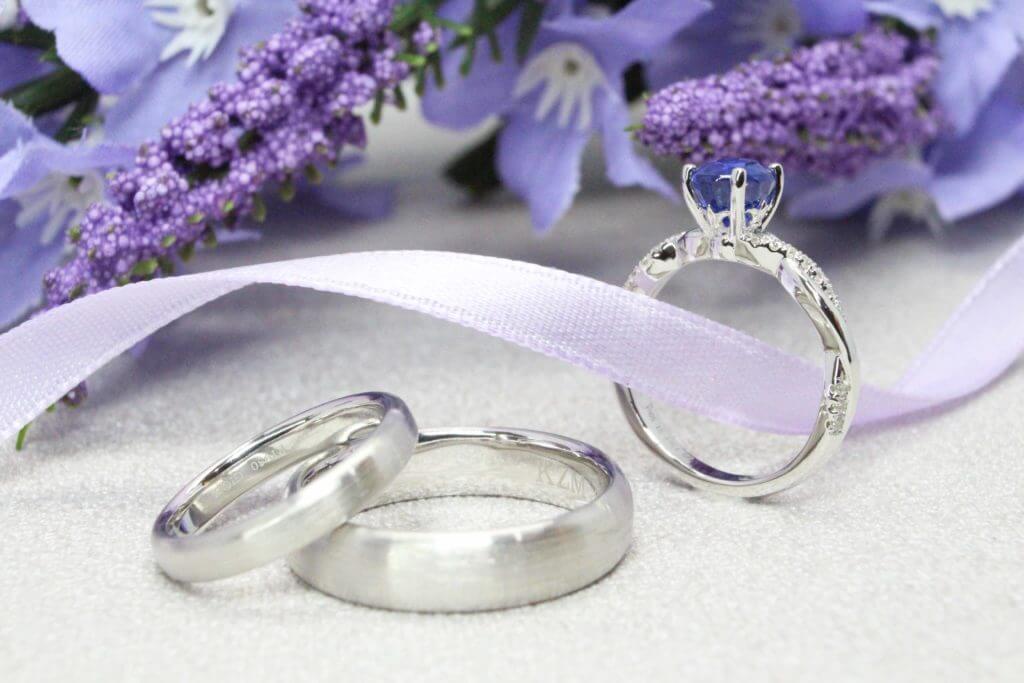
At GIOIA Fine Jewellery, our customised wedding bands are tailored to the precise millimeter, featuring exceptionally smooth polishing and flawless craftsmanship. For clients who desire the ultimate pairing of durability and royal elegance, crafting platinum sapphire wedding bands has become a hallmark of our bespoke service. The cool, neutral tone of PT950 platinum serves as the perfect canvas to amplify the vivid saturation of an unheated blue sapphire.
Even for those who prefer a minimalist exterior, we offer the subtle integration of precious gemstones to represent your unique narrative. A signature detail for many of our couples is the flush-setting of a round brilliant blue sapphire on the inner band. Concealed from the outside world, this hidden gem rests directly against the skin, an intimate symbol of sincerity, calmness, and an eternal connection known only to the two of you.
Bespoke Platinum Artistry: Customised Creations
For many couples, the wedding band is not a standalone decision. It is the companion piece to an engagement ring, and the relationship between the two deserves as much design thought as either individually. At GIOIA, couples often begin their journey with a customised engagement ring, built around a carefully selected coloured gemstone or diamond, and then design the wedding band to complement it perfectly: sharing a metal, echoing a profile, or contrasting intentionally for a more editorial look. Whether you arrive at the engagement ring first or the bands first, the process is the same: we design around what matters to you, not around what happens to be in a display case.
The following pieces offer a cross-section of what is possible when platinum becomes the canvas for personal narrative.
Ice Mountain Inspiration: Platinum Wedding Rings
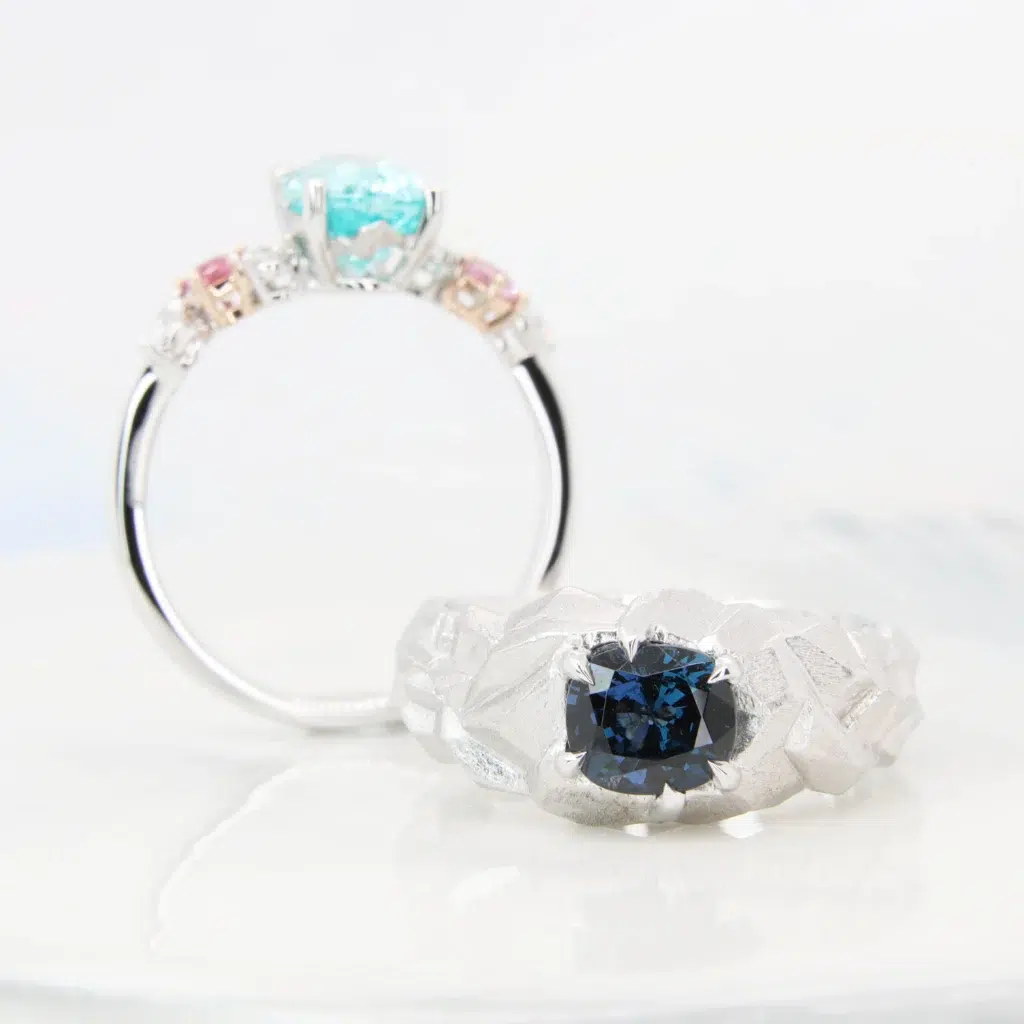
This pair draws its concept from the visual grammar of high-altitude terrain, the sharp, angled facets of ice formations, the stark geometry of a mountain ridgeline seen from a distance. The men’s band is worked entirely by hand, with each facet individually cut and polished to catch light the way sunlit snow does: directionally, dramatically, differently depending on where you are standing. It is not a simple polish on a flat surface. It requires hours of patient metalwork on a material that does not give itself up easily.
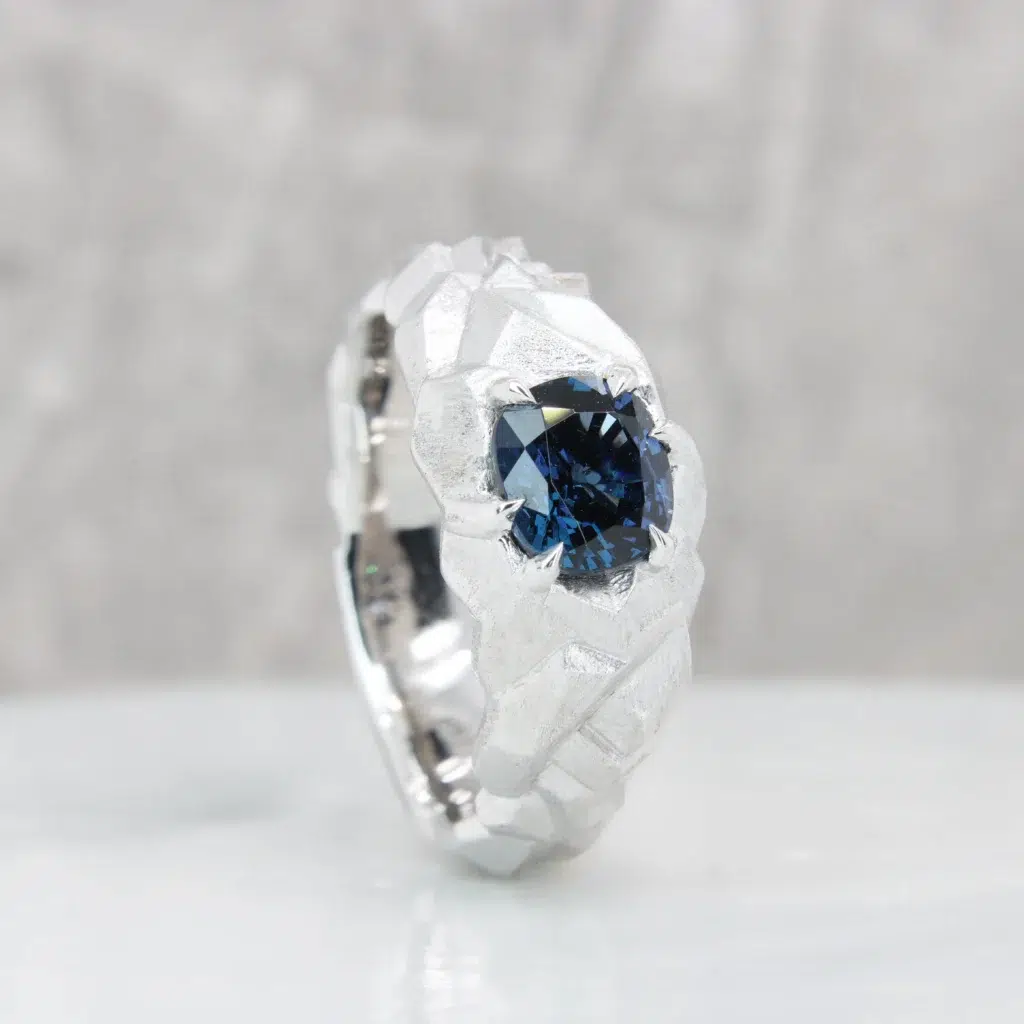
At the crown of the men’s ring sits a cool blue spinel, selected specifically for its icy, slightly muted tone that reads as glacial rather than oceanic. The stone is not incidental, it is the emotional anchor of the entire piece, the point of stillness around which the angular metalwork orbits.
The ladies’ ring interprets the same concept through a subtler lens: an abstract mountain motif worked into the side profile of the band, visible only to those who look closely or already know it is there. It is a shared secret made in metal, exactly the kind of detail that elevates a wedding ring from an accessory into a personal artefact.
A Canvas of Hot Pink Spinel and Hammered Platinum

True bespoke artistry tends to live in the details that only the people wearing the pieces will ever know about. This commission began with a couple who wanted their initials embedded into the design, not engraved inside the shank in the conventional way, but structurally integrated into the metalwork itself. The result is a gallery beneath the bride’s centre stone where the prong architecture forms a series of heart shapes, with the letters “Y” and “S” secured quietly within the platinum sidebands. A vivid hot pink spinel crowns the piece, flanked by brilliant pavé diamonds that reinforce its intensity without competing with it.
The groom’s band took a different direction entirely. A finely hammered platinum finish, a technique that demands considerable precision when applied to such a dense, resistant metal, gives the surface a raw, tactile quality that contrasts sharply with the highly polished norm. Against this artisanal backdrop, a matching hot pink spinel creates a visual jolt that is confident, modern, and completely his own. Two rings that belong to the same story while looking nothing like each other. That balance is difficult to achieve, and it is exactly the kind of challenge our design process is built for.
Crowning Platinum with Brazilian Paraiba Tourmaline
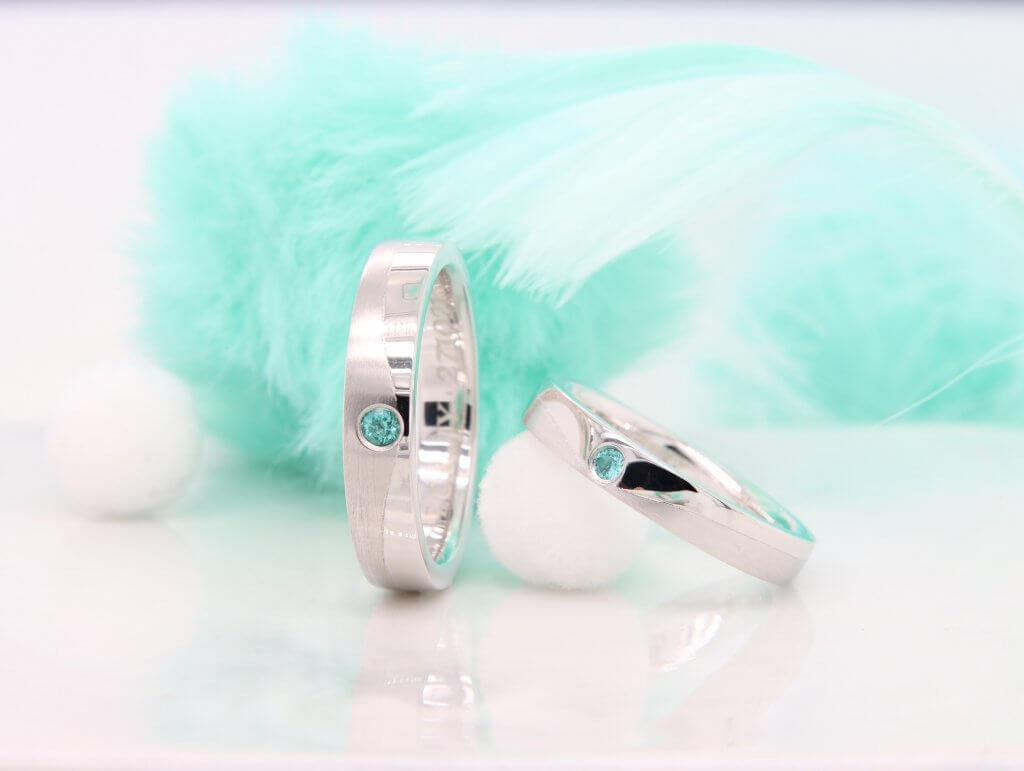
If there is one gemstone in the coloured stone world that platinum was made to host, Brazilian Paraiba Tourmaline is a strong candidate. Its neon bluish-green fluorescence, powered by copper and manganese traces unique to the Paraíba and Rio Grande do Norte deposits of Brazil, is so electrically vivid that it appears to emit light rather than reflect it. Setting that in yellow or rose gold risks a visual competition the metal cannot win. Platinum’s neutral, cool white simply steps aside and lets the stone be the entire conversation.
For this pair of customised wedding bands, we designed curved surface lines that alternate between brushed matte and highly polished sections. The contrast is subtle at a glance and reveals itself fully only under direct light, a kinetic quality that mirrors the shifting luminescence of the tourmalines themselves. The result is a band that secures one of the rarest gemstones in the world in a form that can withstand the demands of daily wear without sacrificing a single point of elegance.
Modern Contrasts: Brushed Platinum and Vibrant Blue Groove
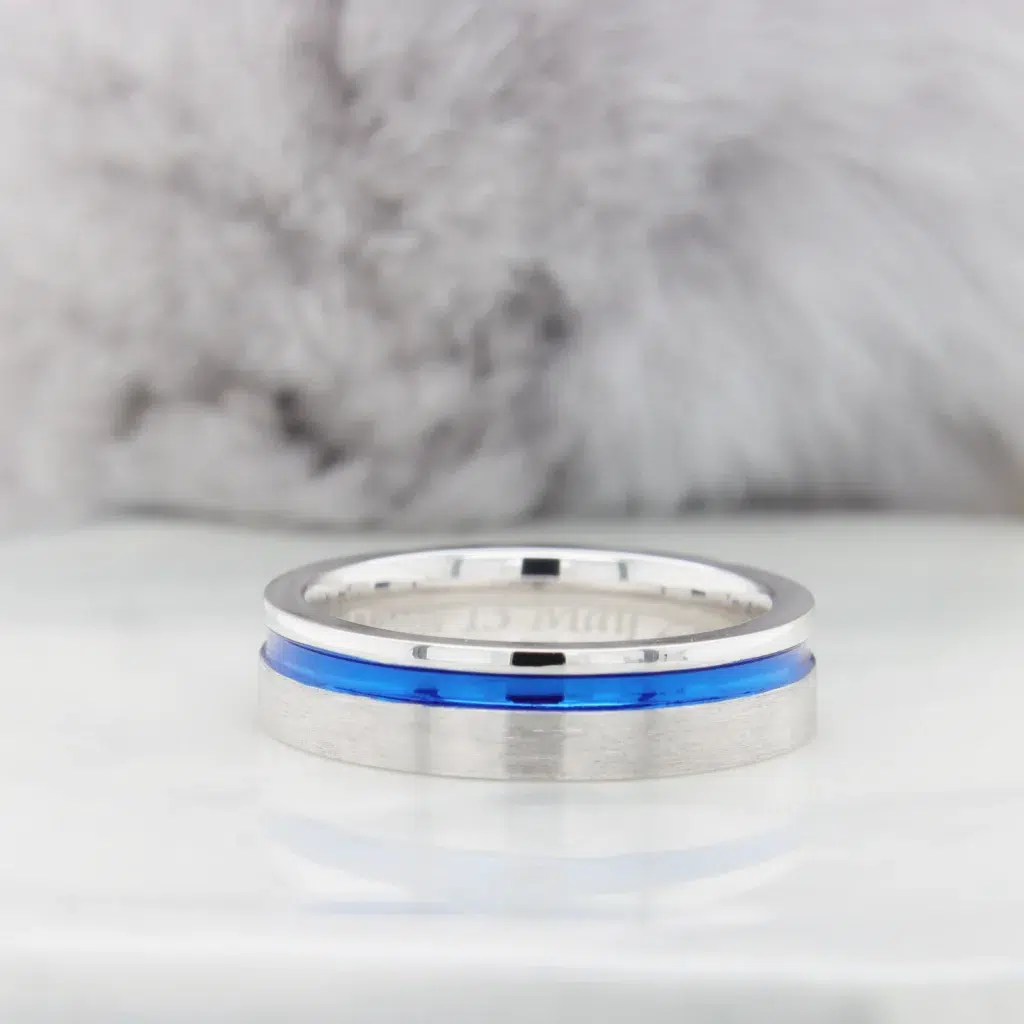
Not every platinum wedding band involves a coloured gemstone. Sometimes the design statement lives entirely in the metalwork. This men’s wedding band is precisely that, a wide, boldly proportioned band finished in a heavily brushed matte platinum that drinks in ambient light rather than reflecting it. Running through the centre is a clean groove plated in electric blue, precisely positioned to command the eye without overpowering the restrained character of the platinum surrounding it.
The design manages a balance that is harder than it looks: it is unmistakably masculine and assertive without tipping into aggressive, modern without being trendy, and personal without being loud. The brushed platinum finish also has a practical advantage, it conceals the minor surface scratches that a high-polish band would show immediately, making it genuinely suited to someone who works with their hands or simply prefers low-maintenance elegance.
Conclusion
Choosing a wedding band is one of the few jewellery decisions that most people make only once. Platinum makes that decision easier to stand behind, not because it is the most fashionable metal or the most accessible one, but because it is simply the most enduring. It asks nothing of its wearer beyond the occasional polish. It gives back permanence, density, natural brilliance, and the knowledge that the piece on your finger is made of something genuinely rare.
At GIOIA, our platinum wedding bands are designed with the same level of care and gemological rigour that we bring to every bespoke commission. Whether your brief is minimal and architectural or layered with hidden meaning and rare coloured stones, we work within your vision until the result is exactly what you imagined, or something better.
Frequently Asked Questions
The questions below cover what most couples ask us during consultation, from metal maintenance to resizing and design suitability. If something specific to your brief is not answered here, you are welcome to drop us a message directly. We respond to every enquiry personally.
Why is platinum more expensive than gold?
Platinum is rarer than gold in the earth’s crust, mined in far smaller quantities globally, and requires significantly higher temperatures and specialised expertise to work. The combination of scarcity and craftsmanship complexity places it at a premium over gold alloys.
Can platinum wedding bands be resized?
Yes, though resizing platinum requires a jeweller with specific experience in the metal. Not all goldsmiths work in platinum, it behaves differently under heat and requires dedicated tools. At GIOIA, all platinum work is handled by craftspeople trained specifically in its properties.
How do I care for my platinum wedding bands?
Warm water and mild soap handle day-to-day cleaning. For a full polish or the removal of deeper surface wear, a professional service is recommended. GIOIA offers complimentary lifetime cleaning for all bespoke commissions, so this is never a concern for our clients.
Is platinum heavier to wear than gold?
Yes, noticeably so. Platinum is approximately 60% denser than 18K gold at the same volume, which translates into a more substantial feel on the finger. Most clients who choose platinum find they come to appreciate this quality, it adds to the sense of permanence, though it is worth trying both if you are sensitive to ring weight.
Is platinum suitable for intricate or filigree designs?
Not always, and we will tell you that upfront. PT950’s malleability, the same quality that gives it exceptional metal retention against scratching, works against very fine detailing. Filigree, micro-pavé, delicate milgrain edging, these demand a metal that holds its geometry rigidly under daily friction. Because platinum is softer in hardness than 18K white gold, fine surface details can compress or lose their crispness faster. A milgrain border that stays sharp in white gold for a decade may show softening in platinum within a few years.
This is not a craftsmanship issue. It is the physics of the metal.
For designs with significant filigree or intricate surface work, 18K white gold is the smarter choice. Platinum earns its place on clean architectural bands and bold profiles where the statement lives in the gemstone and the form. Knowing which metal suits which design is part of what we bring to every consultation, the goal is always a piece that still looks exactly right fifteen years from now.
Begin Your Bespoke Journey
Platinum or white gold, diamond or coloured gemstone, minimal or architecturally complex, at GIOIA, every wedding band begins as a conversation. Explore our full range of customised wedding bands with coloured gemstones, or speak with us about designing your platinum wedding bands as part of a matched set with a customised engagement ring. The most meaningful pieces are always the ones built around your story. Let us help you tell it properly.