
Art Deco jewellery is built from straight lines: octagonal stones, stepped shoulders, fan shapes and borders finished with a row of tiny metal beads. At GIOIA Fine Jewellery we design Art Deco rings and jewellery from scratch in Singapore, pairing that 1920s geometry with natural gemstones Clarence selects himself, many of them unheated sapphires. Below are five of our Art Deco commissions, followed by a short guide to the style, what it costs and how to recognise a genuine period piece.
Table of Contents
Our Art Deco Rings and Jewellery
Unheated Octagon Sapphire Art Deco Ring
The centre stone is an unheated blue sapphire cut as an octagon, with clarity so clean that stones like it rarely reach the market. An octagon suits Art Deco because the geometry is already in the stone: eight straight edges, with each facet returning a crisp, even flash of blue. We set it between two stepped tiers of diamonds that rise towards the sapphire like the setbacks of a 1920s skyscraper.
The ring began as an anniversary surprise. A client came to us with an idea for his wife, gave her the design sketch on the day, and the finished ring followed.

Colour Change Sapphire Art Deco Halo Ring
This couple took their time before choosing an unheated colour change sapphire. In daylight it reads as a cool bluish violet. Under warm indoor light it moves towards purple. The setting had to respect that shift without competing with it, so we designed a floral Art Deco halo in which the diamonds suggest petals rather than drawing them literally. Milgrain runs along every edge, and handmade marquise side bands give the ring its vintage outline. The two photographs show the same ring under daylight and under warm light.


Teal Sapphire and Spinel Layered Halo Ring
A vivid unheated teal sapphire sits inside a vintage diamond halo, with an outer ring of round bluish green spinels chosen to extend the sapphire’s sea colours rather than contrast with them. Each tier of diamonds is calibrated to sit flush with the next, so the halo frames the stone without crowding it. Rose gold warms the cool blue green. The geometry is Art Deco, while the colour story is entirely contemporary.

Blue Sapphire Geometric Halo Ring in Champagne Gold
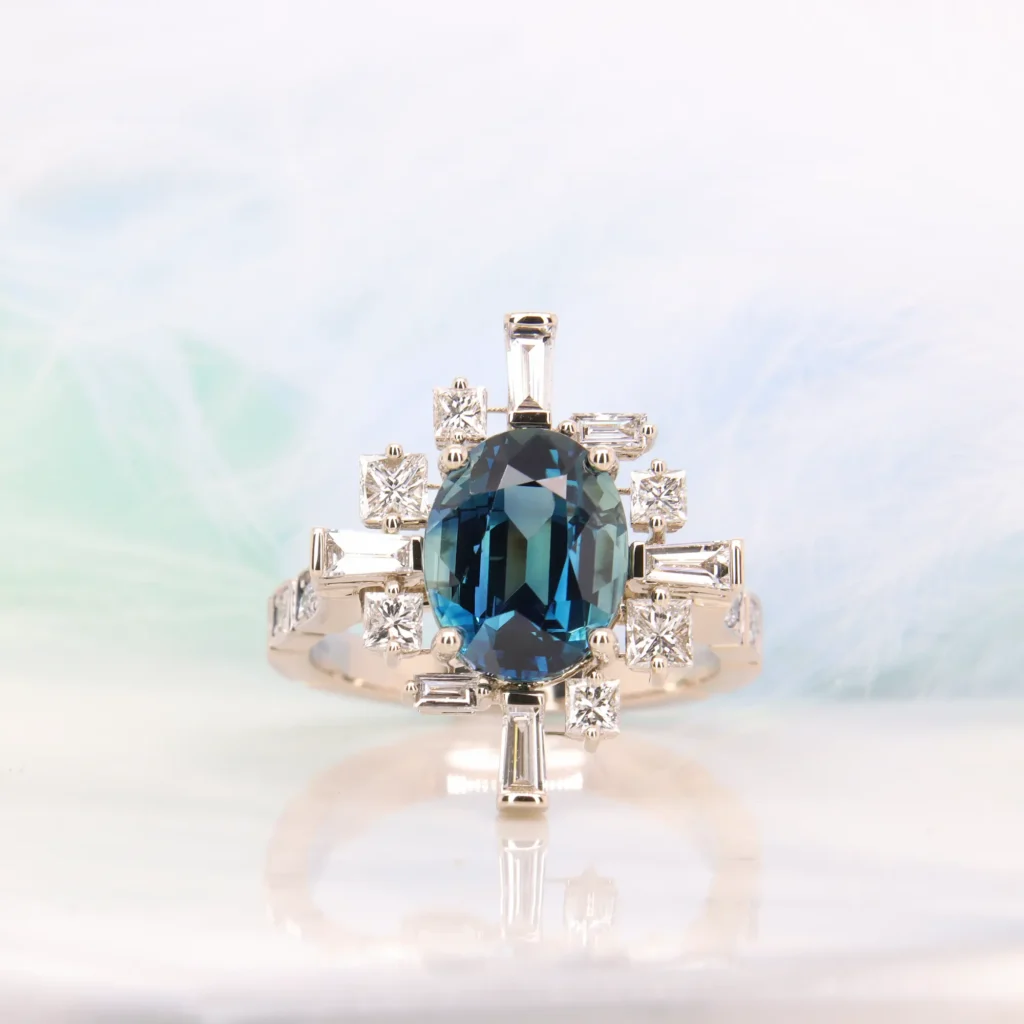
An oval unheated blue sapphire sits inside a halo we built from baguette and square-cut diamonds, set at different lengths so the outline reads as a sunburst rather than a circle. The pattern carries on down the shoulders in short diamond-set segments, the way a 1920s architect would repeat one motif along a façade.
We chose champagne gold for the band. Its soft warmth sits between the white diamonds and the deep blue of the stone, so neither looks cold. See more of our blue sapphire rings.
Art Deco Tanzanite Pendant with Pearl Tassel
Not every Art Deco piece we make is a ring. This pendant centres a violetish blue tanzanite in an oval modified brilliant cut, framed by a pavé diamond halo with milgrain along its geometric border. The contrast between the tanzanite and the white gold is deliberately strong, in the spirit of the 1920s taste for colour tension. An optional Akoya seed pearl tassel at the base turns a modern pendant into something that reads as period.

What Makes Jewellery Art Deco
The style takes its name from the 1925 Exposition Internationale des Arts Décoratifs et Industriels Modernes in Paris, although the label “Art Deco” only caught on decades later. After the First World War, jewellers moved away from the soft garlands of the Edwardian era towards forms borrowed from the machine age, Cubism and the skyscraper. The opening of Tutankhamun’s tomb in 1922 added Egyptian motifs such as lotus flowers and stepped pyramids.
Platinum made the look possible. It is strong enough to hold stones with very little metal, so jewellers could pierce it into fine openwork. Houses such as Cartier and Van Cleef & Arpels set rows of small calibré-cut rubies, sapphires and emeralds, each cut to fit its neighbour exactly, against white diamonds and black onyx. In 1933 Van Cleef & Arpels patented its Mystery Set technique, which hides the metal between stones altogether.
Two finishing techniques carry the look in our own work. Milgrain is a line of tiny metal beads raised along the edge of a setting by hand. It softens the hard geometry and gives the piece an antique texture. Filigree uses fine twisted threads of metal to make lace-like openwork. Both take patient bench time, which is why they rarely appear on mass-produced jewellery.
Art Deco at a Glance
| Period | About 1919 to 1939 |
| Named after | The 1925 Exposition des Arts Décoratifs in Paris |
| Signature shapes | Octagons, chevrons, fans, stepped outlines |
| Classic cuts | Emerald cut, Asscher, baguette, calibré |
| Metals | Platinum and white gold |
| Finishing | Milgrain, filigree, pierced openwork |
Art Deco Engagement Rings That Work Today
- Step-cut solitaire with baguette shoulders. An emerald-cut or octagon centre stone with tapered baguettes either side. Clean, architectural and easy to pair with a straight wedding band.
- Geometric halo. A hexagonal or octagonal diamond frame around a round or oval stone, finished in milgrain.
- Three-stone with calibré detail. A centre stone flanked by two smaller stones, with a channel of calibré-cut sapphires along the band.
- Coloured centre. Sapphire was a favourite of the period and suits daily wear: at 9 on the Mohs scale it is second only to diamond. Ruby is just as hard. Emerald is softer and needs a protective setting.
How Much Does an Art Deco Ring Cost in Singapore?
Bespoke Art Deco rings at GIOIA start from SGD 3,900 and take about 10 to 12 weeks from an approved design. The centre stone accounts for most of the price: an unheated sapphire costs more than a heated stone of the same colour and size, and a fine colour change or teal sapphire carries its own premium. Step-cut diamond shoulders, calibré channels and hand-raised milgrain add setting time. Centre stones above about SGD 1,000 come with a report from an independent laboratory such as GRS, GIA or NGI.
How to Identify Genuine Art Deco Jewellery
A true 1920s or 1930s piece is usually platinum or early white gold. Its diamonds will be old European or single cuts, with a smaller table and a visible culet, rather than modern round brilliants. The openwork was pierced by hand, so look closely for tiny irregularities left by the saw. Take care with coloured stones: synthetic rubies and sapphires were already common in the period, so a ring can be authentic Art Deco and still hold a lab-made stone. Many pieces sold as “Art Deco” today are later revivals, cast rather than pierced and set with modern brilliants.
Our pieces are new, made in the Art Deco style with modern step-cut diamonds and natural gemstones, each described exactly as it is.
Frequently Asked Questions
When was the Art Deco period?
Roughly 1919 to 1939, peaking after the 1925 Paris exhibition that gave the style its name.
Is Art Deco jewellery valuable?
Signed period pieces from houses such as Cartier and Van Cleef & Arpels sell for high prices at auction. Value depends on the maker, the metal, the stones and the condition of the openwork. A new Art Deco design is valued on its gemstones and craftsmanship, like any fine jewellery.
Can GIOIA make a custom Art Deco ring or pendant?
Yes. We design from scratch at our International Plaza boutique, starting from the stone you choose. Bespoke pieces start from SGD 3,900 and take about 10 to 12 weeks.
Which gemstones suit an Art Deco design?
Sapphire, ruby and emerald are the classic choices against white diamonds. Step-cut and octagonal stones suit the geometry best.
Is an Art Deco ring practical for daily wear?
Yes, with a hard centre stone such as sapphire or ruby. Fine milgrain edges soften after years of wear and can be redone by a jeweller.
Begin an Art Deco Commission
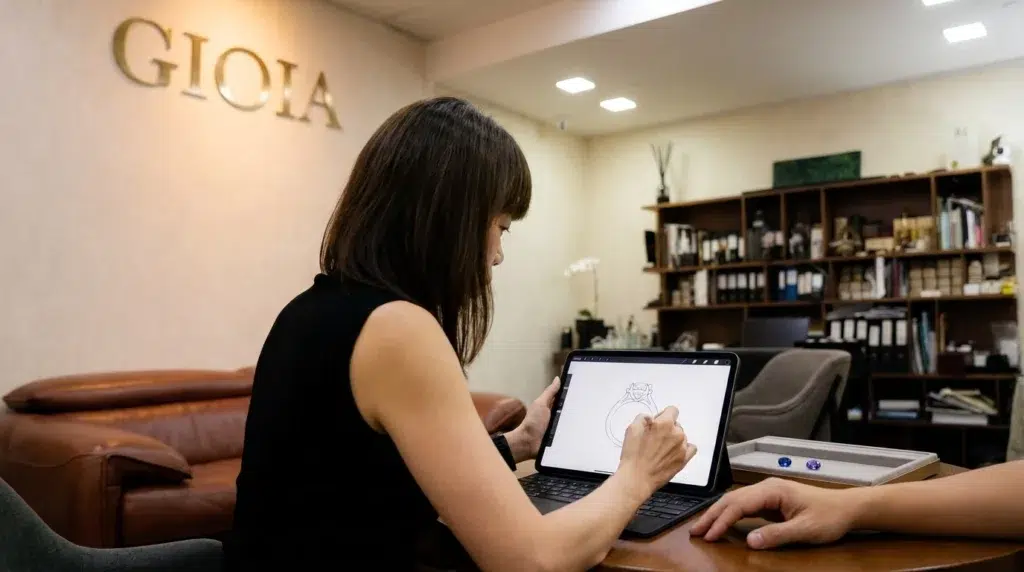
Every Art Deco piece at GIOIA starts with a conversation about the stone, whether that is the clean geometry of a sapphire octagon, the two moods of a colour change gem or the strong contrast of tanzanite against white gold. Cheryl or Matthew sketches the design around the stone you choose, and we take it from first drawing to final polish. Visit us at International Plaza or contact us to book a consultation.

More GIOIA work in this style: our Art Deco chevron wedding bands, a Zambian emerald Art Deco ring and the modern Art Deco aquamarine. Our ballerina designs show a softer vintage look from a later era. For more of our bespoke process, see customised jewellery and our custom ring portfolio.